
Table of Contents
How to Ask Your Employer for Wrist Pain Adjustments in 6 Steps
By Dr. Elliot Smithson, PT, DPT, MS, ATC, EMT·
Quick answer
Put your request in writing and send it to your manager first. Name 3 typing tasks that hurt, 3 specific changes, and a date to check them. Useful changes break up long typing stretches with planned breaks and build back to full workdays gradually.
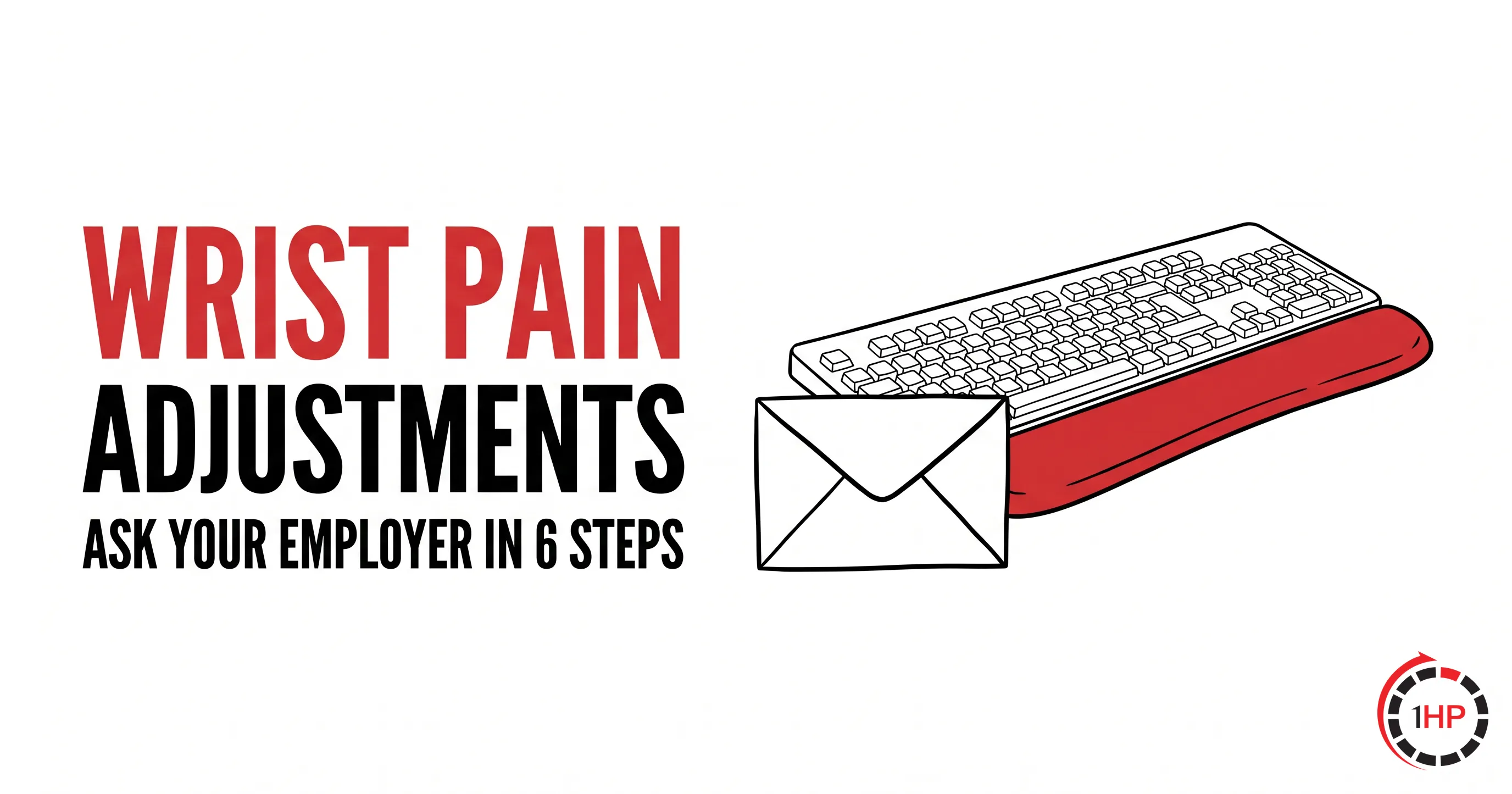
How do I ask my employer for wrist pain adjustments?
Send your manager one short written request that names 3 typing tasks that hurt, 3 specific changes you want, and a date to check whether those changes are working.
This covers the workplace process only. It is not legal advice.
What you need
- A pain log covering one work week: task, minutes before pain starts, pain score out of 10
- Your 3 most painful tasks, taken from that log
- 3 specific changes you want to try
- A proposed review date
- Your manager's name, plus an HR or occupational health contact
- A folder for copies of everything you send
Steps
- Log your painful tasks for one work week. For each task, write how long you do it before pain starts and how bad it gets out of 10. Then circle the 3 worst. Note where it hurts, too: carpal tunnel from repetitive strain and arm and hand numbness from repetitive strain cover common patterns.
- Choose 3 specific changes. Pair one equipment change with at least one pacing change. Examples include movement breaks after long typing blocks, or dictation for long documents. Pain shows up when load is bigger than what your tendons can handle right now (Load > Endurance = Pain), and a new keyboard alone does not cut how much you type.
- Write the request using this script.
Hi [Manager], I have wrist pain from typing that I'm actively working on. The 3 tasks that hurt most are [task 1], [task 2] and [task 3]. I'd like to try [change 1], [change 2] and [change 3]. Can we review how it's going on [date]? I'm happy to talk for 15 minutes this week.
- Send it to your manager first and ask for a short meeting. Your manager sets your workload, so they can approve schedule changes directly.
- Confirm a review date in writing. In The 1HP Clinical Outcomes Report 2026, Power Leveling members who completed follow-up reached a meaningful improvement in function in a median of 45 days, and 55% had reached it by their 4-week check-in. Results vary. A first review at around 4 weeks fits that window. To measure progress, fill in the QuickDASH function survey on day 1 and again at review. It is the same survey our report uses, where average scores fell 46% (34.4 to 18.0) among members who completed follow-up. You can read both of our published reports from the evidence-based recovery approach page.
- Escalate to HR or occupational health if nothing happens. If a week passes with no reply, or the agreed changes never start, forward your original email to HR or occupational health and ask who owns the request.
Common mistakes
- Asking only for gear. Add at least one pacing change so the request also reduces how much you type.
- Keeping it verbal. Follow every conversation with a short email and save a copy.
- Leaving it open-ended. Put the review date in your first message.
Frequently Asked Questions
What do people ask after requesting wrist pain adjustments?
What if my wrist pain limits a full workday?
Say so plainly in your request and ask for a temporary task mix: shorter typing blocks spread across the day, with calls or dictation covering long writing. The hard part is knowing your real limit. A personalized plan with direct 1:1 access to a 1HP expert, which is how 1HP's coaching works, can give you specific typing-time numbers to put in writing, and it starts with a free consultation.
Do I need a doctor's note before I ask?
You can start the conversation without one. If HR or occupational health (the workplace health service that reviews job demands) asks for a note, ask your doctor or physical therapist to list task and time limits, not only a diagnosis. Nothing on record shows whether a note speeds approval. It simply gives HR something to file.
What if my employer says no or stalls?
Ask which of your 3 changes they can approve now, accept the smallest yes, and keep the review date for the rest. Waiting costs you too: 1HP's video on the cost of wrist pain points to lost work hours and skipped activities that never show up on a bill. Meanwhile, the breaks and task order you control yourself still count.
Written by
Dr. Elliot Smithson
PT, DPT, MS, ATC, EMT, Co-Founder
Dr. Elliot Smithson earned his undergraduate degree from the University of Central Florida in Athletic Training, his Master's from Marshall University in Athletic Training, and his doctorate in Physical Therapy from the University of St. Augustine for Health Sciences.
Follow on XThis article is for educational purposes only and is not a substitute for professional medical advice, diagnosis, or treatment.