Back Side Thumb Pain From Repetitive Strain
Thumb Bind Tendinopathy | De Quervain's Tenosynovitis | Gamers Thumb
By Brett Becker, MS, OTR/L, ACE-CPT, ACE-GFI
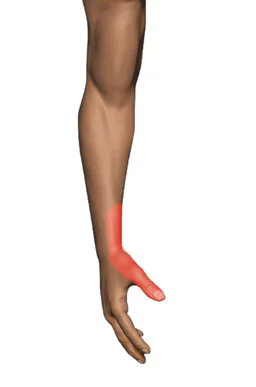
Table of Contents
Expert Opinion
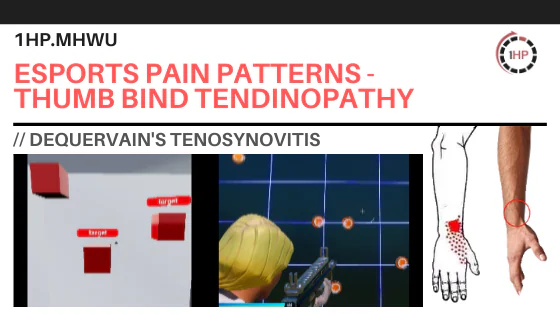
- One of the most commonly injured areas in gaming and heavy phone use due to the stress and strain put on the thumb in combination with moving the wrist.
- Thumb bind tendinopathy is irritation of the 2 tendon sheaths that cross the wrist and lead to the thumb.
- These tendons are responsible for moving the mouse to the left and lifting up the thumb.
What Does This Diagnosis Mean
Thumb bind tendinopathy is a condition that affects the tendons in your wrist and thumb. Tendons are like little ropes that connect your muscles to your bones, and these particular tendons help you move your thumb. When you play games, text, use a mouse or use your thumb and wrist a lot in other ways, these tendons can get irritated and swollen, causing pain.
This diagnosis is termed thumb bind tendinopathy, but may also go by "falcon thumb" due to the frequent occurrence in Smash players who use the thumb to hit the A, X, Y, and C joystick on a GameCube controller. This name is also interchangeable with De Quervain's tenosynovitis, 1st dorsal compartment tenosynovitis, or gamers thumb. The names "falcon thumb" and "gamers thumb" come from gaming, but heavy phone use, mouse work and other repeated thumb and wrist motion strain the same tendons. This diagnosis is vastly different from carpal tunnel syndrome as carpal tunnel from gaming is much less common than many know and believe.
Common Things You Might Feel
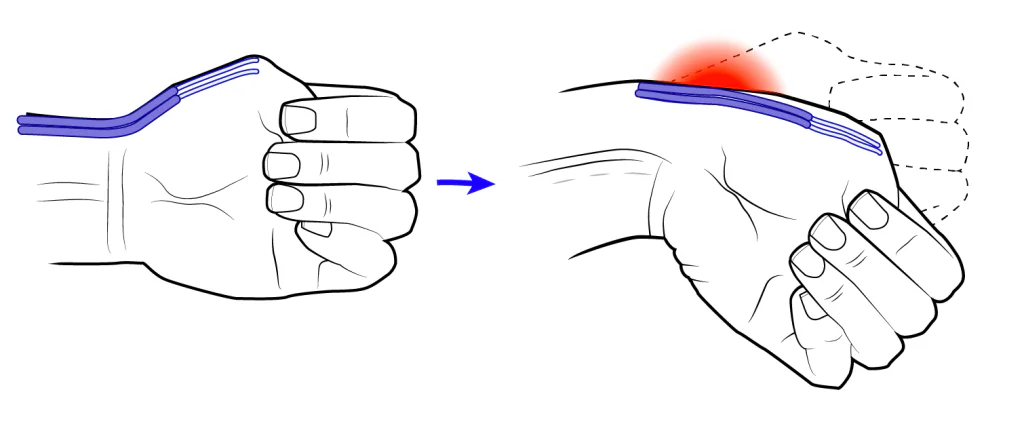
People may experience pain and tenderness in the area indicated above. Weakness is also likely to be present with gripping and moving a mouse, holding a phone, or pinching to open that new pack of Pokemon cards or bag of beef jerky. Many people first notice warmth or mild pain during the activity (gaming, texting, mouse work), but more of the pain is likely to come afterward. This area then may feel sore or achy well after use with general stiffness most often reported even into the next day.
Disclaimer: The following information is provided for general educational purposes only and should not be considered medical advice. It is not intended to replace consultation with a qualified healthcare professional. If you have specific concerns or questions about your health or medical condition, please seek the guidance of a licensed physician or another qualified medical practitioner. Any reliance you place on the information provided is solely at your own risk. In no event will the author or 1HP be liable for any loss or damage arising from using this information. Always consult with a healthcare professional before starting or changing any medical treatment or regimen.
Quick Test
Perform this quick test (Finkelstein Test). If there is a sharp pain experienced on the thumb side of the wrist then this may indicate you have this condition.
How Does It Happen?
Anyone who uses their thumb and wrist a lot is at risk. Long sessions and fewer rest breaks when you are in the zone add to the load, whether you are gaming, texting or working at a computer. These tendons let us hold on to a device and move the thumb to tap buttons, move a joystick or type on a screen.
- Mobile Gaming and Phone Use: Holding the screen for prolonged periods and using the thumb to tap/text.
- Console Gaming: Manipulating the joystick, hitting buttons, and holding a controller for prolonged periods.
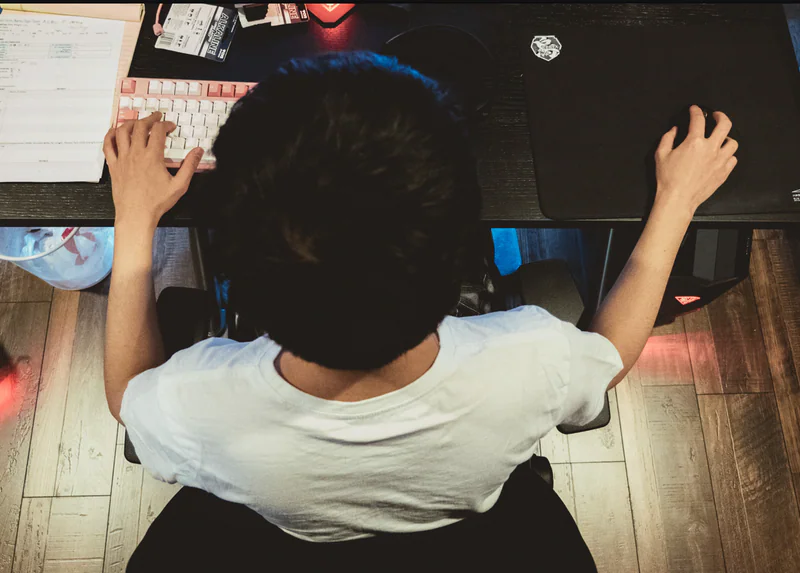
- Computer Gaming and Mouse Work: Frequently moving the wrist/mouse left and right.
- Other Hand Work: Holding a pen, stylus, tool or instrument for prolonged periods while moving the thumb and wrist.
How to Fix It / Recover / What Can You Do?
- Identify the issue (early detection…do NOT push into or through pain).
- Rest the thumb and wrist (a few days reducing workload, but continue gently moving the thumb).
- Splinting: A "forearm based thumb spica" splint is best to rest/relax the overused tendons. Use as minimally as possible, but it may be necessary for very painful acute symptom management.
- Massage in times of pain/discomfort.
- Use heat/ice (hot/cold packs, warm water soak).
- Initiate isometric exercises: a good starting exercise to regain/maintain strength while limiting pain.
- Stretching: helpful in reducing pain throughout the range of motion.
- Isotonic strengthening: improve strength and endurance to decrease pain while playing or working and prevent recurrence.
- Therapy/Medical Professional: A physical therapist trained in rehab and prevention; hands-on treatments may help speed recovery.
Surgery is very rarely required in order to effectively treat.
For a comprehensive guide on the exercises discussed, check out the videos on our Fix Wrist Pain page.
Science Behind The Injury
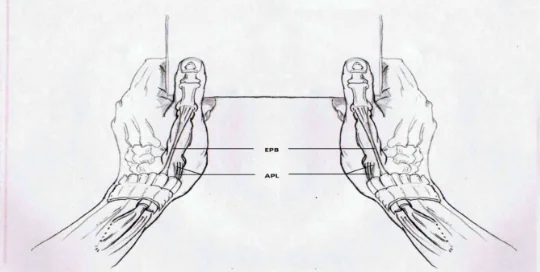
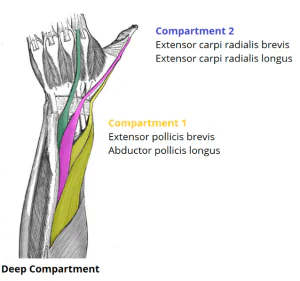
Specifically, this diagnosis is looking at 2 tendons (connecting muscle to bone) and the sheaths that cover them. Through repetitive use and inadequate rest, the tendons themselves are constantly rubbing and experience excess friction. This friction leads to a pain response.
Tendons responsible (highlighted in yellow):
- Extensor pollicis brevis: extension of your thumb (e.g., lifting the thumb up to hit a button).
- Abductor pollicis longus: abduction of your thumb (e.g., moving the thumb from X to C stick).
Moving the thumb a lot in this direction, on a controller or a phone, can lead to increased strain on the tendon. It should also be known that gaming is not the only activity to bring on this condition; school, work, and other hobbies can also stress these tendons.
Differential Diagnosis
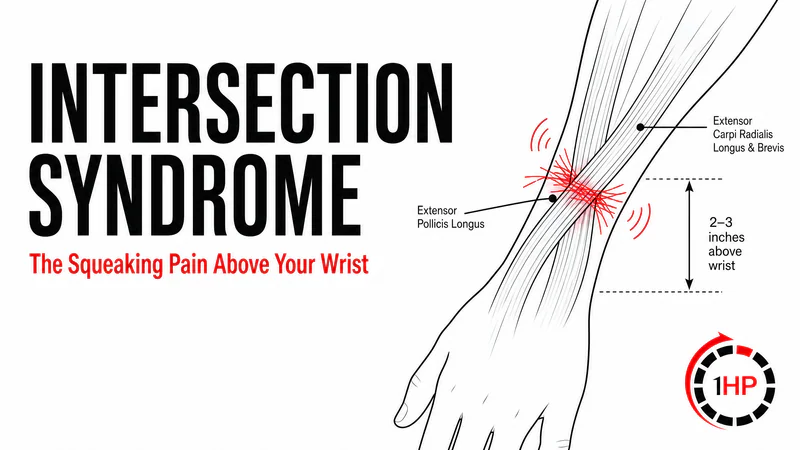
- Intersection Syndrome: Mimics Gamers Thumb (De Quervain's Tenosynovitis) as it is in close proximity to the pain location. It presents (proximal to the dorsal wrist crease) higher up on the back of the forearm roughly 4 to 6 cm from the wrist crease. This is a form of tenosynovitis between 2 sets of tendons intersecting near the wrist causing friction and pain.
Preventative Approach
There are 3 main factors to first focus on, plus secondary factors.
- Strengthening exercises: Build a foundational base to allow the tendon/muscle to keep up with the workload.
- Intermittent stretching (during and after long sessions of gaming, work or practice).
- Proper warm-up: Promotes blood flow and lubricates stiff joints.
Additional: Ergonomics/positioning; rest breaks (every 45 to 60 minutes); massage; ice (after long bouts if painful); heat (prior to sessions/stretches); relative rest; and Sleep/Nutrition/Mental health.
When to see a doctor first
See a doctor before starting if you have any of these:
- Constant numbness that doesn't change with activity
- Worsening weakness
- Visible muscle wasting
- Major swelling or color change
- A recent injury or fall
- Fever
- Severe, unrelenting pain
- Symptoms that wake you every night
Seek urgent care for emergencies.
Frequently asked questions
Is De Quervain's the same as tendonitis?
It is a type of tendon problem. De Quervain's affects two thumb tendons and the sheath they slide through on the thumb side of the wrist. The sheath can thicken and get irritated, so the tendons do not glide as easily. It is not arthritis and not carpal tunnel.
Can phone use cause De Quervain's?
Yes. Holding a phone and tapping or scrolling with the thumb for long periods loads the same tendons. Studies have linked heavy smartphone use and mobile gaming with De Quervain's symptoms. Switching hands, using both thumbs or setting the phone on a table can spread the load.
Do cortisone shots work for De Quervain's?
Steroid injections are a common medical treatment for De Quervain's and often reduce pain. They do not build tendon strength, so symptoms can return if the daily load stays the same. Ask your doctor about the trade-offs, and pair any injection with a plan to manage load.
Can new parents get De Quervain's?
Yes. It is common in new parents, because lifting a baby puts the thumb and wrist in a strained position many times a day. Lifting with your palms facing up and keeping your wrists straight can help. The same idea applies to carrying heavy bags or grocery sacks.
How long should I wear a thumb splint for De Quervain's?
Only as long as you need it. A forearm-based thumb spica splint can rest the tendons during a painful flare, especially at night or during heavy tasks. Long-term use can stiffen and weaken the thumb. Once the flare settles, gentle movement and strengthening matter more than the splint.
References
- Benites-Zapata, V. A., Jiménez-Torres, V. E., & Ayala-Roldán, M. P. (2021). Problematic smartphone use is associated with de Quervain's tenosynovitis symptomatology among young adults. Musculoskeletal science & practice, 53, 102356.
- Ilyas, Asif M. et al. de Quervain Tenosynovitis of the Wrist. Journal of the American Academy of Orthopaedic Surgeons 15(12):757-764, December 2007.
- Huisstede BMA, Coert JH, Fridén J, Hoogvliet P. Consensus on a Multidisciplinary Treatment Guideline for de Quervain Disease (European HANDGUIDE Study). Physical Therapy. 2014 Aug;94(8):1095-1110.
- Ma, T., Song, L., Ning, S. et al. Relationship between the incidence of de Quervain's disease among teenagers and mobile gaming. International Orthopaedics (SICOT) 43, 2587-2592 (2019).
- Morgan, S. D. et al. (2020). A Review of De Quervain's Stenosing Tenovaginitis in the Context of Smartphone Use. The journal of hand surgery Asian-Pacific volume, 25(2), 133-136.