Outer Elbow Pain From Repetitive Strain
Lateral Epicondylalgia | Lateral Epicondylitis | Lateral Epicondylosis | Tennis Elbow | Lateral Elbow Tendinopathy | Mouse Elbow | Common Extensor Tendinopathy
By Brett Becker, MS, OTR/L, ACE-CPT, ACE-GFI
Updated November 5, 2026
Quick answer
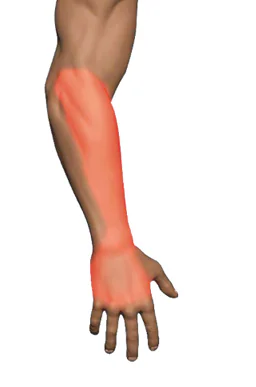
A sharp pain on the outside of your elbow when you pick up a coffee mug, grab a water bottle across the desk, or turn a doorknob. A dull ache that runs down the back of your forearm after a day of mouse work. You have never touched a tennis racket, but your doctor says "tennis elbow."
Table of Contents
Intro
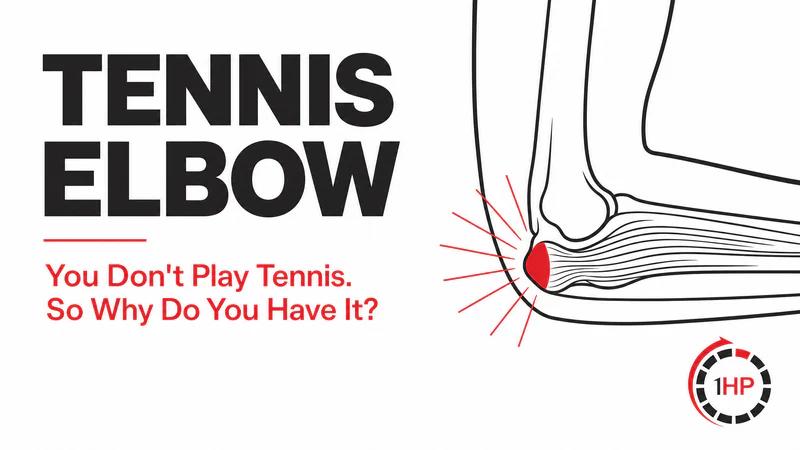
Tennis elbow is a nickname. The more accurate name is lateral epicondylalgia, which means pain at the bony bump on the outside of the elbow. That bump anchors the muscles that lift your wrist and fingers. Every click, keystroke and grip pulls on it. It is the most common overuse problem of the elbow, affecting about 1% to 3% of people [1, 2], and it is common in people who use a mouse for long hours.
The pain lives at the elbow, but the work comes from the wrist and hand. This page explains how the outer elbow is built, how mouse work and gripping load it, what is really going on inside the tendon, what else can cause pain here, which treatments actually hold up in research, and when our approach does and does not fit.
Disclaimer: The following information is provided for general educational purposes only and should not be considered medical advice. It is not intended to replace consultation with a qualified healthcare professional. If you have specific concerns or questions about your health or medical condition, please seek the guidance of a licensed physician or another qualified medical practitioner. Any reliance you place on the information provided is solely at your own risk. In no event will the author or 1HP be liable for any loss or damage arising from using this information. Always consult with a healthcare professional before starting or changing any medical treatment or regimen.
What 1HP's 2026 Data Shows for Outer-Elbow Pain
The 1HP intake body map did not ask about the elbow as a separate region, so The 1HP Wrist and Hand Pain Report 2026 does not provide an outer-elbow prevalence estimate. Among 1,023 coaching applicants, however, 18 named tennis elbow or lateral elbow tendinopathy and 2 said a doctor or test had confirmed it. Six named radial tunnel or radial nerve compression, including 3 reported as confirmed.
Across all applicant labels, 84 people named at least one tendon condition and 67 named at least one nerve condition. These are minimum counts from written applications, not diagnoses made by 1HP. They show why an outer-elbow assessment should compare common extensor-tendon loading with radial nerve and joint patterns instead of treating the nickname "tennis elbow" as a complete explanation.
Related case: Watch a case involving long-term forearm and outer-elbow symptoms. This is one person's experience, not a prediction of another person's outcome. Results vary.
Anatomy and Physiology of the Outer Elbow
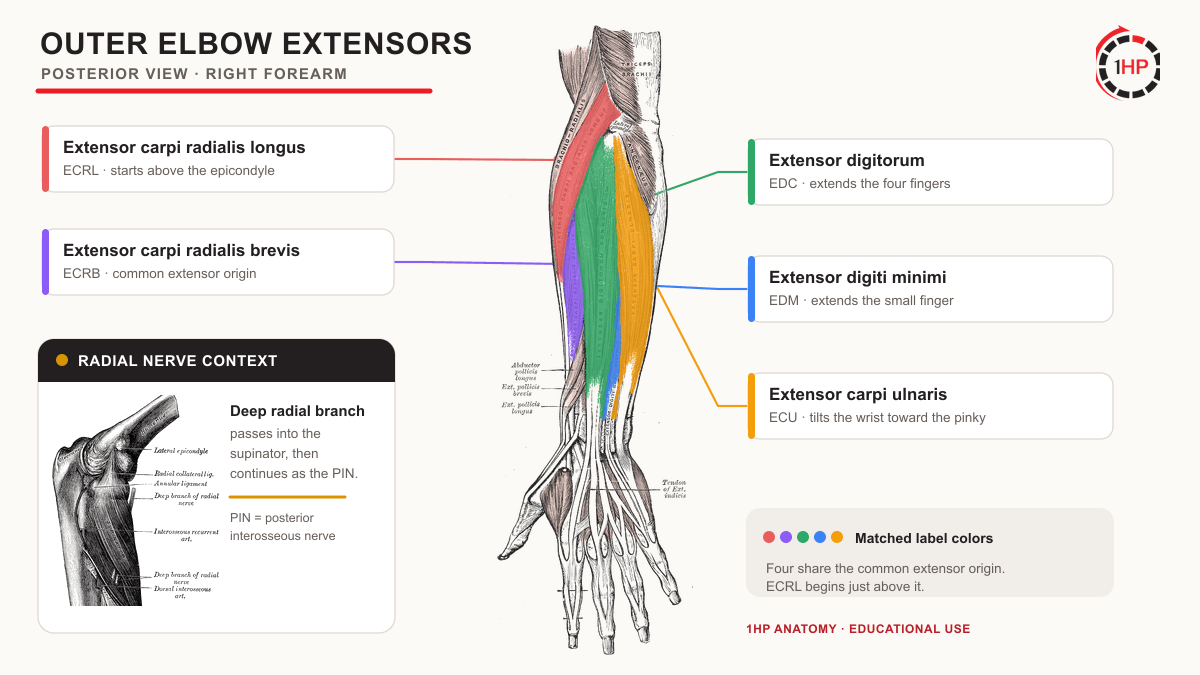
The bony bump on the outside of your elbow is the lateral epicondyle of the humerus. Several muscles that lift (extend) your wrist and fingers share a common tendon that starts here:
- Extensor carpi radialis brevis (ECRB): Lifts the wrist and tips it toward the thumb. This is the tendon most often involved in lateral epicondylalgia [3].
- Extensor carpi radialis longus (ECRL): Lifts the wrist and tips it toward the thumb. It starts just above the epicondyle.
- Extensor digitorum (EDC): Lifts the four fingers and helps lift the wrist.
- Extensor digiti minimi (EDM): Lifts the small finger.
- Extensor carpi ulnaris (ECU): Lifts the wrist and tips it toward the pinky.
All of these muscles are also active when you grip. To make a fist, your finger flexors pull the wrist down, so the extensors have to fire to hold the wrist steady. That is why gripping a mouse or a mug hurts the outside of the elbow even though you are "squeezing," not lifting.
Nearby structures include the radial nerve, which splits near the elbow into a sensory branch and a motor branch (the posterior interosseous nerve, or PIN) that passes through the radial tunnel, and the lateral collateral ligament complex, which stabilizes the outer elbow.
You can see this for yourself. Rest your forearm on a table and lift just your middle finger. Watch or feel the outside of your elbow. The muscles there tighten.
Biomechanics: Why the Outer Elbow Hurts From Hand Work
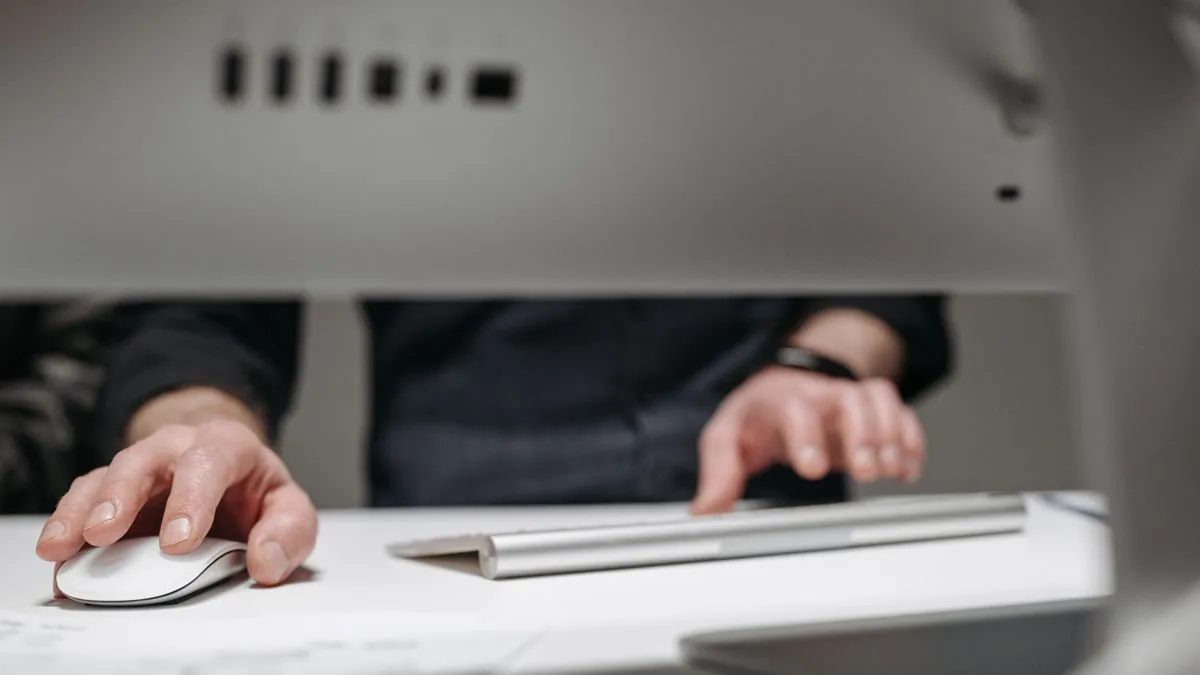
- Grip requires wrist stability. Every grip forces the wrist extensors to co-contract. A firm mouse grip all day means a firm extensor contraction all day.
- Hovering and lifting. Holding the hand up over the mouse or keyboard and lifting fingers between clicks keeps the extensors working.
- Wrist side-to-side motion. Moving a mouse with the wrist uses the ECRB, ECRL and ECU.
- Reaching with a straight elbow. Grabbing something across the desk with the elbow straight and the palm down puts the ECRB in its most stretched, most loaded position. That is the classic "mug test" pain.
- Grip strength is reduced in a predictable way. Pain-free grip is typically weaker with the elbow straight than bent. A 5% to 10% difference between those two positions was one of the more useful exam findings in a 2022 review of tests [4].
How Repetitive Strain Causes It (Functional Mechanisms)
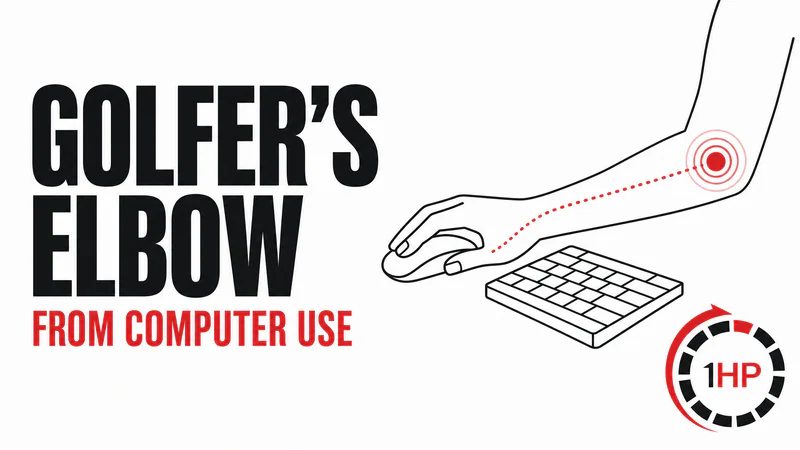
- Mouse work. Hours of firm grip, hovering and wrist-driven movement. Mouse-side elbows are the classic pattern.
- Keyboard work with a bent-back wrist. Wrist held lifted for long periods.
- Laptop and trackpad use. Hands held up and wrists extended.
- Instruments. Guitar picking hand, violin bow arm, drumming, keyboard players.
- Tools and manual tasks. Screwdrivers, painting, scissors, hairstyling, carrying bags with a pinch grip.
- Racket and paddle sports. Tennis and pickleball, which is where the nickname came from.
- Gym work. Front raises, rows and curls with a palm-down grip.
- Mouse-heavy gaming after work. More hours of grip and fast wrist movement stacked on the workday.
In a large Finnish study, the combination of repetitive arm movement and forceful work raised the odds of lateral epicondylitis more than five-fold [1].
Pathophysiology: The Tendinopathy Spectrum and the Healthbar
The Healthbar
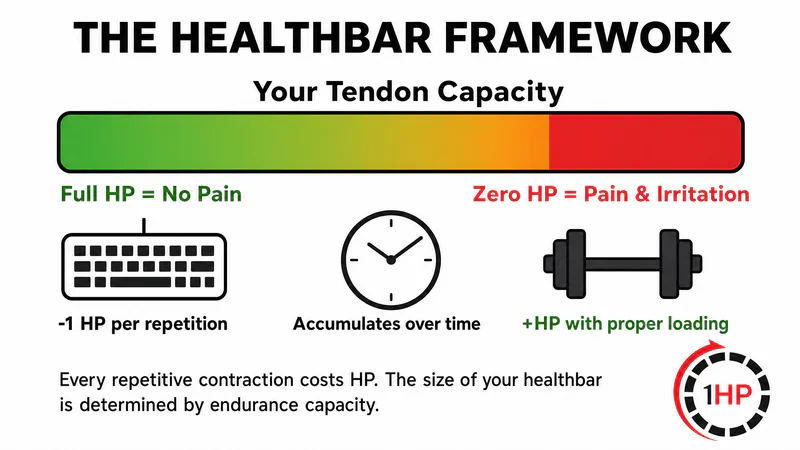
- Your common extensor tendon has a healthbar. The size is its endurance capacity.
- Every grip, click, hover and palm-down reach drains HP. A looser grip, a mouse that fits, and elbow support lower the drain.
- Breaks and sleep refill HP.
- When HP hits zero, you feel sharp pain at the outer elbow with gripping and an ache afterward.
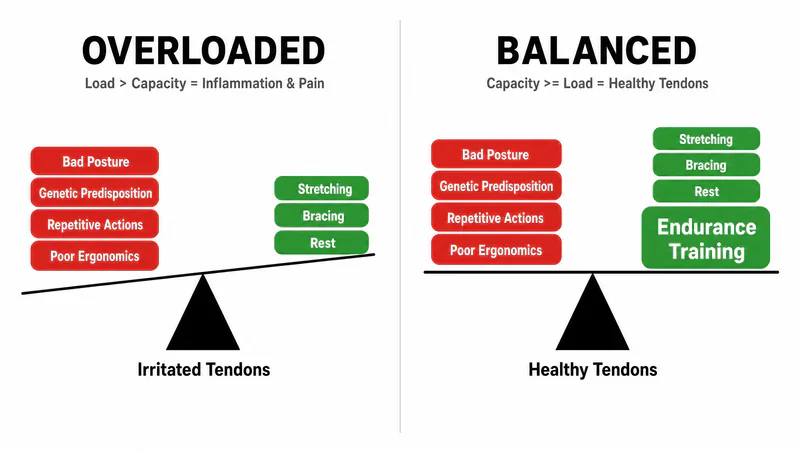
Load > Capacity = Pain.
Inside the Tendon
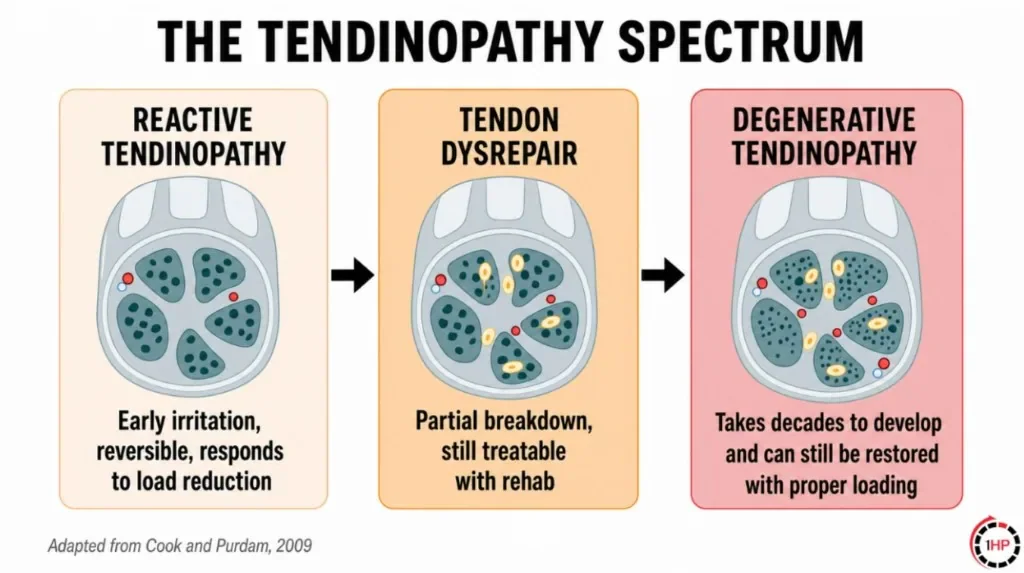
Surgical studies of tennis elbow describe "angiofibroblastic tendinosis": disorganized collagen, new blood vessels, and fibroblast cells, with no inflammatory cells [3]. It is a failed-healing, load-related problem, not an inflamed one. That is why "epicondylalgia" (pain) or "epicondylosis" (tissue change) is more accurate than "epicondylitis" (inflammation).
Tendon problems happen along a continuum [5, 6]:
- Reactive: A fast response to a spike in load. The tendon swells and gets sore. This is often a new job, a launch week, or a new hobby.
- Disrepair: Ongoing overload makes the tendon structure more disorganized.
- Degenerative: Long-term changes in parts of the tendon. The healthy tendon around them can still be trained to carry more.
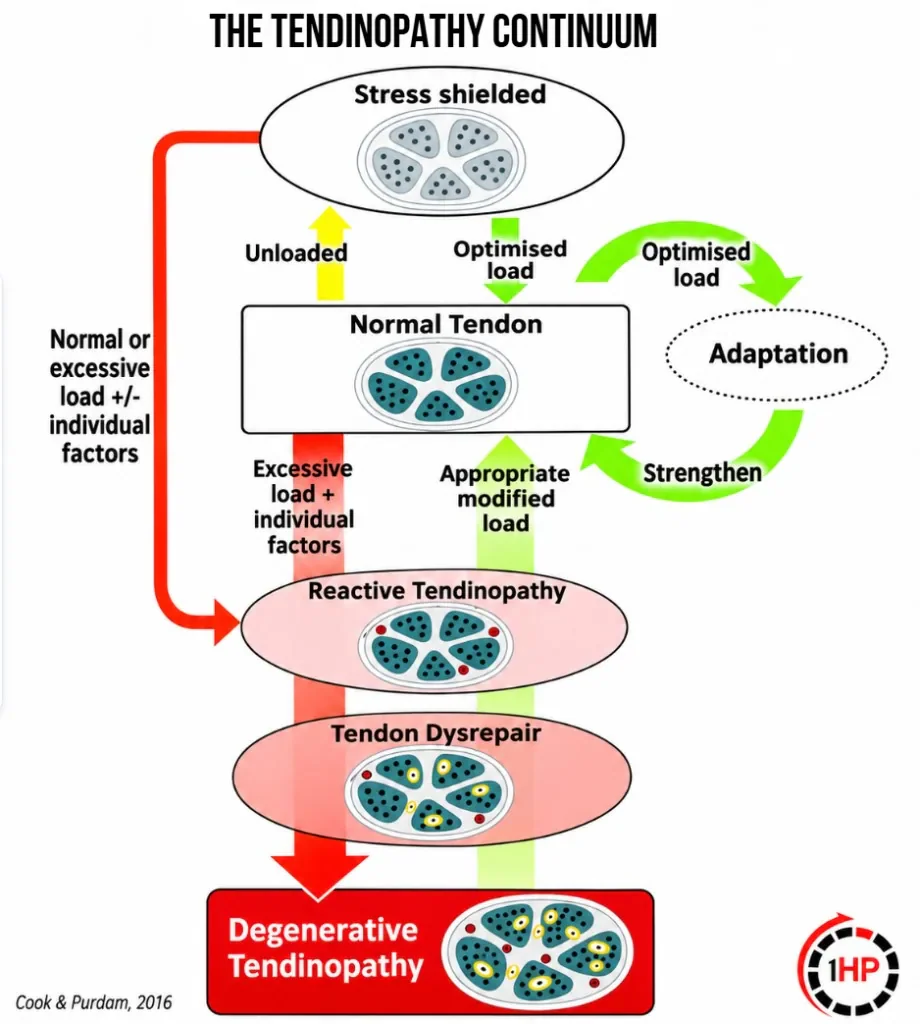
Tendons can move both ways along this path, and an old elbow problem can flare again on top of itself [6]. After each heavy bout, tendon collagen breaks down faster than it rebuilds for roughly the first day before recovery catches up [7].
Load, Imbalance and Load Modification
- Volume: Total grip time, clicks and hover time per day.
- Compression: With the forearm turned palm down and the elbow straight, the ECRB tendon can be pressed against the bone near its attachment, which may add to its load [8].
- Imbalance: Strong grip but low extensor endurance, plus weak shoulder and upper back muscles, pushes more work onto the forearm.
Load modification means lowering the drain enough to stop the flare cycle without stopping work, while you build capacity.
Additional Pathophysiology
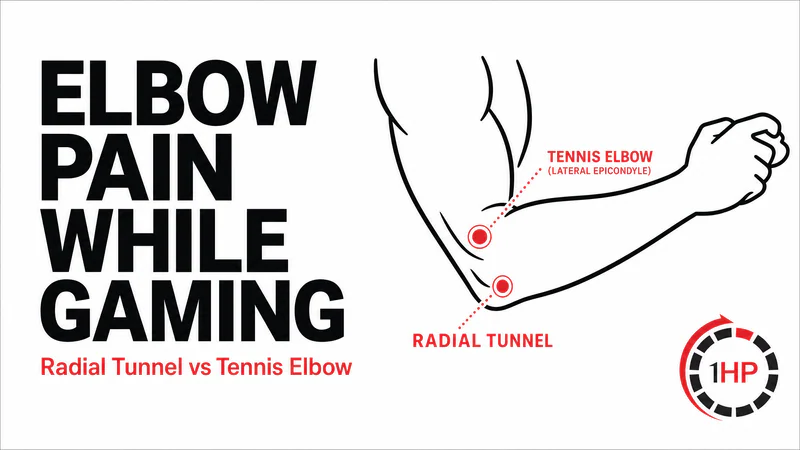
Radial nerve involvement. The posterior interosseous nerve passes through the radial tunnel just below the elbow, under muscles that are part of the extensor group. Tight, overworked muscles can irritate it. This can mimic tennis elbow with a deeper, more spread-out ache.
Sensitization. Long-standing tennis elbow is linked with a more sensitive nervous system. Pain can spread and show up with lighter tasks over time. This is part of why passive treatments that only target the elbow tissue often fall short. See The Way You are Thinking Can Make your Wrist Pain Worse?.
Natural history. Many cases improve slowly over months even without treatment [9]. The goal of a good plan is to get you there faster, with fewer flare-ups, and with a bigger healthbar so it does not come back.
Differential Diagnosis
Differential diagnosis means comparing other conditions that can cause pain around the outer elbow and forearm. The exact location, weakness, clicking, injury history, and response to wrist or neck movement help separate tendon, nerve, joint, and bone problems.
| Condition | Clues |
|---|---|
| Radial tunnel syndrome | Deep, spread-out ache in the forearm about 3 to 5 cm (1 to 2 inches) below the outer elbow, pain with resisted middle finger extension or resisted palm-up turning, usually no numbness. A counterforce strap can make it worse |
| Posterior interosseous nerve (PIN) palsy | Weakness lifting the fingers or thumb (a dropped finger), often without pain. Needs a doctor |
| Cervical radiculopathy (C6 or C7) | Neck pain, symptoms along the arm that change with neck movement, reflex changes |
| Lateral elbow instability | Clicking, clunking or a feeling of the elbow slipping, often after a fall or dislocation |
| Elbow arthritis or loose bodies | Stiffness, locking, loss of full straightening or bending |
| Synovial plica | Painful clicking or catching on the outer back of the elbow |
| Osteochondritis dissecans of the capitellum | Outer elbow pain in teens and young adults who throw or do gymnastics |
| Back side wrist tendinopathy | Pain lower on the forearm and wrist rather than at the elbow. See back side wrist pain guide |
Where the 1HP Approach Fits
- Often a fit: Gradual, load-related lateral-elbow or back-side wrist tendinopathy without instability, locking, or sudden weakness. Capacity coaching can build extensor endurance and grade the return to mouse work, lifting, music, gaming, or sport.
- May fit after assessment: A load-sensitive radial-tunnel pattern can require different positioning and nerve-specific guidance, so the nerve source should be reasonably clear before loading.
- Medical assessment first: PIN palsy, lateral-elbow instability, loose bodies, a symptomatic synovial plica, or osteochondritis dissecans is not an exercise-first presentation. Cervical radiculopathy with objective weakness or reflex change also needs medical evaluation.
Common Misdiagnoses
1. "You don't play tennis, so it can't be tennis elbow." Most people with tennis elbow do not play tennis. Mouse work, keyboard work and manual tasks load the same tendon. See Tennis Elbow From Computer Use and Doctor Said Tennis Elbow? You've Never Played Tennis.
2. "It's inflamed. Rest it and take anti-inflammatories." The tissue is not inflamed in the classic sense [3]. Rest calms symptoms but shrinks capacity. See Rest Is One Reason Your Elbow Pain Never Heals.
3. "Radial tunnel or tennis elbow? Same thing." They feel similar but need different handling. Radial tunnel pain is lower and deeper, and a counterforce strap can irritate the nerve.
4. "Your ultrasound shows tendon damage, so it is permanent." Tendon changes are common and do not predict pain well. The healthy tendon around them adapts to load. See Your Scan Is Looking at the Wrong Thing for Elbow Pain and Degenerative Tendinopathy Recovery.
Medical Tests That Confirm or Rule Out a Misdiagnosis
Lateral epicondylalgia is mainly diagnosed by history and exam. Tests help rule out other causes.
- Diagnostic ultrasound: Shows tendon thickening, tears and new blood vessels. In a 2022 review, grayscale ultrasound accuracy varied widely, while sonoelastography (stiffness imaging) and MRI performed better for tendon thickening [4]. Findings must match symptoms.
- MRI: For suspected partial or full tendon tears, ligament injury, bone bruising, or when symptoms do not improve.
- X-ray: For arthritis, loose bodies, or calcium deposits.
- Nerve conduction study and EMG: If there is weakness lifting the fingers or thumb, or symptoms that suggest nerve involvement.
- Neck evaluation: If symptoms change with neck movement.
How 1HP Screens Capacity (Our Testing Philosophy)
- Load story: Mouse hours and grip, keyboard and laptop setup, tools, instruments, sports and gym work, and next-day response.
- Symptom mapping: Right at the epicondyle, lower and deeper in the forearm, or spreading from the neck.
- Physical therapy special tests: Cozen's test (resisted wrist extension), Mill's test (stretching the extensors), Maudsley's test (resisted middle finger extension), palpation of the epicondyle versus the radial tunnel, lateral elbow stability tests, and a neck screen.
- Pain-free grip strength: Measured with the elbow bent and straight, compared side to side. The difference between those positions is one of the more useful exam findings [4].
- Endurance capacity testing: Wrist extension with a light weight scaled to your body weight, paced by a metronome until fatigue or symptoms show up. Timed isometric holds at moderate effort. Side-to-side comparison and our coaching targets, which are experience-based guides, not published norms.
- Activity tolerance and 24-hour response.
Commonly Prescribed Treatments: What Works and What Doesn't
This is one of the best-studied tendon problems in the body, and the research is clear on a few points.
| Treatment | What the evidence says | Where it fits |
|---|---|---|
| Cortisone injection | Strong short-term relief, but worse long-term results. In a large randomized trial, people who got cortisone had lower recovery at 1 year (83% vs 96% with a placebo injection) and much higher recurrence (54% vs 12%) [10]. See The Injection Trap | We generally advise against it for long-standing lateral elbow pain |
| Wait and see | Many cases improve slowly over months [9] | Okay for mild cases, but slow and prone to recurrence |
| Exercise-based care | Better outcomes than passive treatments and better than injections over time, but effects are modest and programs vary a lot in quality [11]. In one trial, physiotherapy without the steroid had the lowest recurrence and full recovery at 1 year [10] | The core of the plan, done well |
| Counterforce strap | Placed 1 to 2 cm below the epicondyle, it can reduce pain during tasks for some people [12]. It does not build capacity. Not for radial tunnel syndrome. See Your Elbow Strap Hides the Problem | Comfort aid during heavy tasks |
| Wrist splint | Also studied for pain relief [12]. Long-term use weakens the extensors | Short term only |
| NSAIDs | Short-term pain relief | Occasional use |
| PRP and other injections | Mixed evidence | Not first line |
| Ergonomic gear | A mouse that fits, a vertical mouse for some, less hovering. Lowers the drain | Helpful, not enough alone |
| Surgery | For rare cases that fail a long, well-run program | Last resort |
What 1HP Recommends
We use the Load Reset Framework: Reset Load, Activate with Isometrics, Build Endurance and Progress. See The Only Video You Need on Tennis Elbow and Everyone Blames Tennis. Your Keyboard Can Do It Too.
Step 1: Reset load.
- Loosen your mouse grip and rest your forearm on the desk or an armrest so the hand is not hovering.
- Lift objects with the palm up and the elbow bent, not with the palm down and the elbow straight.
- During a flare, use straps for pulling exercises and swap palm-down lifts for neutral grips.
- Keep symptoms at about 3 to 4 out of 10 or less, settling by the next morning [13].
Step 2: Activate with isometrics.
- Wrist extension holds against light resistance with the elbow bent, then progressing to straight, about 45 seconds, 3 sets, at a moderate effort, about half to seven tenths of your maximum.
- Isometrics ease pain for some people with lateral elbow pain. A 2020 review found the evidence limited and the effect variable [14]. We use them as a starting tool.
Step 3: Build endurance and progress.
- High-repetition, light-weight wrist extension, radial deviation and grip, paced by a metronome.
- Add slow, controlled lowering (eccentric) work as tolerance grows. See Eccentric Wrist Extension.
- Add shoulder and upper back endurance so the forearm is not doing all the stabilizing.
- Progress reps, then weight, then elbow position (bent to straight), then real tasks. See These 3 moves and your Tennis Elbow will Vanish.
Step 4: Support tools.
- Wrist Extensor Stretch, Posterior Forearm Massage, heat before long sessions, and a strap during heavy tasks if it helps.
What to expect. Elbow tendons adapt slowly. Many people notice change in 4 to 8 weeks, and lasting change often takes 12 weeks or more [15]. Early soreness is normal. Sharp pain above about 5 to 6 out of 10, weakness, or symptoms still there the next day mean scale back.

Is This Approach Right for You?
Likely a good fit:
- Outer elbow pain that rises with mouse work, gripping, lifting or playing and eases on lighter days.
- Pain with gripping a mug at arm's length, resisted wrist extension, or resisted middle finger extension.
- Normal imaging or tendon changes without a full tear.
- You have tried rest, a strap or an injection and the pain came back.
Likely NOT a good fit (or not first):
- A sudden pop or injury, especially with bruising or weakness. Rule out a tendon rupture or ligament tear.
- Weakness lifting the fingers or thumb without much pain. That can be a nerve problem (PIN palsy) and needs a doctor.
- A clunky, unstable elbow, especially after a dislocation or fall.
- Locking or loss of motion that suggests a loose body or arthritis.
- Several recent cortisone injections into the same spot. Get medical guidance on how much load the tendon can safely take.
Red Flags: When to See a Physician
See a doctor before starting if you have:
- Constant numbness that does not change with activity
- Worsening weakness, especially trouble lifting the fingers or thumb
- Visible muscle wasting
- Major swelling or color change
- A recent injury, fall or pop
- Fever, redness or heat
- Severe, unrelenting pain
- Symptoms that wake you every night
- An elbow that locks or will not straighten
Seek urgent care for a deformed elbow after a fall or a hot, red, swollen elbow with fever.
Frequently asked questions
Can you get tennis elbow without playing tennis?
Yes. Most people with it do not play tennis. Mouse work, typing, tools and gripping load the same tendon.
Why does my outer elbow hurt when I pick up a cup?
Gripping forces the wrist extensors to hold your wrist steady, and reaching with a straight elbow puts the main tendon in its most stretched position.
Do cortisone shots help tennis elbow?
They often help for a few weeks. In a major trial they led to worse results at one year and much higher recurrence than a placebo injection [10].
What is radial tunnel syndrome?
Irritation of a branch of the radial nerve a little below the outer elbow. It feels like a deep, spread-out ache and can be mistaken for tennis elbow. A counterforce strap can make it worse.
Is a vertical mouse good for tennis elbow?
It helps some people by changing forearm position. It lowers the drain but does not build capacity. A vertical mouse is not the whole plan.
References
- Shiri R, Viikari-Juntura E, Varonen H, Heliövaara M. Prevalence and determinants of lateral and medial epicondylitis: a population study. Am J Epidemiol. 2006;164(11):1065-1074.
- Keijsers R, et al. Tennis elbow. Shoulder Elbow. 2019;11(5):384-392.
- Kraushaar BS, Nirschl RP. Tendinosis of the elbow (tennis elbow). Clinical features and findings of histological, immunohistochemical, and electron microscopy studies. J Bone Joint Surg Am. 1999;81(2):259-278.
- Karanasios S, Korakakis V, Moutzouri M, et al. Diagnostic accuracy of examination tests for lateral elbow tendinopathy (LET): a systematic review. J Hand Ther. 2022;35(4):541-551.
- Cook JL, Purdam CR. Is tendon pathology a continuum? Br J Sports Med. 2009;43(6):409-416.
- Cook JL, Rio E, Purdam CR, Docking SI. Revisiting the continuum model of tendon pathology. Br J Sports Med. 2016;50(19):1187-1191.
- Magnusson SP, Langberg H, Kjaer M. The pathogenesis of tendinopathy: balancing the response to loading. Nat Rev Rheumatol. 2010;6(5):262-268.
- Cook JL, Purdam C. Is compressive load a factor in the development of tendinopathy? Br J Sports Med. 2012;46(3):163-168.
- Bisset L, Beller E, Jull G, et al. Mobilisation with movement and exercise, corticosteroid injection, or wait and see for tennis elbow: randomised trial. BMJ. 2006;333(7575):939.
- Coombes BK, Bisset L, Brooks P, Khan A, Vicenzino B. Effect of corticosteroid injection, physiotherapy, or both on clinical outcomes in patients with unilateral lateral epicondylalgia: a randomized controlled trial. JAMA. 2013;309(5):461-469.
- Karanasios S, Korakakis V, Whiteley R, et al. Exercise interventions in lateral elbow tendinopathy have better outcomes than passive interventions, but the effects are small: a systematic review and meta-analysis of 2123 subjects in 30 trials. Br J Sports Med. 2021;55(9):477-485.
- Garg R, et al. A prospective randomized study comparing a forearm strap brace versus a wrist splint for the treatment of lateral epicondylitis. J Shoulder Elbow Surg. 2010;19(4):508-512.
- Silbernagel KG, Thomeé R, Eriksson BI, Karlsson J. Continued sports activity, using a pain-monitoring model, during rehabilitation in patients with Achilles tendinopathy. Am J Sports Med. 2007;35(6):897-906.
- Clifford C, Challoumas D, Paul L, Syme G, Millar NL. Effectiveness of isometric exercise in the management of tendinopathy. BMJ Open Sport Exerc Med. 2020;6(1):e000760.
- Bohm S, Mersmann F, Arampatzis A. Human tendon adaptation in response to mechanical loading: a systematic review and meta-analysis. Sports Med Open. 2015;1(1):7.