Table of Contents
The Free 7-Point Wrist Pain Screen: What It Is and Who It's For
By Dr. Matthew Hwu, PT, DPT, OCS, CSCS·
Quick answer
1HP's free 7-point wrist pain screen is a no-cost first step for wrist, hand or forearm pain from typing, mouse use, gaming or music. It fits best when pain has lasted months or years despite rest, braces or clean scans. It maps your pain pattern, checks doctor-first warning signs that 1HP experts review, and points you to a next step. It is educational, not a diagnosis.
Key stats at a glance, from The 1HP Wrist and Hand Pain Report 2026 and The 1HP Clinical Outcomes Report 2026:
- Among 6,842 people who took 1HP's intake assessment, 58% of the 5,619 who completed the nerve-symptom step reported numbness or tingling (Ulnar 59%, Median 47%, Radial 44% of those).
- Among 6,842 people who took 1HP's intake assessment, 52% marked the wrist extensors, 47% the wrist flexors and 37% the fingers, and 48% marked 3 or more pain regions.
- Among 6,842 people who took 1HP's intake assessment, 53% of people 55 and older had pain for more than a year, compared with 14% of under-18s.
- Among 229 program members (August 2025 to November 2026), 25% answered yes to a red-flag question on the intake medical screening, which 1HP experts review.
- Among Power Leveling members who completed follow-up, 72% reached a meaningful improvement in function, compared with 33% in the self-guided Wrist Pain Troubleshooter; the median time was 45 days, and average QuickDASH scores fell 46% (34.4 to 18.0). Results vary.
Three quick definitions. A repetitive strain injury (RSI) is pain in tendons, nerves or muscles from long-term, repeated movement, according to the University of Rochester Medical Center. Chronic wrist pain means pain lasting more than three months, according to the Real World NP podcast. QuickDASH is a 0 to 100 questionnaire of arm, shoulder and hand function, where a lower score means less disability.
Maybe this is just how my hands are now... If that thought has crossed your mind after a clean MRI, a cortisone shot and a desk full of ergonomic gear, you are not alone. It is not your fault either. I would go further: I think the usual one-label approach is the bigger problem here, not your hands. So try a better question: when does your pain peak, and how long can you type or play before it starts?
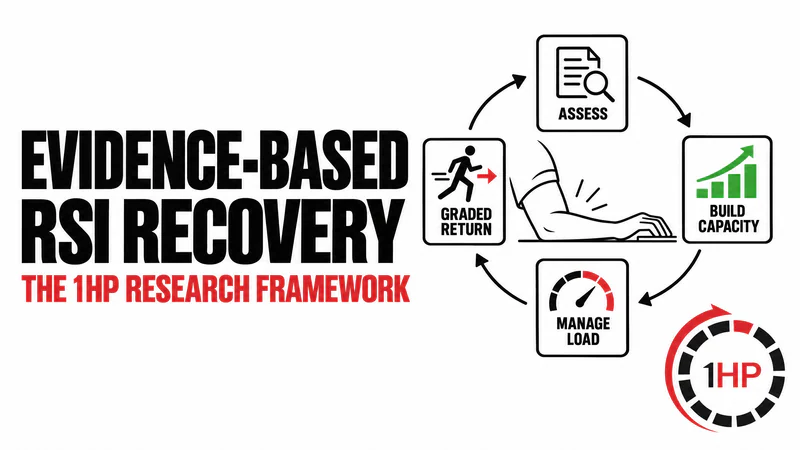
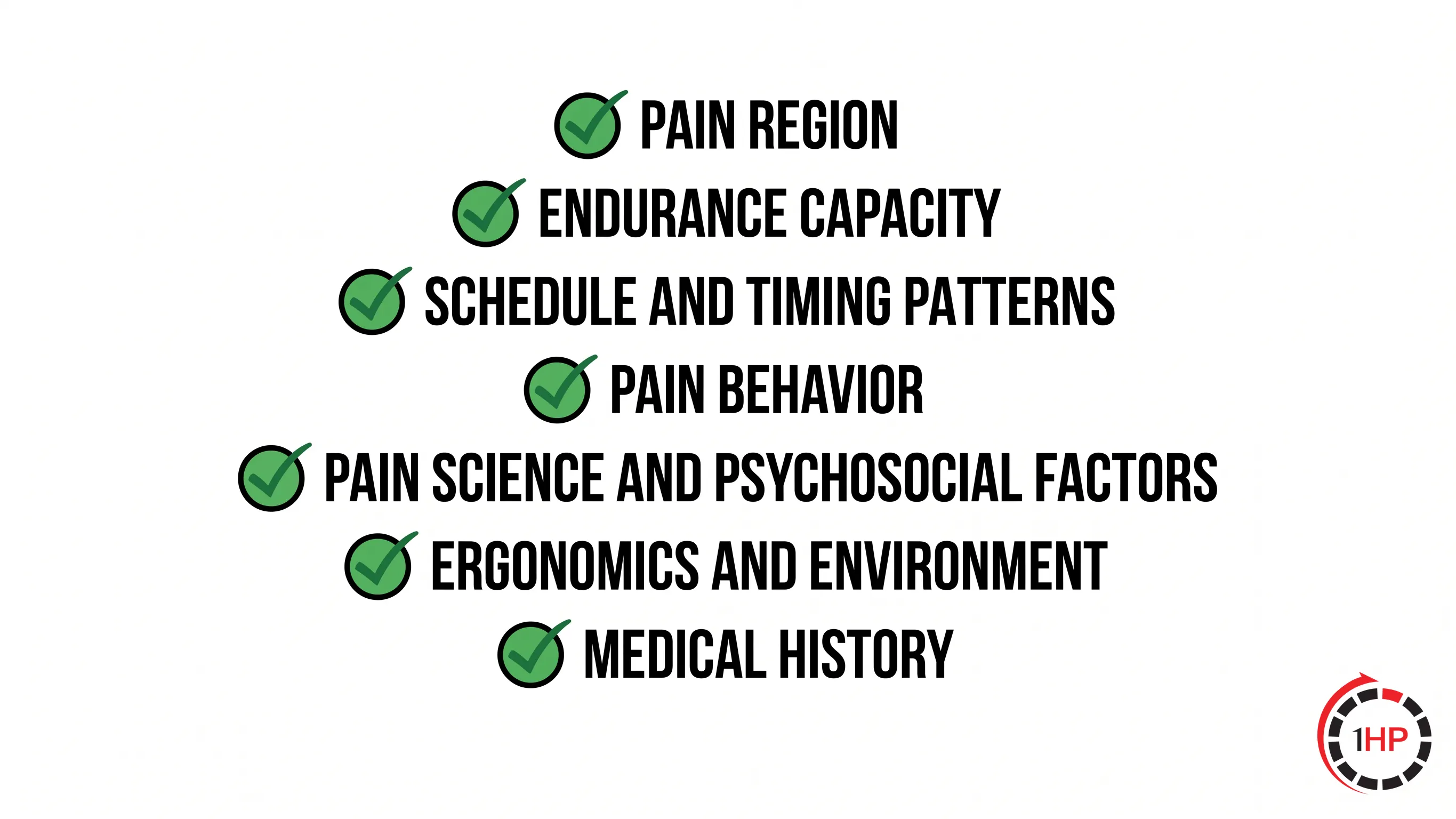
The free 1HP 7-Point Wrist Pain Screen is the framework built for that gap. It is a structured screen of 7 named areas: Pain Region, Endurance Capacity, Schedule and Timing Patterns, Pain Behavior, Pain Science and Psychosocial Factors, Ergonomics and Environment, and Medical History. Together they cover where it hurts, nerve symptoms, how long you can keep working before symptoms start, doctor-first warning signs, and how any scan fits the story. What the screen finds then feeds the 1HP Load Reset Framework: reset load, activate with isometrics, build endurance. I like this pairing because, in my experience of explaining it, it turns a vague ache into a clear game plan. The research section below walks through what a single label tends to miss.
Screening also shapes how gently a plan should start. Among 229 program members in The 1HP Wrist and Hand Pain Report 2026, 3% (8 members) had sensitization mode enabled, aka a gentler progression for a nervous system that is on high alert. Small number, big point, and in my opinion one of the most underrated details in the whole 2026 report. I believe a plan that ignores it can stall before it begins. Rushed evaluations tend to skip exactly this step, which strikes me as the clearest gap in how the system handles long-term wrist pain.
Here is what I walk through below:
- Why a broader screen matters right now, and what one label misses after a year of pain
- Why a quick online RSI quiz cannot tell you the whole story
- Who fits the screen, and who should get imaging first
- A real case of an animator whose wrist pain outlasted surgery
- What to do next, at your own pace
My honest take: start wherever feels manageable, because a small first step usually beats a perfect plan you never begin. If your pain sits on the palm side, our free video guide on palm-side wrist and hand pain is a helpful companion. Ready? Let's start with why this matters now...
Last updated , with intake data current as of November 2026 (1HP clinical data record exported November 5, 2026). If your wrist has hurt for a year or more, this guide can help you decide whether a free, wide look at your pain fits you. Maybe your MRI came back clean. Maybe a scan showed a small finding and someone called it the cause. Either way, you are not alone. The missing piece is often not a hidden injury. I think that is the most freeing idea in this whole guide, and I suspect it may change how you read your own scan. We will get to the 2026 data in the research section below.
Here is how we look at imaging at 1HP. A scan shows structure. It cannot count reps: one pro Overwatch player in a 1HP case study by Dr. Matthew Hwu, Anon1, felt pain at 31 wrist repetitions on his right side, while his left handled more than 60 without issues. In my view, that one detail says more than most MRI reports could. It suggests the tissue ran short on endurance, not that something was broken. So we read imaging alongside where it hurts, what sets it off, nerve signs, load history and what your hand can still do.
One student and gamer had palm-side wrist pain and an MRI showing a minor ligament finding on the back of the wrist. His pain sat on the opposite side, and he could still bench press heavy without pain. He kept training, which I consider the smartest call in the whole story. By week 9 his endurance in that wrist was normal, and by week 16 he had no pain with any activity.
My read is that his scan finding was probably a bystander, not the cause: hear hoofbeats, think horses, not zebras. That is the thinking behind the free 1HP 7-Point Wrist Pain Screen: look wide before you narrow down. I would argue this matters most for anyone who has already tried rest, a brace and a cortisone shot. Our team has talked through this with gamers for years, like Dr. Kevin Ho's 2021 conversation with mixed reality streamer Naysy about VR wrist and shoulder health. Imaging still matters for a suspected fracture, major trauma or a mass, so the screen sorts that out first. To me, that order (rule out the serious stuff, then build capacity) is the fairest deal a worried reader can get...
Why does a broader wrist pain screen matter right now?
Chronic wrist pain rarely lives in one tissue, and in our outcomes data, 72% of coached members who completed follow-up reached meaningful improvement in function, versus 33% self-guided.
Before you decide whether a screen fits you, run through a few quick questions:
- Has your pain hung around for months, not days?
- Did rest, a brace or a shot calm things down only for a while?
- Did a scan come back "clean" while typing or gaming still hurts?
- Does the ache wander, palm side one week and thumb side the next?
If several of these sound familiar, you are not alone, and a wider look is likely worth your time. Those outcome figures come from The 1HP Clinical Outcomes Report 2026, an internal analysis that was not peer reviewed. Results vary. If you want the thinking behind the numbers, our evidence-based approach to wrist pain walks through it in plain language.
So why does a single label so often miss? A 2017 explainer from UC Irvine's Morning Sign Out describes repetitive strain injury as an umbrella over disorders of tendons, muscle, peripheral nerves, joint capsules and the neurovascular system. The same piece notes that a review of several clinical trials found no single best treatment for RSI. It also points out that corticosteroid injections give only short-term relief and do not resolve the disorder.
Think of it like a character with five separate HP bars. If the healer only ever tops up one of them, the others keep draining. You feel a little better for a few days... but you still end up back at zero.
The common assumption is that long-term wrist pain means a pinched nerve or a broken structure. The evidence points somewhere broader. Many tissues can be involved. Habits, schedule and endurance matter too.
That is why the free screen looks at seven areas side by side: pain region, endurance capacity, schedule and timing, pain behavior, pain science and stress, ergonomics, and medical history. Each area answers its own question, like when your pain peaks, what grip or wrist angle sets it off, or which past fixes you already tried.
Our team has worked with more than 3,000 people over 10 years across our practice, esports work and programs. The screen I'll walk you through below was shaped to look at tissues, habits and history side by side, not one at a time.
The bottom line is simple. If the usual fixes have not held, the problem may not be you. A free screen costs you a little time, and it can show you where to start. Your hands can build CAPACITY again, and it often starts with asking better questions.
What does a single label miss when wrist pain lasts more than a year?
Nearly half the people who applied to our coaching program said they could not get a clear diagnosis or explanation for their pain. Their own answers hint at why one label kept falling short.
Among 1,023 people who applied for our coaching program between November 2025 and September 2026, 46% (475) said they had not been able to get a clear diagnosis or explanation, according to The 1HP Wrist and Hand Pain Report 2026, which we built from our own application and app data. No single named condition came close to that group in size. And 70 of the 475 still named one: they had a label, but no explanation that made sense to them.
UCLA's ergonomics program names the same problem in its guide to overuse injuries: "Diagnosis of RSI is not simple," because people "may have a multitude of symptoms that can change from time to time."
Start with where the symptoms are. Among 229 program members who joined between August 2025 and November 2026, 225 marked at least one painful region of the wrist, hand and forearm. Only 8% marked a single region, 39% marked two and 53% marked three or more, an average of 3.1. Among the 5,656 people who marked a region on our intake assessment, 48% marked three or more.
Then there are the nerves: 62% of the same 229 members reported numbness or tingling. Doctors most often give carpal tunnel syndrome as the label to people who come to us. According to MedlinePlus, the National Library of Medicine's consumer health site, it "happens when a nerve in your wrist becomes squeezed," and that nerve is the median nerve. An orthopedic surgeon on The Curbsiders, an internal medicine podcast, placed carpal tunnel's numbness and tingling in the thumb, index and middle fingers and the thumb side of the ring finger. The most common pattern among our members sits on the other side of the hand.
The order holds among the 3,275 people who reported nerve symptoms on our intake assessment: 59% ulnar, 47% median and 44% radial. On the same podcast, another speaker said primary care tends to call almost any hand or wrist pain carpal tunnel and is right maybe half the time. 1HP experts go further. In their view, many carpal tunnel labels describe irritated tendons pressing on the median nerve, and the thickened carpal ligament that surgery cuts is not the source. Our nerve patterns are self-reported, so they cannot tell any reader whether their own diagnosis fits.
A third measure shows how much of the day the pain takes. Program members started with a median rest pain of only 1 out of 10, yet their activity tolerance looked very different.
48.4 minutes
Median time program members could keep up activity before symptoms started (161 of 229 members answered; middle half 26.7 to 102.4 minutes). Median worst pain during activity: 4 out of 10 (124 members). Source: The 1HP Wrist and Hand Pain Report 2026.
For half of these members, symptoms arrived within the first hour. A hand that barely hurts sitting still can hit its limit before lunch, and neither a label nor a scan records that. We measure capacity because, in our experience, structure alone can't tell us what a hand can do.
A broader screen also has to sort people first. Among the 229 program members, 25% answered yes to a red-flag question on our intake medical screening, which 1HP experts review. Among 6,377 people who answered that screening on our intake assessment, 35% did. Providers who teach wrist triage start in the same place. A primary care nurse practitioner on the Real World NP podcast first separates acute from chronic pain, with chronic meaning more than three months, and the surgeon on The Curbsiders first separates trauma from non-trauma.
Read side by side, the numbers describe a recognizable starting point: no explanation that made sense, pain spread across several regions, tingling that leans toward the pinky side, and a hand that seems fine at rest until the clock runs. A single label names one structure. The people in our data arrived with a pattern, and a pattern needs several questions asked together. Our figures come from people who sought us out, so they may not match everyone with wrist pain.
If your pain has outlasted several explanations, bring these to your next assessment, wherever you go:
- Mark every spot that hurts on a hand diagram, minor ones included, so whoever assesses you sees the whole map.
- Note which fingers go numb or tingle, and ask whether that pattern matches the label you were given.
- Time how many minutes of typing, gaming or playing you manage before symptoms start, and bring that number along with your pain ratings.
- Write down every explanation and treatment you have had, and ask which of your symptoms each one accounted for.
- If your pain began with a fall or injury, or a screening question flagged something, read our section on who should get imaging first before starting any exercise plan.
How we checked this
We used The 1HP Wrist and Hand Pain Report 2026, a UCLA Ergonomics guide, MedlinePlus and two podcasts for medical providers. Every applicant, member and intake figure is ours, exported from our own data on November 5, 2026, and self-reported. Applicants' conditions are what they wrote on an application. They are not diagnoses we made. The nerve patterns are what people described, without nerve testing. Program members and intake users are separate groups, and we kept their figures apart. The podcast remarks come from machine transcripts, so we paraphrased them. We sell online coaching and offer the free screen this article describes, so we have a stake in the answer. Still unknown: how these patterns compare with people who never sought help, and whether self-reported nerve patterns would match nerve conduction tests.
- Smithson E, Hwu M., The 1HP Wrist and Hand Pain Report 2026, November 2026.
- UCLA Ergonomics, guide to preventing MSDs and RSI, April 2019.
- MedlinePlus, National Library of Medicine, carpal tunnel syndrome health topic, retrieved November 7, 2026.
- The Curbsiders Internal Medicine Podcast, episode on hand and wrist pain with an orthopedic surgeon, June 2022.
- Real World NP, podcast episode on wrist pain triage, December 2022.
Why can't a quick online RSI quiz tell you what is actually going on?
Quick quizzes flag risk, but recovery depends on your pattern. In The 1HP Clinical Outcomes Report 2026, among members who completed follow-up, the median time to meaningful improvement was 45 days, and 55% had reached it by the 4-week check-in.
Those timelines come from members who completed follow-up, and results vary. They also tell you something important. Change usually shows up when the plan fits the person, not when the person fits a generic plan.
Okay so where do most people start? Often with a free self-test. The University of Rochester Medical Center hosts a 5-question multiple-choice RSI quiz in its online Health Encyclopedia. It names carpal tunnel syndrome, bursitis, tendonitis, tennis elbow, golfer's elbow, ganglion cysts and trigger finger as common repetitive strain injuries. It lists fatigue and pain in the wrist, forearm, elbow or shoulder as warning signs. It also says rest usually improves strain symptoms.
That word "usually" is doing a lot of work. If you have already rested for weeks, braced for months, and felt the pain come right back, you have lived the exception. You sit down to type and think, here we go again...
The same quiz adds a caveat I really like. Numbness or pain in the wrist at night, hours after you stop a repeated task, may mean the problem isn't work-related. Even a simple quiz admits that timing changes the story.
So here is the tension. A short quiz is a fine way to learn the warning signs. It can't tell you how many reps your forearm handles before it fatigues. It can't tell you whether your pain peaks in the morning or after lunch. It can't tell you which side of the wrist is complaining, or why.
If carpal tunnel is the label you were handed, our page on carpal tunnel from repetitive strain explains another way to look at numbness and tingling from heavy hand use.
Conventional wisdom says to rest it and wait. Rest can lower the load for a while. But rest alone does not build CAPACITY, aka how much work your tendons and muscles can handle before they get irritated.
Our approach is a personalized plan with direct 1:1 access to an RSI specialist, not a generic exercise sheet. That matters because two people with the same quiz score can need very different things.
What does that mean for you? A quiz is a starting point, not an answer. If yours keeps coming back "possible RSI" and nothing has helped, the next step is a broader look at your patterns. Everyone is different, and your plan can be too.
So who fits the screen, and who should get imaging first?
Long-term wrist pain that built up slowly from typing, gaming or drawing fits a broad screen, while pain that started with a recent fall needs imaging first.
QuickDASH is a short questionnaire about how well you can use your arm, wrist and hand in daily life. Lower is better. In The 1HP Clinical Outcomes Report 2026, average QuickDASH disability scores among members who completed follow-up fell 46%, from 34.4 to 18.0. I like it because it tracks FUNCTION, not just pain on a given day. Results vary, and those figures come only from members who finished their follow-up survey.
Now for the honest part. Contrary to what many people expect, a structured screen does not replace a fracture check. The New York State Workers Compensation Board's treatment guidelines describe wrist sprains as usually coming from acute traumatic events such as slips, trips and falls. For those cases, the guidelines recommend X-rays to check for fracture, particularly with scaphoid pain, aka pain over a small wrist bone near the base of the thumb. When X-rays are negative in those same patients, they recommend CT. They also recommend MR arthrography, a specialized MRI, for people who have not improved after approximately 6 weeks of treatment.
The same guidelines carry a line I agree with completely: "Emphasis should be on active interventions over passive ones." Even in a trauma framework, the direction of travel is toward doing, not just waiting.
So the path splits in two. If your pain started with a fall or impact, imaging comes first. If it built up slowly from typing, mousing, drawing or gaming, a broad screen is a calm, sensible first step. That split keeps you safe and saves you time.
See a doctor before starting if you have any of these:
- Constant numbness that doesn't change with activity
- Worsening weakness
- Visible muscle wasting
- Major swelling or color change
- A recent injury or fall
- Fever
- Severe, unrelenting pain
- Symptoms that wake you every night
Seek urgent care for emergencies.
If none of those apply, you are in the group this screen was built for. Our approach began with professional esports athletes at Team Liquid, 100 Thieves, CLG, Immortals and FlyQuest, whose long, high-repetition sessions mirror desk work. Players with 8 to 12 hour days and software engineers with full sprint weeks are loading the same tissues in very similar ways.
What does that mean for you? Slow-building pain is usually a CAPACITY story, and capacity can be measured and trained. A painful wrist after a fall is a different story, and it deserves a different first step.
If you are still unsure which group you are in, our frequently asked questions page walks through common situations in plain language. And if you are somewhere in between, that is okay too. Asking the question is already the right move.
What should you actually do next when your wrist pain has outlasted every fix?
Start by mapping your whole pain pattern instead of chasing one label, because long-running wrist pain is often a CAPACITY problem your hands can rebuild over time.
I worked with PG, an animator, 1.5 years after his carpal tunnel release surgery. He felt pinching pain within 4 to 5 mouse clicks and could draw for only 30 to 60 minutes a day. His forearm endurance sat at 35% of normal on the right and 25% on the left. Surgery had eased some tingling, yet his wrist pain was worse. We built his plan around endurance and strength, plus a desk setup that let his forearms rest on the table. After 12 weeks he reported 95% improvement and was back to 8 to 10 hours of drawing and animating, even through 3-day crunch sessions with only minor end-of-day soreness.
His story does not mean surgery is a mistake. It can help numbness in some cases. What it cannot do is build the endurance your workday asks for. Our outcomes data points the same way, with most coached members who finished follow-up reaching a meaningful gain in FUNCTION. Most members see meaningful improvement within 6 to 12 weeks. Full recovery can take up to 18 months depending on the case. Results vary.
You have already done the hard part by refusing to settle for more rest and another brace. A broader look at your pattern is a calm, reasonable next step, and you can take it at your own pace...
Summarize This Article With AI
Open this article in your preferred AI engine for an instant summary.
Frequently Asked Questions
What else do people ask about the free 7-point wrist pain screen?
Most questions come down to fit, cost, scans and timelines. Here are short, plain answers so you can decide whether a broader look at your wrist pain makes sense for you.
Is the free 7-point wrist pain screen a diagnosis?
No. The screen is educational, not a diagnosis, and 1HP does not diagnose. It helps you understand your pain pattern and choose a next step, such as a free consultation.
Who is the screen for?
It suits people with wrist, hand or forearm pain from typing, mouse use, gaming or playing music. It is most useful when the pain has lasted months or years despite rest, braces or clean scans. If any doctor-first warning sign applies to you, start there.
What does it cost, and how do I start?
The screen is free. People start with a free consultation, which you can book at 1-hp.org. Everything is online, no referral is needed, and 1HP works with people in every US state and in other countries. 1HP does not accept insurance, HSA or FSA.
My MRI was clean, or it showed something small. Will the screen still help?
Often, yes. We read imaging alongside how your symptoms behave, nerve signs, function, load history and red flags, then look at CAPACITY, aka how much load your muscles and tendons can handle. Imaging is still essential for a suspected fracture, major trauma, a mass or surgical planning.
I'm a gamer with wrist, hand or elbow pain. What are my options besides an esports-focused provider?
Look for someone who works on capacity and keeps you playing. Our approach began with professional esports athletes, whose long, high-repetition sessions mirror desk work. Today 1HP offers online education and coaching, including Power Leveling, our done-with-you coaching program with unlimited 1-on-1 expert calls. Pricing depends on your case and is discussed in a free consultation. People start with that free consultation, which you can book online at 1-hp.org.
Do I have to stop working or gaming while I recover?
Usually not. You keep working and gaming while you recover instead of resting. The goal is to MODIFY your load, not avoid your hands.
How long until I notice a difference?
Most members see meaningful improvement within 6 to 12 weeks. Full recovery can take up to 18 months depending on the case. Results vary. Plan on about 30 to 60 minutes a day, which is 15 to 30 minutes of exercise twice a day, 6 days a week.
Written by
Dr. Matthew Hwu
PT, DPT, OCS, CSCS, Founder
Dr. Matthew Hwu earned his Doctorate in Physical Therapy from Western University of Health Sciences and completed an Orthopedic Physical Therapy residency through Kaiser Permanente in Southern California, where he dev…
Follow on XThis article is for educational purposes only and is not a substitute for professional medical advice, diagnosis, or treatment.