Cubital Tunnel From Repetitive Strain
Cubital Tunnel Syndrome | Ulnar Neuropathy at the Elbow (UNE) | Ulnar Nerve Entrapment | Ulnar Nerve Compression | Funny Bone Nerve Irritation | Pinky Numbness and Tingling
By Brett Becker, MS, OTR/L, ACE-CPT, ACE-GFI
Updated November 5, 2026
Quick answer
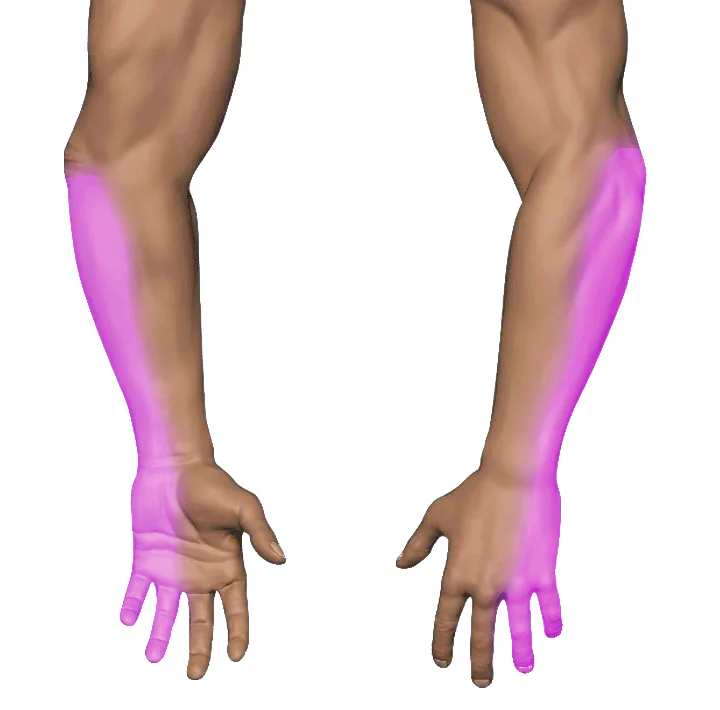
Your ring and pinky fingers go numb or tingly during a long day at the desk. You wake up with that side of your hand "asleep." The Shift and Ctrl keys feel clumsy. Maybe there is an ache on the inside of your elbow or forearm too.
Table of Contents
Intro
This pattern points to the ulnar nerve, the nerve you hit when you bang your "funny bone." At the elbow, it passes through a narrow space called the cubital tunnel. Cubital tunnel syndrome means that nerve is being squeezed or stretched there. It is the second most common nerve entrapment in the arm, after carpal tunnel syndrome [1], but it gets far less attention.
For people who type, mouse, draw or play an instrument, two things usually drive it: long hours with the elbow bent, and tight, tired forearm muscles that sit right on top of the nerve. In our experience, the second one is the most overlooked. When the wrist and finger flexors at the inner elbow run low on endurance, they tighten and crowd the nerve. That is a capacity problem, and it can be trained. This page explains how the nerve and tunnel work, what loads them, what else can cause pinky-side numbness, which tests matter, and when our approach is and is not the right fit.
Disclaimer: The following information is provided for general educational purposes only and should not be considered medical advice. It is not intended to replace consultation with a qualified healthcare professional. If you have specific concerns or questions about your health or medical condition, please seek the guidance of a licensed physician or another qualified medical practitioner. Any reliance you place on the information provided is solely at your own risk. In no event will the author or 1HP be liable for any loss or damage arising from using this information. Always consult with a healthcare professional before starting or changing any medical treatment or regimen.
What 1HP's 2026 Data Shows for Cubital Tunnel Symptoms
In The 1HP Wrist and Hand Pain Report 2026, 3,275 of 5,619 people, or 58%, reported numbness, tingling or another nerve symptom. Among those 3,275 people, the ulnar pattern was the most common at 59%. People could mark more than one nerve, and these were self-reported symptom maps rather than nerve-conduction results or confirmed entrapments.
Among 1,023 coaching applicants, 10 named cubital tunnel syndrome, including 1 who said a doctor or test confirmed it. A separate 11 named ulnar nerve subluxation, neuritis or entrapment, including 6 reported as confirmed. Across all labels, tendon conditions were named more often than nerve conditions, 84 applicants versus 67. This is why pinky-side tingling should be localized rather than assumed to come from the wrist or elbow.
Related case: Watch a case involving cubital tunnel symptoms and forearm capacity. This is one person's experience, not a prediction of another person's outcome. Results vary.
Anatomy and Physiology of the Cubital Tunnel
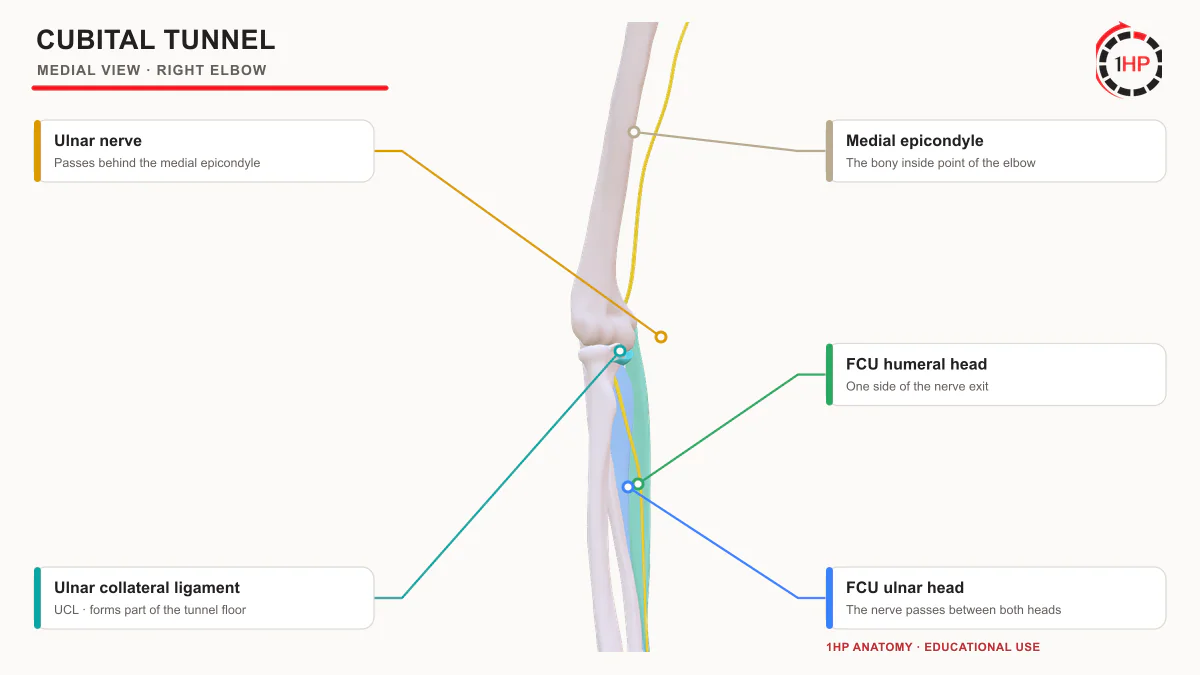
The ulnar nerve starts from the brachial plexus, the bundle of nerves that leaves the neck. It runs down the inside of the upper arm and passes behind the medial epicondyle, the bony bump on the inside of the elbow.
The cubital tunnel is the space it passes through at the elbow:
- Floor: The elbow joint capsule and part of the ulnar collateral ligament.
- Roof: A band called Osborne's ligament (cubital tunnel retinaculum), which connects the two heads of the flexor carpi ulnaris (FCU) muscle.
- Exit: The nerve then dives between the two heads of the FCU into the forearm.
Other possible pressure points along the way include the arcade of Struthers above the elbow and the deep flexor muscle layer in the forearm.
What the ulnar nerve does:
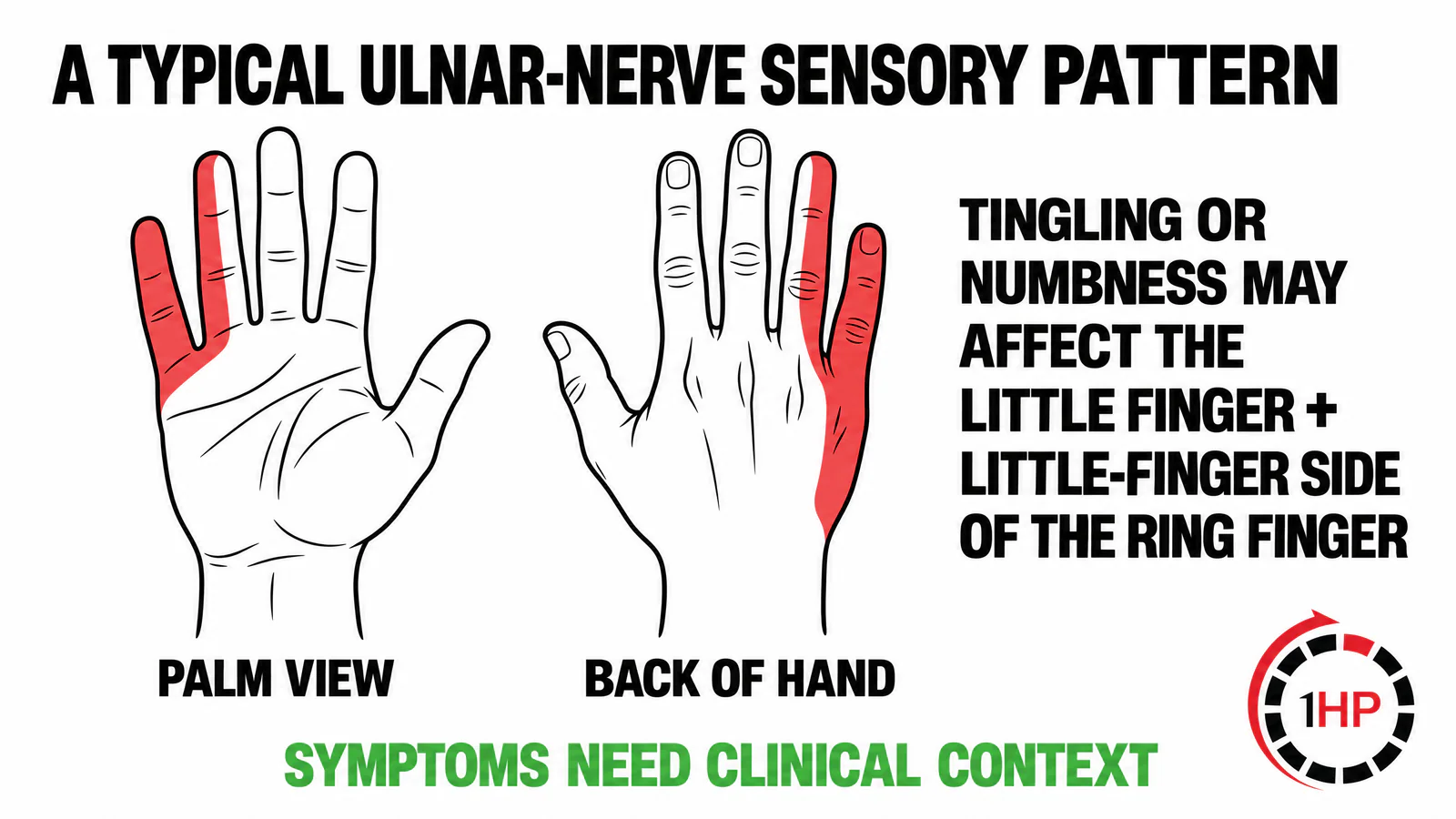
- Feeling: The small finger, the pinky side of the ring finger, and the pinky side of the palm and back of the hand.
- Muscle power: The FCU and part of the deep finger flexor (FDP) for the ring and small fingers in the forearm, and most of the small muscles inside the hand. These hand muscles control fine finger movement, spreading the fingers, and a strong pinch between the thumb and index finger.
Like all nerves, the ulnar nerve needs blood flow and room to glide. Blood flow in the small veins inside a nerve starts to slow at pressures as low as 20 to 30 mmHg [2].
Biomechanics: Elbow Bending, Pressure and Stretch
- Bending the elbow narrows the tunnel and stretches the nerve. In a cadaver study, moving from a straight elbow to a fully bent elbow shrank the tunnel's area by about 30% to 41% and flattened the nerve by up to 50%. Pressure inside the nerve rose early with bending, which suggests that stretch (traction) is a major factor, not just squeezing [3].
- Leaning on the elbow adds outside pressure. Resting the inner elbow on a hard armrest or desk edge presses directly on the nerve.
- Wrist and finger flexor activity adds pressure. The FCU sits right over the nerve. When it contracts hard or stays tight, it tightens the roof of the tunnel and the entry point between its two heads.
- Combined positions are the worst. A bent elbow, a bent wrist, and a hard grip at the same time, such as holding a phone to your ear or face, stack all three.
How Repetitive Strain Causes It (Functional Mechanisms)
- Desk work with bent elbows. A keyboard pulled close, a laptop on your lap, or a mouse held tight with the elbow sharply bent for hours.
- Leaning on the elbow. Hard armrests, desk edges, car door ledges.
- Phone use. Holding a phone to your ear or up to your face with the elbow bent far.
- Gripping work. Mouse, stylus, tools and instruments that keep the wrist and finger flexors firing. Violin and viola left arms, guitar fretting arms, and drummers often hold sharp elbow bends for long periods.
- Sleep position. Sleeping with the arms bent up under the pillow or the hands tucked under the chin. Many people with cubital tunnel notice their worst symptoms in the morning.
- Lifting and climbing. Heavy curls, rows and climbing that load the forearm flexors.
- Gaming after work. Elbows bent and resting on armrests, with a tight grip, for more hours after the workday.
Data from repetitive work populations also link ulnar nerve entrapment at the elbow with factors like higher body weight and sustained elbow and hand loads [4].

Pathophysiology: The Tendinopathy Spectrum and the Healthbar
Why a "Nerve Problem" Starts With Muscles and Tendons
This is the part of cubital tunnel that is most often missed. The muscles that form the roof and entry of the tunnel, mainly the FCU and the rest of the wrist and finger flexors that start at the inner elbow, are some of the hardest-working muscles in a desk worker's arm.
When those muscles run low on endurance, they fatigue early, tighten as a protective response, and stay tight. Their tendons at the inner elbow can become irritated and thickened, the same way any overloaded tendon does. Tight, overloaded flexors raise pressure on the tunnel and reduce the nerve's ability to glide. Add long periods of elbow bending, and the nerve gets both squeezed and stretched.
In our coaching experience with thousands of hand-heavy workers, low wrist flexor endurance is the most common driver of repetitive-strain cubital tunnel symptoms when there is no anatomical cause. That is a clinical observation, not a proven research finding, and it is why we screen for it.
The Healthbar
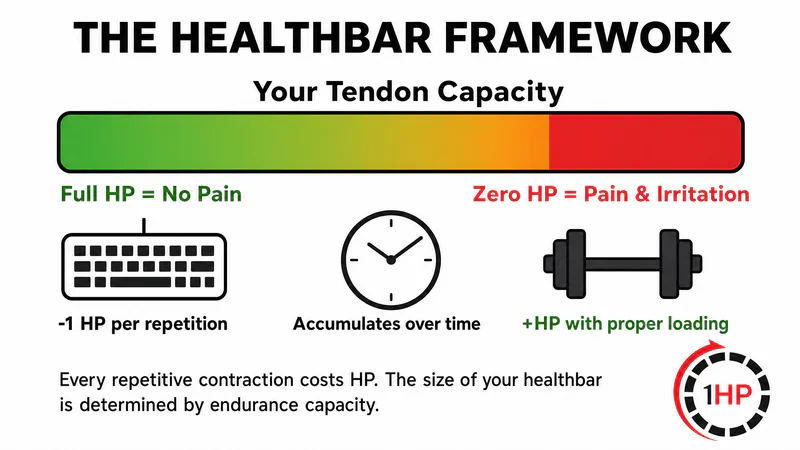
- Your forearm flexors have a healthbar. The size is their endurance capacity.
- Every grip, click and minute of bent-elbow work drains HP. Elbow position, padding and a looser grip lower the drain.
- Breaks and sleep refill HP.
- When HP runs low, the muscles tighten, the nerve gets crowded, and tingling shows up.
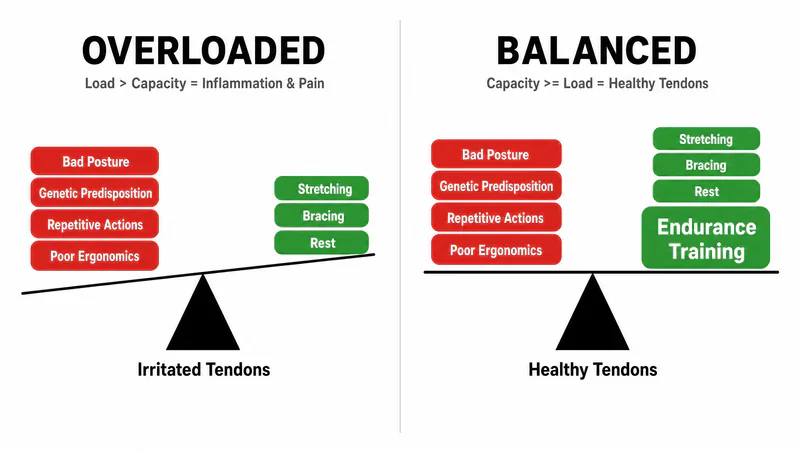
Load > Capacity = Symptoms.
The Tendinopathy Continuum
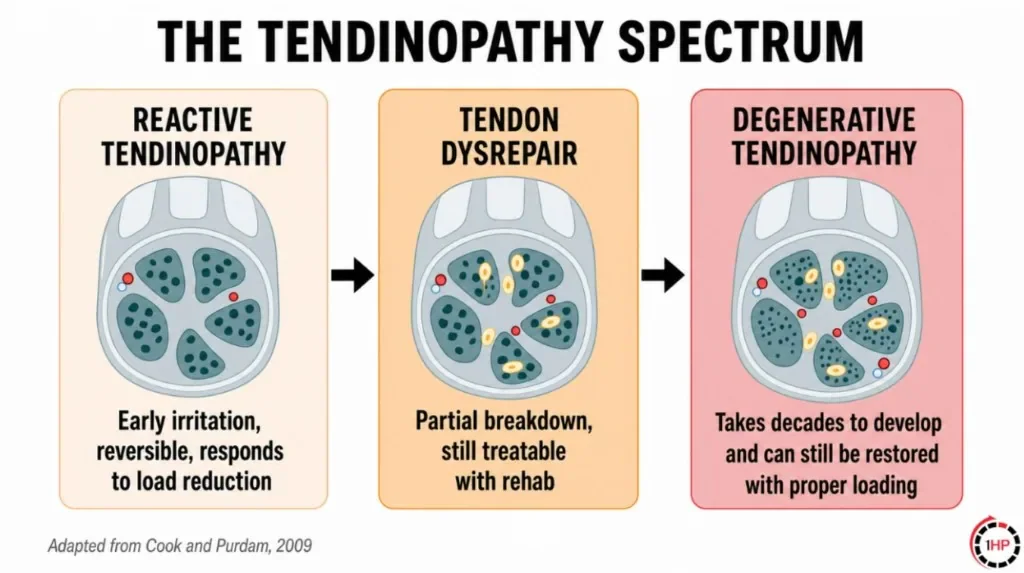
The flexor tendons at the inner elbow follow the same continuum as other tendons [5, 6]:
- Reactive: A short-term swelling response to a spike in load.
- Disrepair: Ongoing overload makes the tendon more disorganized.
- Degenerative: Long-term changes in parts of the tendon, with healthy tissue around them that can still adapt.
After each heavy bout of use, tendon collagen breaks down faster than it rebuilds for roughly the first day [7]. Without enough recovery, overloaded tissue on top of the nerve keeps the cycle going. See inner elbow pain guide.
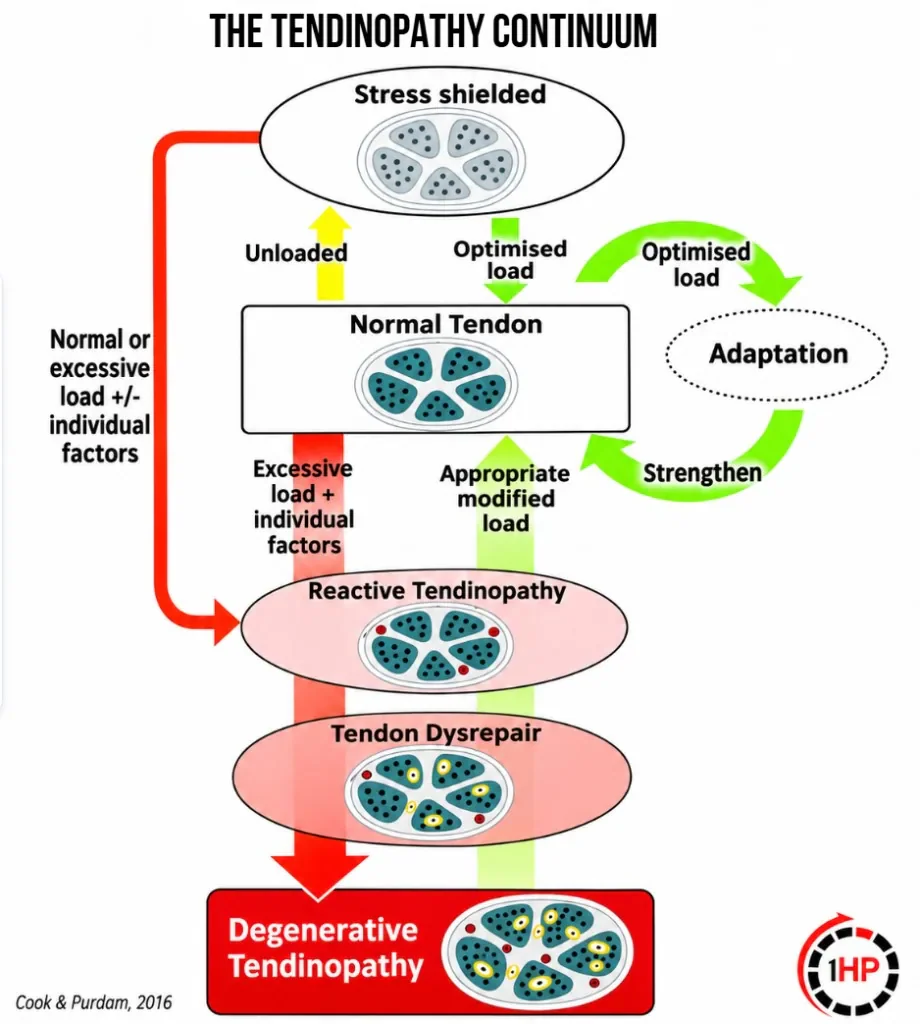
Load, Imbalance and Load Modification
- Volume: Total grip and flexor work per day.
- Position: Total time with the elbow sharply bent.
- Direct pressure: Leaning on the elbow.
- Imbalance: Strong but low-endurance flexors, weak extensors, and weak shoulder and upper back muscles push more work into the forearm.
Additional Pathophysiology: The Nerve
Compression and traction. Pressure and stretch slow blood flow in the nerve, fluid builds inside it, and the nerve becomes more sensitive [2, 3]. Early on, this is reversible. If severe and prolonged, it can damage the nerve, starting with feeling and later affecting muscle strength.
Nerve subluxation. In some people, the ulnar nerve slips forward over the medial epicondyle when the elbow bends, causing a snap or a jolt. This is often an anatomical variation. It can add friction and irritation.
Double crush. A nerve that is irritated at one spot, like the neck or the thoracic outlet, may be more sensitive at another, like the elbow. That is why we check the whole chain. See arm and hand numbness guide.
Advanced signs. Long-standing, severe compression can cause wasting of the hand muscles, especially between the thumb and index finger, and a "claw" position of the ring and small fingers. These signs need a doctor.
Sensitization. After months of symptoms, the nervous system can amplify signals. Tingling can show up faster than tissue changes alone would explain.
Differential Diagnosis
Differential diagnosis means checking whether the same finger symptoms could start at the wrist, elbow, shoulder, neck, or from a body-wide nerve condition. The symptom map helps, but weakness, muscle loss, a lump, or symptoms in both hands and feet need medical assessment.
| Condition | Clues |
|---|---|
| Guyon's canal (ulnar tunnel) syndrome | Numbness in the ring and small fingers but the back of the hand is spared, because the branch to the back of the hand leaves before the wrist. Often from pressure on the heel of the hand (cycling, wrist rests) |
| Cervical radiculopathy (C8 or T1) | Neck pain, symptoms along the inner arm that change with neck movement, possible weakness in more muscle groups |
| Thoracic outlet syndrome | Symptoms across the whole arm, heaviness, worse with arms overhead. The lower part of the brachial plexus feeds the ulnar nerve. See arm and hand numbness guide |
| Medial epicondylalgia (golfer's elbow) | Inner elbow pain with gripping and palm-down turning, without true numbness. Often coexists. See inner elbow pain guide |
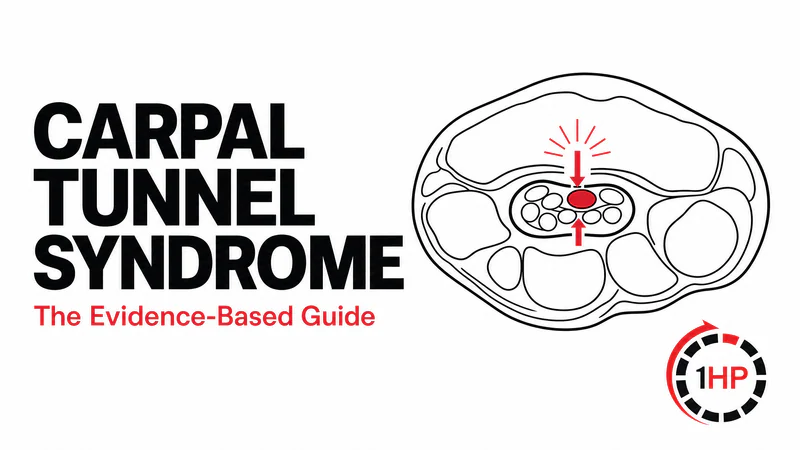
| Carpal tunnel syndrome | Numbness in the thumb, index and middle fingers instead. See carpal tunnel guide |
| Peripheral neuropathy | Numbness in both hands and feet, not tied to elbow position |
| Motor neuron disease or other neurologic conditions | Painless weakness and muscle wasting, twitching, symptoms spreading beyond one nerve. Needs a neurologist |
| Space-occupying lesion | A lump or ganglion near the elbow, symptoms that do not change with position |
Where the 1HP Approach Fits
- May fit after assessment: Mild, intermittent ulnar-nerve symptoms that change with elbow position or activity and occur without constant numbness, progressive weakness, or muscle wasting. Capacity coaching can combine position changes, forearm endurance, and graded exposure. Load-related medial epicondylalgia may also fit, using its own plan.
- Assessment first: Guyon's canal syndrome, cervical radiculopathy, thoracic outlet syndrome, or carpal tunnel symptoms may still be load-sensitive, but the source must be identified because the target and safety checks differ.
- Not a primary fit: Peripheral neuropathy, motor-neuron disease, a mass pressing on the nerve, or a snapping or visibly unstable ulnar nerve needs medical evaluation. Endurance training does not remove a mass, reposition an unstable nerve, or manage a body-wide neurologic disease.
Common Misdiagnoses
1. "It's carpal tunnel." Carpal tunnel affects the thumb side fingers. Ring and small finger numbness is a different nerve. Getting this wrong can lead to treatment aimed at the wrong place.
2. "It's just pain, so it's cubital tunnel." Cubital tunnel is defined by nerve symptoms: numbness, tingling, pins and needles, and sometimes weakness in the ulnar nerve pattern. Inner elbow pain without those signs is more likely a tendon problem [1].
3. "Your nerve test was normal, so it's not your ulnar nerve." Nerve tests can miss mild or position-dependent compression. Symptoms that come with elbow bending and go away when the elbow is straight can still be real ulnar nerve irritation.
4. "You need surgery to move the nerve." Most mild to moderate cases improve with conservative care [8]. When surgery is needed, a Cochrane review found that simply releasing the tunnel and moving the nerve to a new position (transposition) gave similar results, while transposition had more wound infections [9].
Medical Tests That Confirm or Rule Out a Misdiagnosis
- Nerve conduction study and EMG: Measures how well the ulnar nerve conducts across the elbow and whether the hand muscles show signs of losing nerve supply. This is the key test for severity and for deciding about surgery.
- Diagnostic ultrasound: Measures the ulnar nerve's size at the elbow, shows whether the nerve slips over the epicondyle when you bend (dynamic scan), and finds cysts, bone spurs or extra muscles.
- X-ray: For arthritis, bone spurs or old fracture changes at the elbow.
- MRI: For masses, unclear cases, or to look at the nerve and surrounding tissue in detail.
- Neck imaging: If symptoms point to the neck (neck pain, symptoms that change with neck movement, or weakness in other muscle groups).
- Blood tests: If symptoms are in both hands and feet, to check for diabetes, B12 deficiency or thyroid problems.
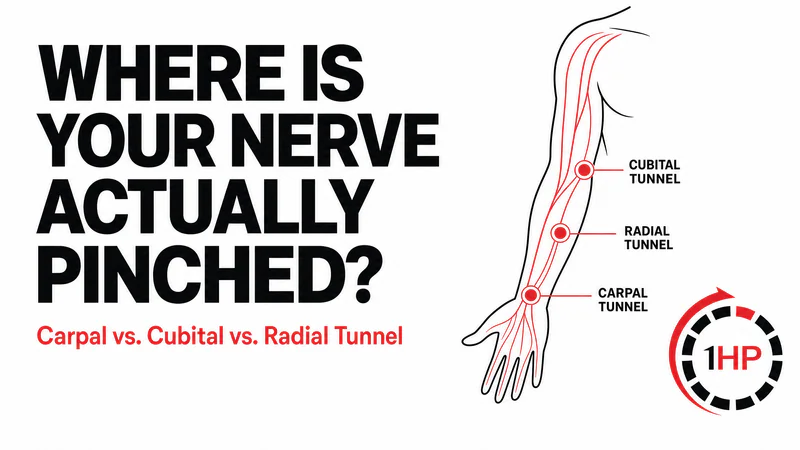
More on nerve testing: EMG & Nerve Tests Explained and Nerve Compression in the Arm: Carpal vs Cubital vs Radial Tunnel.
How 1HP Screens Capacity (Our Testing Philosophy)
- Load story: Hours with bent elbows, armrest and desk contact, phone habits, sleep position, grip-heavy work and hobbies, and when symptoms show up (during the day, after work, at night, in the morning).
- Symptom mapping: Exactly which fingers and which side of the hand. Back of the hand included or not. Elbow, forearm, shoulder or neck involvement.
- Physical therapy special tests: Elbow flexion test (holding the elbows fully bent for 60 seconds), Tinel's sign at the cubital tunnel, pressure provocation, Froment's sign (pinch weakness), finger spread strength, a check for nerve subluxation, upper limb neural tension tests, Guyon's canal screen, and screening of the neck and thoracic outlet.
- Endurance capacity testing: Wrist flexion and grip endurance with a light weight scaled to your body weight, paced by a metronome until fatigue or symptoms show up. Timed isometric holds at moderate effort. We pay close attention to whether tingling appears as the flexors fatigue. Side-to-side comparison and our coaching targets, which are experience-based guides, not published norms.
- Activity tolerance and 24-hour response: Minutes of real desk work before tingling starts, and morning symptoms after a known day.
Commonly Prescribed Treatments: What Works and What Doesn't
| Treatment | What the evidence says | Where it fits |
|---|---|---|
| Education and position changes | In a Cochrane review, information on avoiding prolonged elbow bending and pressure improved symptoms in mild cases. Adding night splints or nerve glides to that information did not add further benefit in the one trial that tested it [9] | Always step one |
| Night splint or elbow pad | Keeps the elbow from bending sharply during sleep. One study found rigid night splinting plus activity changes helped most people with mild to moderate cases [10] | Useful for night and morning symptoms, used as briefly as possible |
| Elbow padding at the desk | Removes direct pressure from armrests and desk edges | Simple and helpful |
| Nerve gliding | Evidence for cubital tunnel specifically is limited and mixed [9, 11] | A comfort tool, not a plan by itself |
| Cortisone injection | One trial found no difference from placebo for ulnar neuropathy at the elbow [9] | Not recommended |
| Surgery (release or transposition) | For severe or progressive cases, muscle wasting, or failed conservative care. Simple release and transposition give similar results [9] | Clear structural cause or significant nerve loss |
| Forearm flexor endurance training | Not yet directly studied in a trial for cubital tunnel. Based on the role of the flexor muscles in forming the tunnel and our clinical experience | The core of our plan for repetitive-strain cases |
What 1HP Recommends
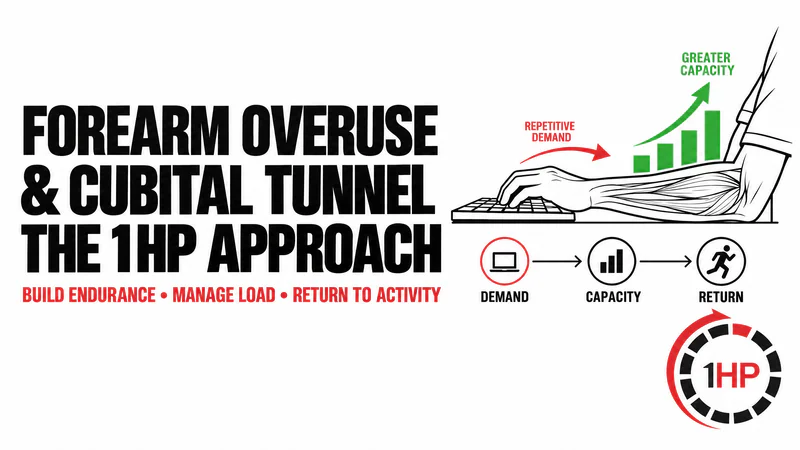
We use the Load Reset Framework: Reset Load, Activate with Isometrics, Build Endurance and Progress, plus nerve-specific position changes. See The Hidden Cause of Cubital Tunnel Syndrome and Forearm Overuse and Cubital Tunnel Syndrome: The 1HP Approach.
Step 1: Reset load and position.
- Open your elbow angle at the desk. Move the keyboard and mouse slightly farther away so your elbows are more open than 90 degrees.
- Get your elbows off hard surfaces. Pad the armrest or use the forearm, not the inner elbow, for support.
- Use earbuds or speakerphone instead of holding the phone to your ear.
- At night, avoid sleeping with your elbows sharply bent. A towel wrapped loosely around the elbow or a soft night splint can help for a few weeks. See How to Sleep With Wrist Pain Without Making It Worse.
- Take movement breaks every 30 to 60 minutes to straighten the arms.
- Keep tingling mild and short-lived. If it lingers for hours after a task, the dose was too high.
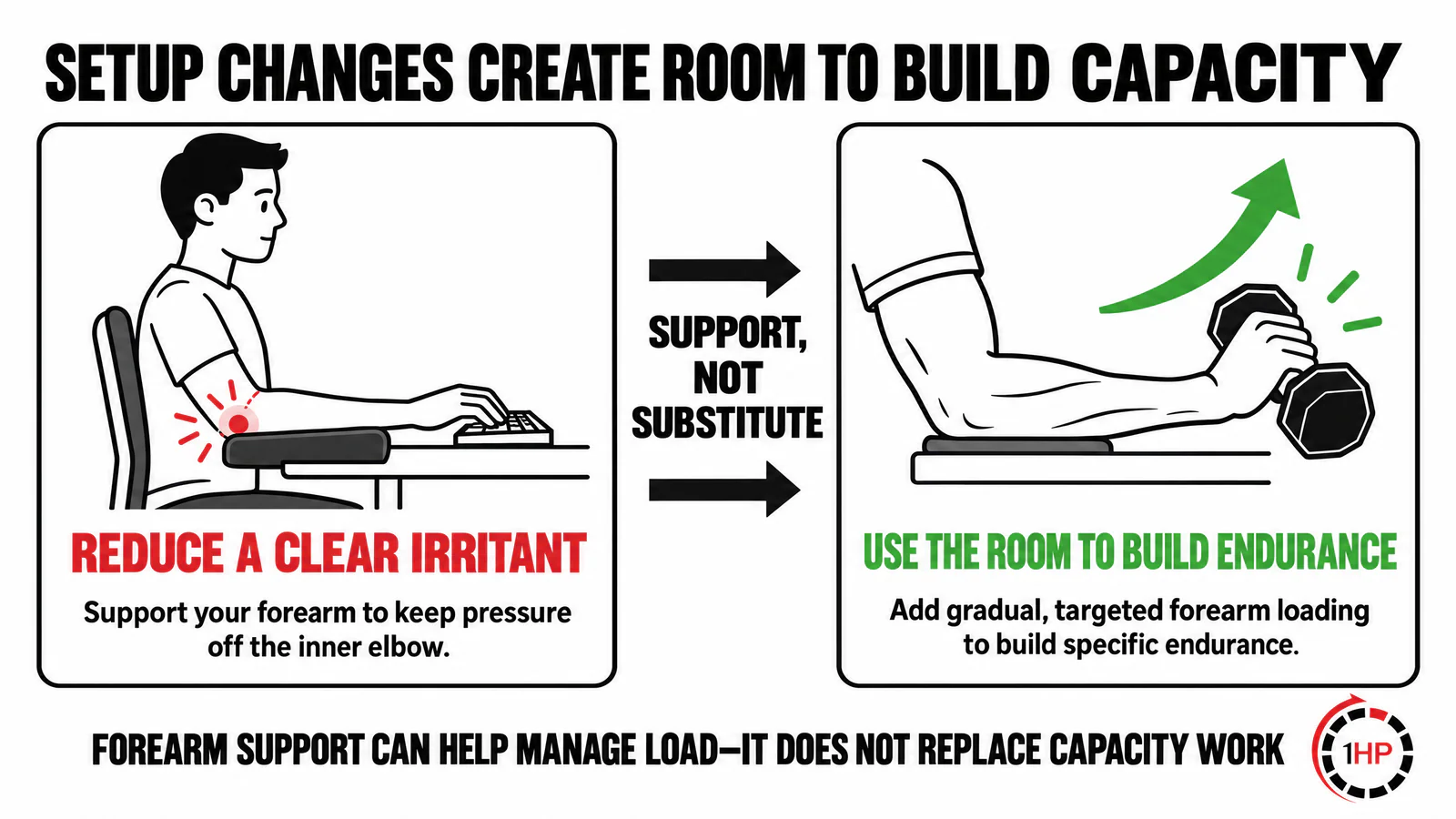
Step 2: Activate with isometrics.
- Light wrist flexion and grip holds, about 45 seconds, 3 sets, at a moderate effort, about half to seven tenths of your maximum, with the elbow comfortably open rather than sharply bent.
Step 3: Build endurance and progress.
- High-repetition, light-weight wrist curls and grip endurance work, paced by a metronome.
- Add the wrist extensors, forearm rotators, and shoulder and upper back endurance.
- Progress reps first, then weight, then elbow positions, then longer real-task blocks.
Step 4: Support tools.
- Gentle ulnar nerve glides (sliders, not aggressive stretching), Wrist Flexor Stretch, and Anterior Forearm Massage to reduce muscle tension over the nerve.
- Track which fingers tingle and when. That pattern tells you which positions and tasks matter most.
What to expect. Nerve symptoms tied to position often ease within a few weeks of changing posture and sleep habits. Building flexor endurance takes longer, often 8 to 12 weeks. Nerves recover more slowly than muscles, so some tingling can linger even as you improve.

Is This Approach Right for You?
Likely a good fit:
- Ring and small finger tingling that comes and goes with elbow bending, desk work, phone use or sleep position.
- Forearm tightness or inner elbow aching along with the tingling.
- A nerve test that was normal, mild or moderate.
- No hand muscle wasting.
Likely NOT a good fit (or not first):
- Visible wasting of the hand muscles (a hollow between the thumb and index finger), a clawed ring and small finger, or constant numbness that does not change with position. See a hand surgeon or neurologist promptly.
- Worsening weakness on nerve testing or signs of denervation on EMG.
- A past elbow fracture or deformity, elbow arthritis with bone spurs, or a mass pressing on the nerve. These are structural causes.
- Previous ulnar nerve surgery with scar tissue around the nerve.
- Symptoms in both hands and both feet or other signs of a body-wide nerve problem. Get a medical workup first.
Red Flags: When to See a Physician
See a doctor before starting if you have:
- Constant numbness that does not change with activity or position
- Worsening weakness, dropping things, or trouble with buttons or keys
- Visible muscle wasting in the hand
- Clawing of the ring and small fingers
- Major swelling or color change
- A recent injury or fall onto the elbow
- Fever
- Severe, unrelenting pain
- Symptoms that wake you every night despite position changes
Go to urgent care or the emergency room for sudden weakness or numbness on one side of the body, facial drooping or trouble speaking.
Frequently asked questions
How should I sleep with cubital tunnel?
Keep your elbows more straight than bent. Avoid tucking your hands under your pillow or chin. A loose towel wrap or a soft night splint for a few weeks can help.
Does leaning on my elbow cause cubital tunnel?
It can contribute. Pressing the inner elbow on a hard surface presses on the nerve. Padding the armrest and supporting your forearm instead helps.
Is it cubital tunnel or carpal tunnel?
Look at which fingers tingle. Ring and small finger points to the ulnar nerve (cubital tunnel). Thumb, index and middle finger points to the median nerve (carpal tunnel).
Why does my elbow snap when I bend it?
In some people, the ulnar nerve slips over the bony bump on the inside of the elbow when it bends. A dynamic ultrasound can confirm it.
Is surgery needed for cubital tunnel?
Most mild to moderate cases improve without surgery. Surgery is considered for muscle wasting, severe or worsening nerve findings, or failed conservative care.
References
- Andrews K, Rowland A, Pranjal A, Ebraheim N. Cubital tunnel syndrome: anatomy, clinical presentation, and management. J Orthop. 2018;15(3):832-836.
- Rydevik B, Lundborg G, Bagge U. Effects of graded compression on intraneural blood flow. J Hand Surg Am. 1981;6(1):3-12.
- Gelberman RH, Yamaguchi K, Hollstien SB, et al. Changes in interstitial pressure and cross-sectional area of the cubital tunnel and of the ulnar nerve with flexion of the elbow. An experimental study in human cadavera. J Bone Joint Surg Am. 1998;80(4):492-501.
- Descatha A, Leclerc A, Chastang JF, Roquelaure Y. Incidence of ulnar nerve entrapment at the elbow in repetitive work. Scand J Work Environ Health. 2004;30(3):234-240.
- Cook JL, Purdam CR. Is tendon pathology a continuum? Br J Sports Med. 2009;43(6):409-416.
- Cook JL, Rio E, Purdam CR, Docking SI. Revisiting the continuum model of tendon pathology. Br J Sports Med. 2016;50(19):1187-1191.
- Magnusson SP, Langberg H, Kjaer M. The pathogenesis of tendinopathy: balancing the response to loading. Nat Rev Rheumatol. 2010;6(5):262-268.
- Kooner S, Cinats D, Kwong C, Matthewson G, Dhaliwal G. Conservative treatment of cubital tunnel syndrome: a systematic review. Orthop Rev (Pavia). 2019;11(2):7955.
- Caliandro P, La Torre G, Padua R, Giannini F, Padua L. Treatment for ulnar neuropathy at the elbow. Cochrane Database Syst Rev. 2016;11:CD006839.
- Shah CM, Calfee RP, Gelberman RH, Goldfarb CA. Outcomes of rigid night splinting and activity modification in the treatment of cubital tunnel syndrome. J Hand Surg Am. 2013;38(6):1125-1130.
- Wolny T, et al. The effects of physiotherapy in the treatment of cubital tunnel syndrome: a systematic review. J Clin Med. 2022;11(14):4247.