Back of Hand Numbness From Repetitive Strain
Wartenberg Syndrome | Superficial Radial Nerve Entrapment | Cheiralgia Paresthetica | Superficial Radial Neuropathy | Handcuff Neuropathy | Wristwatch Neuropathy
By Brett Becker, MS, OTR/L, ACE-CPT, ACE-GFI
Updated November 5, 2026
Quick answer
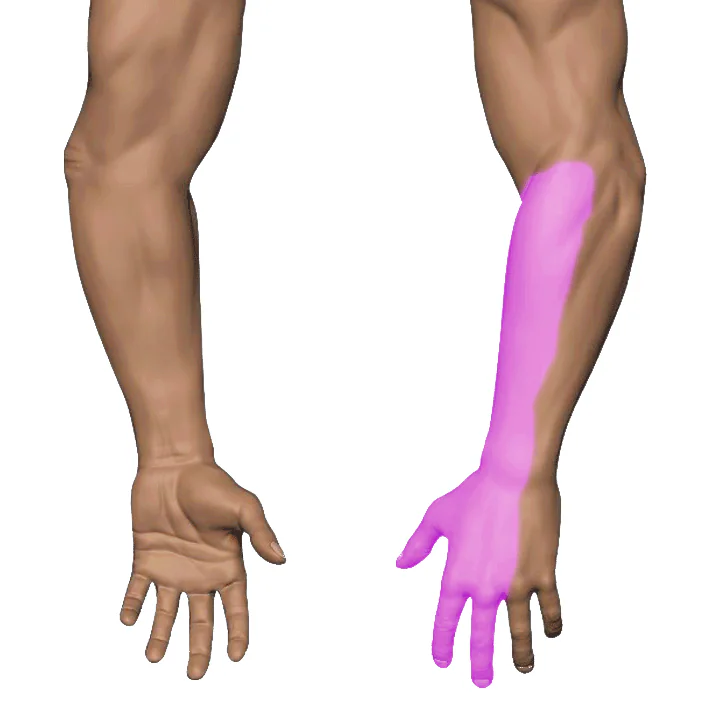
Numbness, tingling or burning on the back of your thumb and the back of your hand. Maybe a sore spot on the thumb side of your forearm a few inches above the wrist. Maybe it gets worse after wearing a watch, a fitness band or a snug sleeve all day, or after hours of typing with your palms down.
Table of Contents
Intro
This pattern points to the superficial branch of the radial nerve. When that nerve is squeezed in the forearm, it is called Wartenberg syndrome, named for the neurologist who described it in 1932. It is much less common than carpal tunnel or cubital tunnel syndrome [1], which is part of why it is so often missed.
The good news is that the most common causes are things you can change: something tight around the wrist, and tight, overworked forearm muscles that pinch the nerve when your palm is turned down. This page explains how the nerve runs, what squeezes it, what else can cause back-of-hand symptoms, which tests help, and when our approach does and does not fit.
Disclaimer: The following information is provided for general educational purposes only and should not be considered medical advice. It is not intended to replace consultation with a qualified healthcare professional. If you have specific concerns or questions about your health or medical condition, please seek the guidance of a licensed physician or another qualified medical practitioner. Any reliance you place on the information provided is solely at your own risk. In no event will the author or 1HP be liable for any loss or damage arising from using this information. Always consult with a healthcare professional before starting or changing any medical treatment or regimen.
What 1HP's 2026 Data Shows for Back-of-Hand Numbness
In The 1HP Wrist and Hand Pain Report 2026, 3,275 of 5,619 people, or 58%, reported numbness, tingling or another nerve symptom. Among those 3,275 people, 44% marked a radial nerve pattern on the back of the hand. People could mark more than one nerve, and these were self-reported symptom maps rather than nerve-conduction results or confirmed diagnoses.
Among 1,023 coaching applicants, 6 named radial tunnel or radial nerve compression, including 3 who said a doctor or test confirmed it. Radial tunnel is a different, more proximal radial nerve problem, and Wartenberg syndrome was not counted as its own diagnosis row. This means the applicant count is not a Wartenberg estimate. Across all labels, applicants named tendon conditions more often than nerve conditions, 84 versus 67.
Anatomy and Physiology of the Superficial Radial Nerve
The radial nerve comes from the brachial plexus near the neck and wraps around the back of the upper arm. Just past the elbow, it splits into two branches:
- The deep branch (posterior interosseous nerve, PIN): A motor branch that powers the muscles that lift the wrist, fingers and thumb. It does not carry skin feeling.
- The superficial branch: A sensory branch. It carries feeling from the back of the thumb, index finger, middle finger and the thumb-side half of the ring finger (up to about the middle knuckle), plus part of the back of the hand and a small area on the palm side of the thumb.
Wartenberg syndrome involves only the superficial branch. That is why it causes numbness, tingling and burning but not weakness.
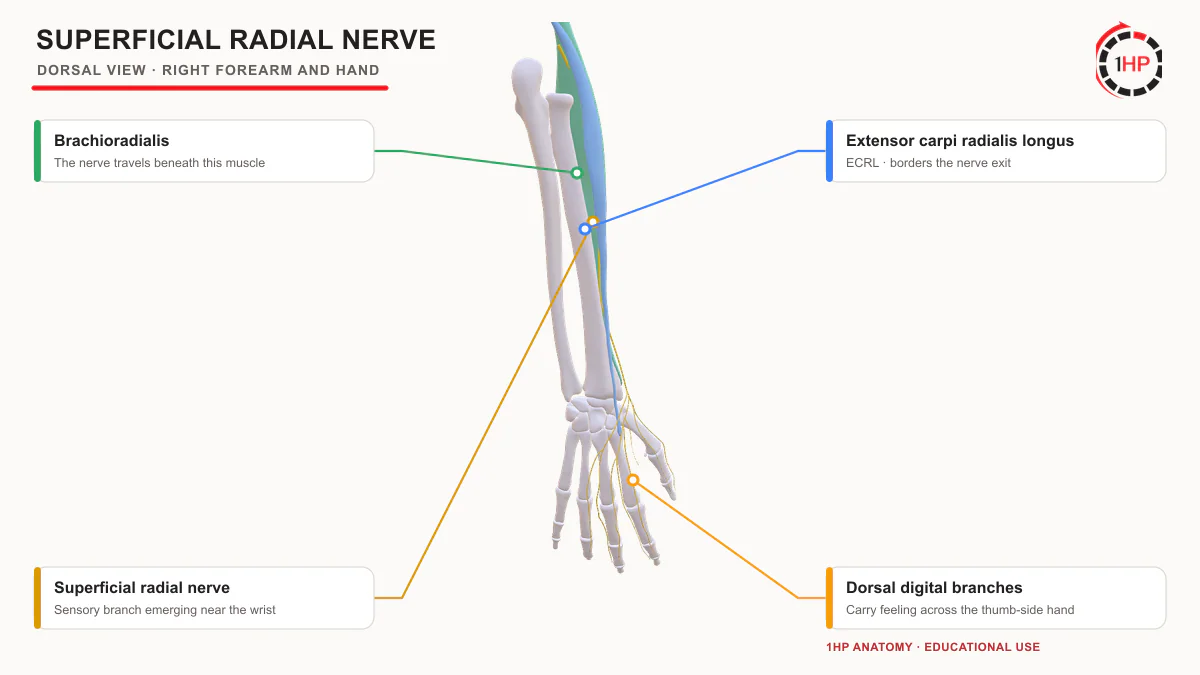
On its way down the forearm, the superficial branch travels under the brachioradialis muscle. About 9 cm (3.5 inches) above the wrist, it comes out from under the fascia between two tendons:
- Brachioradialis: Helps bend the elbow, especially with the thumb pointing up.
- Extensor carpi radialis longus (ECRL): Lifts the wrist and tips it toward the thumb.
From there, the nerve runs just under the skin over the thumb side of the wrist. There is very little padding to protect it, which is why a tight watch, a band or a cast can press on it so easily. Some people also have anatomical variations, like a doubled nerve branch or an extra muscle belly, that make the space tighter [2].
Biomechanics: Scissors, Straps and Palm-Down Work
- Pronation closes the scissors. When you turn your palm down, the brachioradialis and ECRL tendons move closer together and can pinch the nerve between them like the blades of scissors [1, 3]. Typing and mousing happen palm down.
- Wrist bending toward the pinky stretches the nerve. Tipping the wrist toward the pinky side (ulnar deviation) and bending it down pull on the nerve where it exits the fascia. Combining pronation with that wrist position is the classic provoking position.
- External pressure is direct. A watch, fitness tracker, bracelet, glove cuff, compression sleeve or tight splint can press right on the nerve where it has little protection.
- Tight, tired muscles add pressure. When the brachioradialis and ECRL are overworked and low on endurance, they tighten and close the scissors further.
How Repetitive Strain Causes It (Functional Mechanisms)
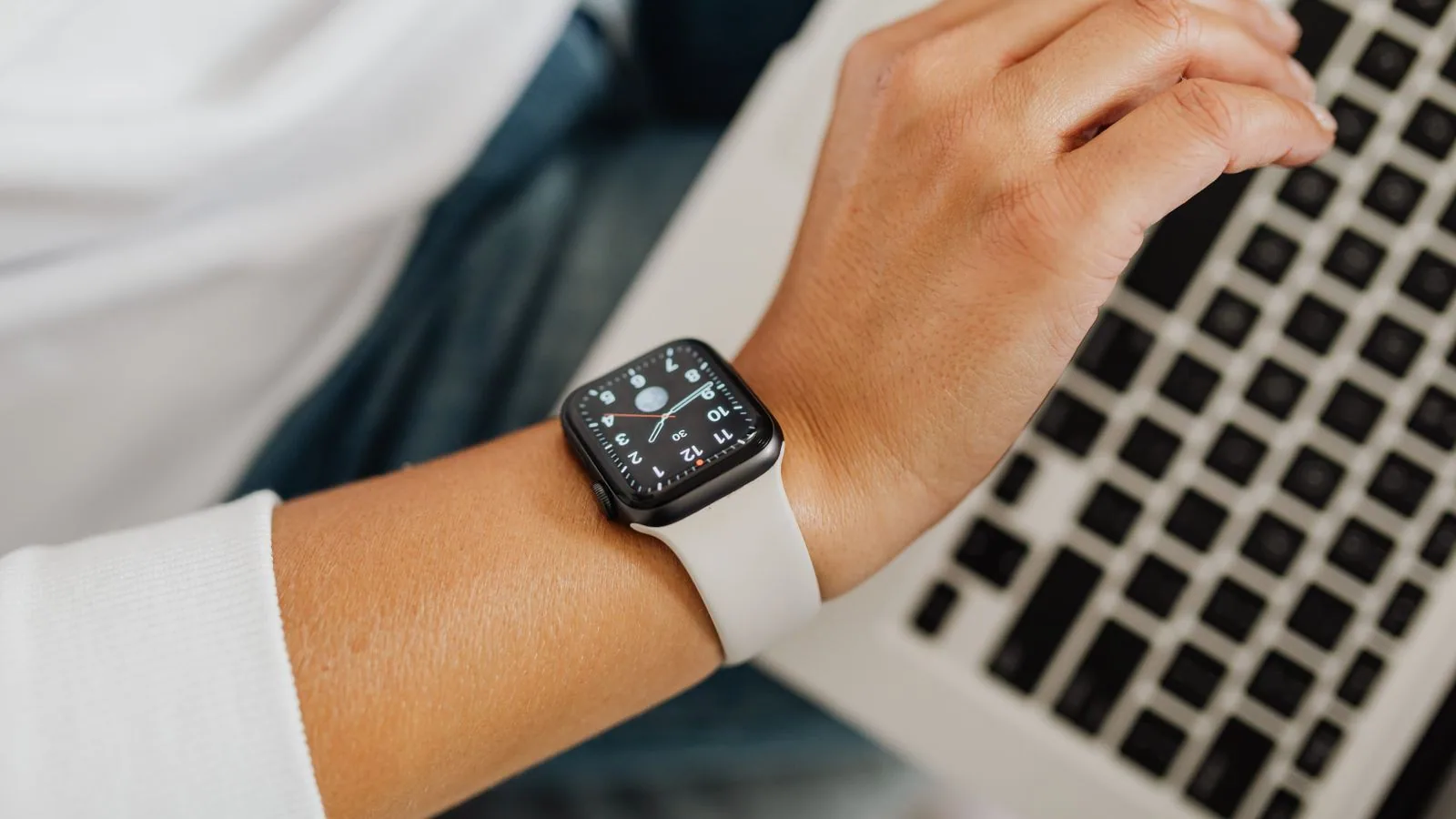
- Wearables and anything snug at the wrist. Watches, fitness trackers, bracelets, wrist sweatbands, glove cuffs and compression sleeves. This is the most common cause [1, 4]. Symptoms often show up during the day after wearing a watch for hours, unlike carpal and cubital tunnel symptoms, which often show up at night.
- Palm-down desk work. Long hours of typing and mousing keep the forearm pronated.
- Thumb-side wrist motion. Moving the mouse with the wrist, using a stylus, and repeated twisting tasks load the brachioradialis and ECRL.
- Tight splints. A thumb or wrist splint worn for another problem, like De Quervain's, can press on the nerve.
- Instruments and hands-on work. Violin and viola, guitar, dental tools, screwdrivers and other tasks with repeated forearm rotation.
- Gaming after work. Snug sleeves or gloves and hours with the palms down on top of a workday.
Pathophysiology: The Tendinopathy Spectrum and the Healthbar
How a Nerve Problem Ties Back to Muscle and Tendon Load
When the cause is not a watch or a band, the most common driver we see in desk and hand-heavy workers is overloaded forearm muscles. The brachioradialis and ECRL work every time you lift your wrist, move a mouse toward your thumb, or stabilize the forearm while typing. When their endurance is lower than the day demands, they fatigue, tighten, and their tendons can get irritated, the same way other overloaded tendons do. Tighter, bulkier tissue around the nerve's exit point means more pressure on the nerve, especially in palm-down positions.
The Healthbar
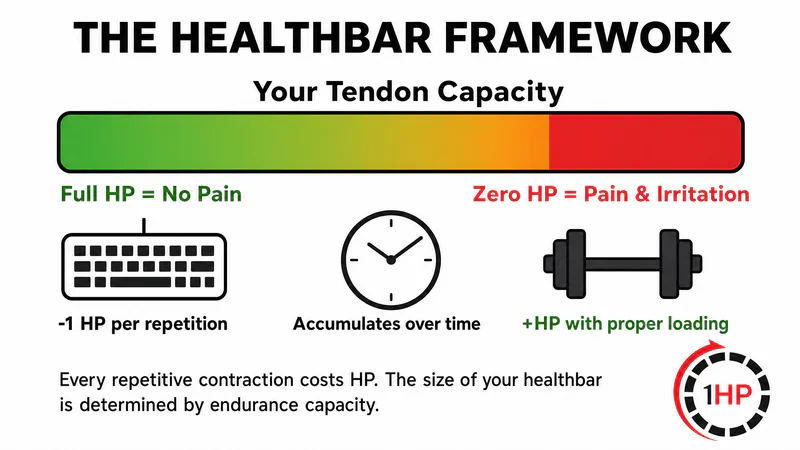
- Your thumb-side forearm muscles have a healthbar. The size is their endurance capacity.
- Every palm-down hour, mouse move toward the thumb and twist drains HP. Loosening wearables and changing forearm position lower the drain.
- Breaks and sleep refill HP.
- When HP runs low, the muscles tighten, the nerve gets crowded, and you feel burning, tingling or numbness on the back of the hand.
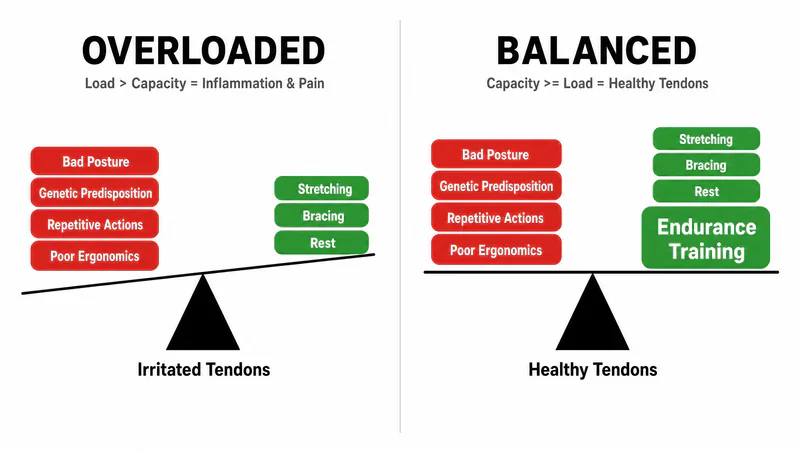
Load > Capacity = Symptoms.
The Tendinopathy Continuum
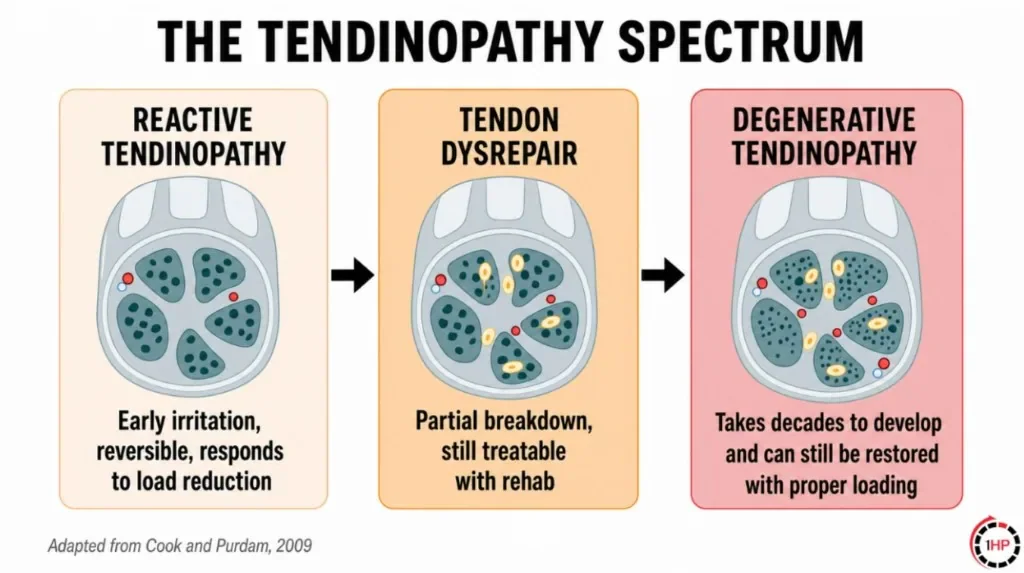
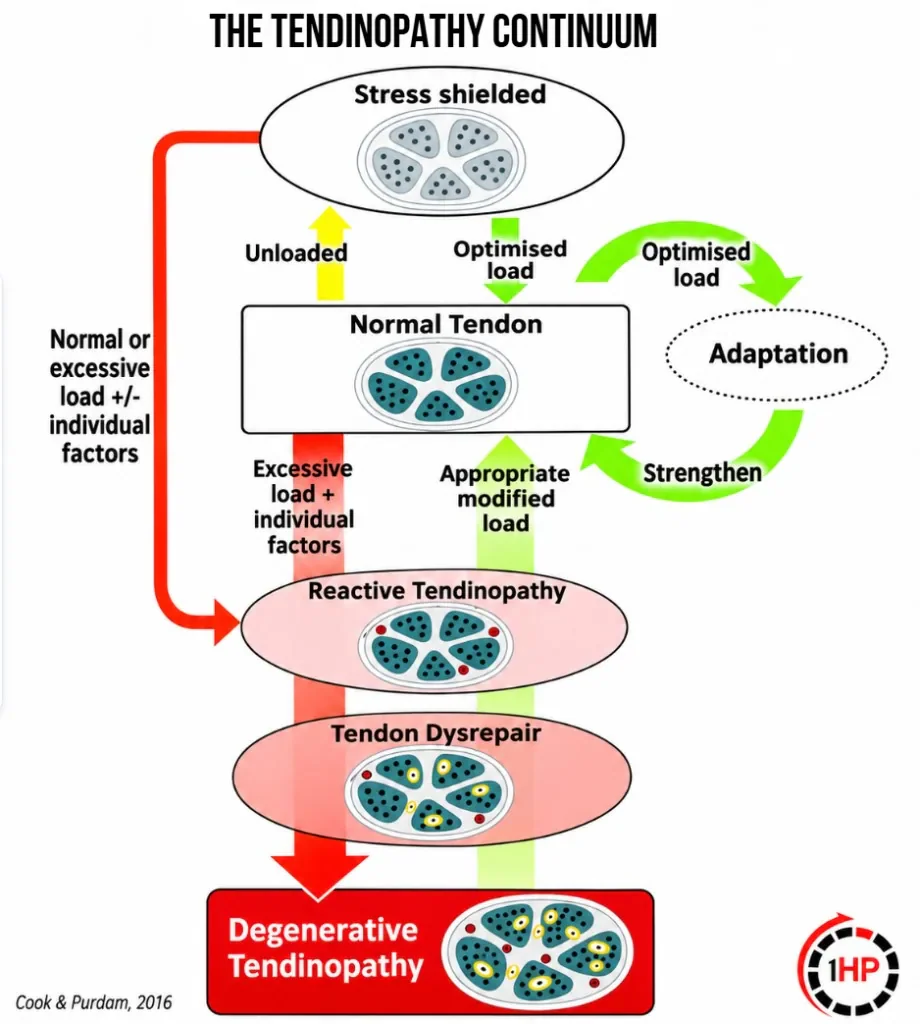
The ECRL and brachioradialis tendons follow the same continuum as other tendons [5, 6]: a reactive swelling response to a spike in load, disrepair with ongoing overload, and longer-term degenerative change with healthy tissue around it that can still adapt. Tendon collagen breaks down faster than it rebuilds for roughly the first day after a heavy session, so recovery time between heavy days matters [7].
Additional Pathophysiology: The Nerve
Compression and blood flow. Pressure on a nerve slows the blood flow inside it, starting at fairly low pressures, and fluid can build inside the nerve [8]. Early on, removing the pressure lets the nerve recover. Prolonged or severe pressure can cause longer-lasting symptoms.
Nerve glide. The superficial radial nerve has to slide a little with every wrist and forearm movement. Tight tissue at its exit point can limit that glide.
Overlap with De Quervain's. The nerve runs right over the first dorsal compartment, where De Quervain's happens. Swelling there, or a tight thumb splint used to treat it, can irritate the nerve. It is common to have both at once. See back side thumb pain guide.
Sensitization. Burning nerve pain can make the area very sensitive to light touch. That sensitivity often calms as the pressure is removed and the nervous system settles.
Differential Diagnosis
Differential diagnosis means comparing nerve and tendon problems that overlap around the thumb side of the wrist and hand. Numbness versus movement pain, the palm versus the back of the hand, weakness, and a recent procedure or injury help locate the likely source.
| Condition | Clues |
|---|---|
| De Quervain's tenosynovitis | Sharp pain with thumb and wrist movement, swelling over the radial styloid. Pain more than numbness. See back side thumb pain guide |
| Intersection syndrome | Pain, swelling or squeaking higher up the back of the forearm about 4 to 6 cm above the wrist. Should not cause numbness. See Intersection Syndrome |
| Carpal tunnel syndrome | Numbness on the palm side of the thumb, index and middle fingers, often at night. See carpal tunnel guide |
| Cervical radiculopathy (C6) | Neck pain, numbness in the thumb and index finger on both sides of the hand, changes with neck movement, weakness or reflex changes |
| Thoracic outlet syndrome | Symptoms across the whole arm, heaviness, worse with arms overhead. See arm and hand numbness guide |
| Posterior interosseous nerve (PIN) problem | Weakness lifting the fingers or thumb, usually without numbness |
| Lateral antebrachial cutaneous nerve irritation | Numbness along the thumb side of the forearm rather than the back of the hand |
| Ganglion cyst or mass | A lump near the thumb side of the wrist pressing on the nerve |
| Nerve injury after surgery, injury or an IV line | Symptoms that started after a wrist fracture, a procedure on the thumb side of the wrist, or an IV in that area |
Where the 1HP Approach Fits
- Often a fit after assessment: Mild, intermittent superficial-radial-nerve symptoms that change with a watch, wrist position, forearm load, or activity and occur without weakness or a fixed mass. Capacity coaching can remove pressure triggers, build forearm tolerance, and grade activity.
- A different 1HP pathway may fit: Load-related De Quervain or intersection-syndrome pain can use tendon-focused capacity work, but those conditions cause pain rather than true numbness.
- Assessment first: Carpal tunnel, cervical radiculopathy, thoracic outlet syndrome, and lateral antebrachial cutaneous nerve irritation start elsewhere and need a different target.
- Not a primary fit: PIN weakness, a ganglion or other mass pressing on the nerve, or nerve injury after surgery, fracture, or an IV needs medical evaluation. Endurance training does not remove a mass or repair a directly injured nerve.
Common Misdiagnoses
1. "It's carpal tunnel." Carpal tunnel numbness is on the palm side. Wartenberg numbness is on the back of the hand. Wrist braces used for carpal tunnel can actually make Wartenberg worse by pressing on the nerve.
2. "It's De Quervain's." They overlap in location and can coexist, but De Quervain's is a tendon problem with sharp pain on movement. Wartenberg is a nerve problem with burning, tingling or numbness. Treating only one can leave the other behind.
3. "It's in your neck." A C6 nerve root problem can cause thumb and index finger symptoms, but it usually comes with neck pain, symptoms on both sides of the hand, and sometimes weakness or reflex changes. Wartenberg only affects feeling and gets worse with wrist and forearm position or a tight band.
4. "It's just tendonitis." When the main symptom is pain without numbness, a tendon problem is likely. When there is numbness, tingling or burning on the back of the hand, the nerve needs to be considered too.
Medical Tests That Confirm or Rule Out a Misdiagnosis
- Clinical exam: Wartenberg is mainly diagnosed by history and exam, including a positive Tinel's sign over the nerve and symptoms with the hyperpronation test.
- Nerve conduction study: Can show slowing in the superficial radial sensory nerve compared with the other side. It also helps rule out carpal tunnel, cervical radiculopathy and broader nerve problems.
- Diagnostic ultrasound: Can show nerve swelling, the scissoring point between the brachioradialis and ECRL, anatomical variations, and cysts or masses pressing on the nerve.
- Diagnostic nerve block: In unclear cases, a doctor may numb the nerve to see if symptoms disappear.
- Neck evaluation: If symptoms suggest a nerve root problem.
See EMG & Nerve Tests Explained.
How 1HP Screens Capacity (Our Testing Philosophy)
- Load story: Watches, trackers, bracelets, sleeves and splints. Palm-down hours. Mouse style. Twisting tasks and instruments. When symptoms show up (often during the day after wearing something snug).
- Symptom mapping: Back of the thumb and hand versus palm side versus forearm. Any weakness.
- Physical therapy special tests: Tinel's sign over the superficial radial nerve, the hyperpronation test (turning the palm down hard with the wrist tipped toward the pinky to see if symptoms appear), Finkelstein's test (which can be positive in both De Quervain's and Wartenberg), radial nerve neural tension testing, De Quervain's and intersection syndrome screens, a PIN strength screen, and a neck screen.
- Endurance capacity testing: Wrist extension and radial deviation (lifting the wrist and tipping it toward the thumb) with a light weight scaled to your body weight, and forearm rotation with a light weight, paced by a metronome until fatigue or symptoms show up. Timed isometric holds at moderate effort. Side-to-side comparison and our coaching targets, which are experience-based guides, not published norms.
- Activity tolerance and 24-hour response: How long you can type, mouse or play before symptoms show up, with and without your usual wearables.
Commonly Prescribed Treatments: What Works and What Doesn't
| Treatment | What the evidence says | Where it fits |
|---|---|---|
| Remove or loosen the compression | Removing watches, bands or tight splints is the first and most important step in reviews of superficial radial nerve entrapment [1, 3] | Always step one |
| Wrist or thumb splint | Can make things worse if it presses on the nerve. Some doctors use a loose splint to limit provoking positions | Use with caution, never tight |
| Activity and position changes | Less time with the palm hard down and the wrist tipped toward the pinky | Helpful |
| Cortisone injection | Sometimes used around the nerve. Evidence is limited | Not first line |
| Nerve gliding | Used to restore nerve movement. Evidence is limited, as with most nerve glide research [9] | A comfort tool inside a bigger plan |
| Surgery (nerve release) | For cases that do not improve after several months of conservative care, or with a clear structural cause [1, 3] | After well-run conservative care fails |
| Forearm endurance training | Not directly studied for Wartenberg. Based on the role of the brachioradialis and ECRL in pinching the nerve and our clinical experience | Core of our plan when overloaded muscles are part of the picture |
What 1HP Recommends
We use the Load Reset Framework, with compression removal first. See Why the Back of your Hand Hurts (And What To Do About It!).
Step 1: Remove compression and reset load.
- Take off or loosen watches, trackers, bracelets and tight sleeves. Move a watch higher on the forearm or to the other wrist. Give the nerve a few hours a day with nothing on the wrist.
- Check any splint you wear for another problem. It should never press on the thumb side of the forearm.
- Reduce time with the palm hard down. Try a slightly tilted keyboard position, a vertical mouse for part of the day, and moving the mouse with the forearm instead of tipping the wrist toward the pinky.
- Keep symptoms brief and mild. If burning or tingling lasts for hours after a task, the dose was too high.
Step 2: Activate with isometrics.
- Light wrist extension, radial deviation and elbow flexion holds with the thumb pointing up, about 45 seconds, 3 sets, at a moderate effort, about half to seven tenths of your maximum. These load the brachioradialis and ECRL without a lot of nerve stretch.
Step 3: Build endurance and progress.
- High-repetition, light-weight wrist extension, radial deviation and hammer curls, paced by a metronome.
- Add forearm rotation endurance and grip work.
- Progress reps first, then weight, then real task time.
Step 4: Support tools.
- Gentle radial nerve gliding (sliders, not aggressive stretching).
- Light massage of the brachioradialis and the thumb side of the forearm, and heat before long sessions. See Posterior Forearm Massage.
What to expect. When a watch or band is the main cause, symptoms often ease within days to a few weeks after removing it. When overloaded forearm muscles are involved, building endurance takes longer, often 6 to 12 weeks. Nerve symptoms can lag behind muscle gains.
Is This Approach Right for You?
Likely a good fit:
- Burning, tingling or numbness on the back of the thumb and hand that changes with wearables, palm-down work or wrist position.
- Tenderness on the thumb side of the forearm a few inches above the wrist.
- No weakness.
- Symptoms that ease when you take off your watch or change position.
Likely NOT a good fit (or not first):
- Symptoms that started after a wrist fracture, surgery on the thumb side of the wrist, a cut, or an IV line. That may be a direct nerve injury and needs a hand surgeon.
- Constant numbness that stays the same even weeks after removing all compression.
- Weakness lifting the fingers or thumb. That points to the deep branch (PIN) or the neck, not Wartenberg.
- A lump pressing on the nerve. Get it imaged.
- Signs of a neck problem, like neck pain with arm symptoms that change when you move your head.
Red Flags: When to See a Physician
See a doctor before starting if you have:
- Constant numbness that does not change with activity or after removing wearables
- Worsening weakness
- Visible muscle wasting
- Major swelling or color change
- A recent injury, fall, surgery or IV in the area
- Fever
- Severe, unrelenting pain
- Symptoms that wake you every night
Go to urgent care or the emergency room for sudden weakness or numbness on one side of the body, facial drooping or trouble speaking.
Frequently asked questions
Can a watch cause hand numbness?
Yes. A snug watch, tracker or bracelet can press on the superficial radial nerve where it sits just under the skin on the thumb side of the wrist. This is the most common cause of Wartenberg syndrome.
Will numbness go away after I take off my watch?
Often, yes, within days to a few weeks. If it does not improve after several weeks with nothing on the wrist, see a doctor.
Is Wartenberg syndrome serious?
It is usually not dangerous, because it affects feeling, not strength. It can be very uncomfortable, and lasting symptoms should be checked.
Is back of hand numbness the same as carpal tunnel?
No. Carpal tunnel affects the palm side of the thumb, index and middle fingers. Wartenberg affects the back of the thumb and hand.
Why does the back of my thumb tingle when I type?
Typing keeps your palms turned down, which can bring the two forearm tendons around the nerve closer together. If those muscles are tired and tight, or you are wearing something snug, the nerve gets pinched.
References
- Dang AC, Rodner CM. Unusual compression neuropathies of the forearm, part I: radial nerve. J Hand Surg Am. 2009;34(10):1906-1914.
- Herma T, Slezak J, Baca V, Kachlik D. Duplicated superficial branch of the radial nerve and brachioradialis muscle belly: prevalence and significance. Folia Morphol (Warsz). 2023;82(3):558-561.
- Lanzetta M, Foucher G. Entrapment of the superficial branch of the radial nerve (Wartenberg's syndrome). Int Orthop. 1993;17(6):342-345.
- Shields LBE, Iyer VG, Zhang YP, Shields CB. Etiological study of superficial radial nerve neuropathy: series of 34 patients. Front Neurol. 2023;14.
- Cook JL, Purdam CR. Is tendon pathology a continuum? Br J Sports Med. 2009;43(6):409-416.
- Cook JL, Rio E, Purdam CR, Docking SI. Revisiting the continuum model of tendon pathology. Br J Sports Med. 2016;50(19):1187-1191.
- Magnusson SP, Langberg H, Kjaer M. The pathogenesis of tendinopathy: balancing the response to loading. Nat Rev Rheumatol. 2010;6(5):262-268.
- Rydevik B, Lundborg G, Bagge U. Effects of graded compression on intraneural blood flow. J Hand Surg Am. 1981;6(1):3-12.
- Basson A, Olivier B, Ellis R, et al. The effectiveness of neural mobilization for neuromusculoskeletal conditions: a systematic review and meta-analysis. J Orthop Sports Phys Ther. 2017;47(9):593-615.