Table of Contents
The Real Cost of 6 Years of Wrist Pain: Visits, Braces and Scans
By Dr. Elliot Smithson, PT, DPT, MS, ATC, EMT·
Quick answer
Years of wrist pain cost far more than any single bill shows. Premiums, co-pays, repeat visits, scans, braces and injections stack up every year, and lost work hours and confidence never get itemized.
Last updated: . Figures reviewed as of November 2026.
Key stats at a glance (as of 2026):
- 19.1% of adults have wrist pain, according to a 2024 American Journal of Managed Care (AJMC) study of 867,119 adults in the IBM MarketScan Research Databases.
- In that AJMC cohort, 52.6% of the 40,164 people who had a wrist MRI got a study the American College of Radiology (ACR) Appropriateness Criteria rate as inappropriate, worth $44,493,234 in total payments and $8,307,540 out of pocket.
- One wrist MRI averaged $1,522 in total payments and $395 out of pocket (2020 US dollars).
- Immediate carpal tunnel surgery was the costliest strategy in a 2017 NYU Langone Orthopedic Hospital analysis published in HAND, at $2,149 to $9,927 per patient.
- A 2018 University of Pittsburgh Medical Center (UPMC) model found that carpal tunnel syndrome (CTS) that stays symptomatic but stable costs $3,846.72 a year, equal to 2 missed workdays a month.
- According to the Bureau of Labor Statistics (BLS), people with CTS missed 28 days of work in 2015.
- Among 229 members of 1HP's programs (August 2025 to November 2026), 75% of those aged 35 to 44 had been in pain for more than a year before joining (The 1HP Wrist and Hand Pain Report 2026).
Repetitive strain injury (RSI) is an overuse problem that shows up when the load on your wrist's muscles and tendons runs higher than their endurance. An inappropriate MRI is a scan the ACR criteria do not support for that situation, most often because no X-ray came first.
Most of that spend buys relief, not capacity. On a 2025 orthobiologics podcast, a regenerative medicine physician said people would choose "a shot as opposed to a surgery." I get it. Neither one trains your tendons for a full workday, and building that endurance is the exit. At 1HP, people start with a free consultation.
If you have added up years of wrist pain and winced at the total, you are not alone. Try listing every wrist cost from the last year on one page. Spending tends to drip in: a co-pay here, a brace there, another scan that comes back clean.
In our 1HP YouTube video on the yearly cost of wrist pain, our experts break the spending into pieces most people never total up. Injections, including PRP and corticosteroid shots, can run $50 to $3,000. Surgery itself can run $1,000 to $8,000 plus. The video calls this cycle what we call the healthcare hamster wheel: repeat visits, limited progress, and more confusion about what is going on with each lap. It feels like grinding the same dungeon for six years and never leveling up.
Our own data shows how long people stay on that wheel. In The 1HP Wrist and Hand Pain Report 2026, we found that among 229 program members (August 2025 to November 2026), the share who had been in pain for more than a year before joining was 60% at ages 18 to 24, 59% at 25 to 34 and 75% at 35 to 44. Long pain is the norm by the time people reach us, not the exception. I think that says more about the system than about the people stuck in it. In my view, a year of pain is usually a year of band-aids, not a year of bad luck.
The good news is that a long history did not lock anyone out. Our analysis of follow-up surveys found that 58% of members in pain for more than a year reached a meaningful improvement of 8 or more QuickDASH points (106 members, among 148 program members with a follow-up survey, both programs combined). In The 1HP Clinical Outcomes Report 2026, we found that in Power Leveling alone, 69% of members in pain for more than a year got there, among members who completed follow-up. Results vary. I find that encouraging, because it suggests the length of the history matters less than what you do next. I'd argue that is the most hopeful number in this whole article.
Some of the biggest costs never show up on a bill. Long-running pain can bring anxiety, fear and mood changes, and many people start skipping the gym or gaming, the very things they used to lean on for stress relief.
One writer's 2025 account of a single hand problem reads like a receipt. ER visits, X-rays, MRIs, casts and wrist splints, orthopedist visits, hand therapy sessions.
Scans stack up fastest. Even for an acute wrist or hand injury, the American College of Radiology (ACR) Appropriateness Criteria expert panel rates a plain X-ray as the only "Usually Appropriate" first test. It rates a bone scan "Usually Not Appropriate" in all seven injury scenarios it reviewed, which tells you how often the fancier option is the extra spend rather than the answer. Physio Matters, writing on the MSKMag Substack in February 2025, argues that fewer add-ons mean less discomfort and less cost, and I agree with them.
This is where I part ways with the usual advice. The common belief is that an MRI is the thorough, careful choice. The data says otherwise: in the 2024 American Journal of Managed Care (AJMC) study of IBM MarketScan claims, 52.6% of wrist MRIs were inappropriate, most often because no X-ray came first. The second belief I'd push back on is that braces and rest are the cheap, safe option. Contrary to popular belief, staying stuck is the expensive path. The 2018 University of Pittsburgh Medical Center (UPMC) model by Alexandra Gabrielli, Alex Lesiak and John Fowler, published in HAND, priced carpal tunnel syndrome that stays symptomatic but stable at $3,846.72 a year, every year it lingers. A brace can help at night, but it does not build capacity, so the bill keeps coming.
Here is how I read all of this. I believe the scary figure is not the surgery quote; it is the slow yearly drip that nobody totals. I'd call a scan the ACR Appropriateness Criteria would not support the clearest example of money that buys reassurance instead of progress. Honestly, I think the smartest spend is the one that changes what your hands can do, and that is where I'd put your next dollar.
So the receipts below start with the line items, then move to the ones nobody prints.
Can dictation software or another gadget end years of wrist pain?
According to a 2017 NYU Langone Orthopedic Hospital analysis by Milone, Karim, Klifto and Capo in the journal HAND, immediate carpal tunnel surgery was the costliest strategy modeled, at an expected $2,149 to $9,927 per patient. Gadgets sit at the cheap end, yet they only lower the load.
| Line item | Reported cost | Source | Builds endurance? |
|---|---|---|---|
| Wrist MRI | $1,522 total, $395 out of pocket | AJMC 2024, IBM MarketScan data | No |
| Injections (PRP, corticosteroid) | $50 to $3,000 | 1HP YouTube video, 2026 | No |
| Immediate carpal tunnel surgery strategy | $2,149 to $9,927 per patient | NYU Langone, HAND 2017 | Not its goal |
| Carpal tunnel release, one wrist (US) | $3,000 to $10,000 | Acibadem International, prices reviewed August 2026 | Not its goal |
| Carpal tunnel syndrome that stays symptomatic but stable | $3,846.72 a year, about 2 missed workdays a month | UPMC, HAND 2018 | No |
| Braces, dictation software, vertical mouse | Small one-off buys | No study figure | No, they lower load |
| Graded endurance plan | Discussed in a free consultation | 1HP | Yes, that is the point |
Put these five sources side by side and a pattern shows up that none of them states alone: the line items that image structure or lower load keep recurring, year after year, while only the capacity line aims at the reason the bill exists.
You've probably priced out both ends by now. On one side sit the small buys: a vertical mouse, a split keyboard, a brace, maybe dictation software so you can talk instead of type. On the other side sits the surgery consult. It's common to bounce between the two for years.
Dictation software is a fair tool on a rough day. It lowers load. It does not raise endurance, so the same gap is waiting for you the moment you go back to the keyboard.
The middle of the road is not free either. According to that same 2017 cost analysis, only 40% of patients who received one or more steroid injections later had surgery, and trying one injection before surgery saved an estimated $359 million a year in direct costs. Stepping up slowly costs less than jumping straight to the operating room. Before any shot or gadget, I'd ask one question: what will this build in my hands?
That question is the core of the 1HP Load Reset Framework, which runs in three steps: reset load, activate with isometrics, then build endurance. It pairs with the 1HP 7-Point Wrist Pain Screen, a structured evaluation framework 1HP uses to assess chronic wrist, hand and forearm repetitive strain injuries before any plan is set. One looks at where you are; the other sets the order of the climb.
Our data backs that order. In The 1HP Clinical Outcomes Report 2026, our analysis found that 72% of Power Leveling members who completed follow-up reached a meaningful improvement in arm, wrist and hand function, compared with 33% in the self-guided program, and we found that average QuickDASH disability scores fell 46%, from 34.4 to 18.0. Results vary. Our experience with scans points the same way. We read imaging alongside symptom behavior, load history and what the hand can still do, because, according to wrist MRI research on people without pain, there was an abnormal triangular fibrocartilage complex (TFCC) in 39 of 103 volunteers who had no symptoms at all.
A good first step costs nothing: time how long you can type before the ache starts, and write it down. People start with a free consultation, and before you book anything, it helps to see where a six-year bill actually comes from.
Top 3 questions this article answers
- How much does wrist pain cost over 6 years of visits, braces and scans?
- Why do clean MRIs, braces, rest and cortisone keep missing the cause?
- My wrist pain has lasted years despite seeing multiple doctors. What should I try next?
Honest trade-off: the cheapest next appointment is rarely the cheapest path. Start with the bill.
How much does wrist pain cost over 6 years?
Most of the bill comes from repeat visits, scans and passive fixes stacked year after year, and the total grows quietly because no single appointment looks expensive on its own.
Before you look at anyone else's numbers, it can help to pull up your own records. Check these four things:
- Add up your yearly premium and what you paid toward your deductible.
- Count every visit tied to your wrist, including primary care and physical therapy.
- List each scan or nerve test and what you paid out of pocket for it.
- Write down every brace, splint, keyboard or mouse you bought because of the pain.
Most people are surprised by the total. In our YouTube video on how wrist pain can cost 5,000 to 20,000 dollars in one year, our experts walk through each line item, and that realistic yearly range depends on how long the case has dragged on. We also point out that people with chronic wrist and hand pain often see 4 to 5 providers over several years, with limited progress along the way. Here is how the direct costs break down, using the ranges from that video.
| Cost item | Typical range |
|---|---|
| Annual health insurance premium | $1,400 to $1,800 |
| Deductible and co-pays | $500 to $3,000 |
| Primary care visits (3 to 4 a year) | $20 to $50 each |
| Physical therapy (8 to 30 visits) | Around $400 to $3,000 |
| X-ray, out of pocket | $20 to $300 |
| Ultrasound, out of pocket | $50 to $600 |
| MRI, out of pocket | $300 to $2,500 |
| Nerve conduction or EMG test, out of pocket | $150 to $1,500 |
| Surgery consultation | $300 to $700 |
Real claims data tell a similar story. Across a large group of adults with wrist pain, the average wrist MRI came to $1522 in total payments and $395 out of pocket, in 2020 dollars, according to research published in 2024. That is one scan. Many people on the hamster wheel get more than one.
The costs also settle in for the long haul. A 2018 study on the direct and indirect costs of carpal tunnel release found that 67% of people who skipped surgery stayed symptomatic, and 75% of those held steady at $3,846.72 a year, which equals 2 days of missed work per month. And the problem is common. A 2017 cost analysis cited a large US survey that found clinically diagnosed carpal tunnel syndrome in 6.7% of workers.
The common assumption is that small, cheap steps keep costs low. A brace here, a quick visit there. In practice, those small steps repeat. Six years of them can quietly outgrow almost any single procedure, because the yearly floor of premiums and co-pays never goes away while the pain stays.
Before your next appointment, ask what it will change about how long you can work. In The 1HP Clinical Outcomes Report 2026, average disability scores fell 46% (QuickDASH, from 34.4 to 18.0) among members who completed follow-up. Results vary. That is why I keep coming back to an evidence-based approach to wrist pain that asks what each visit or test will actually change. Scans are where that question matters most, since they carry some of the biggest line items in the table above.
Where does the money go when wrist pain lasts for years?
When orthopaedic surgeons at the University of Pittsburgh priced carpal tunnel syndrome, the line that kept growing looked unremarkable: another year of symptoms that neither worsened nor went away.
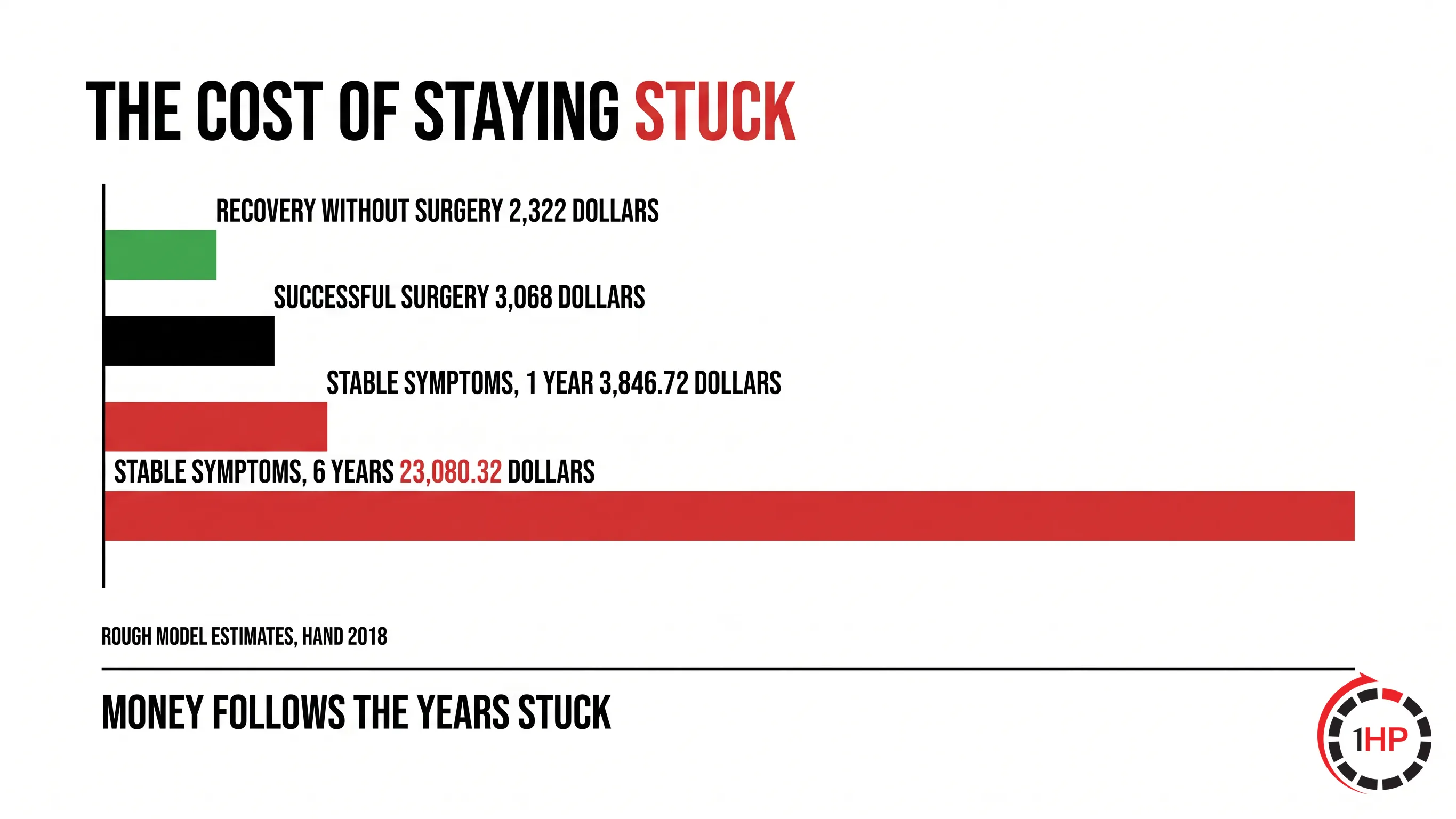
Their 2018 model, published in the journal HAND, priced each outcome of surgery or nonsurgical care, including wages lost to missed work. A successful operation came to $3,068. Recovering without surgery came to $2,322, the cheapest result in the model. Staying symptomatic but stable cost $3,846.72, and that charge comes back every year, because it "accounts for 2 days per month of missed work," the authors wrote.
The authors called surgery "clearly a cost-effective treatment strategy," and their reasoning matters here. The nonsurgical arm looks expensive on average because 67% of people in it stay symptomatic year after year, while the third who recover cost the least of any group. The model's margins are very wide and some of its inputs are expert opinion, so the dollar amounts are rough. The pattern is sturdier: in this model, the money follows the years someone stays stuck.
Some of those years go to scans. A 2024 study in the American Journal of Managed Care looked at insurance claims for 867,119 US adults with a new wrist pain diagnosis between 2016 and 2019. Of the 40,164 who had an MRI, 52.6% got one the researchers judged inappropriate under the American College of Radiology's criteria, most often because no X-ray had come first. A wrist MRI averaged $1,522 in total payments, $395 of it out of pocket, and the inappropriate scans added up to $44,493,234. Publishing the guidelines had only a "subtle impact on ordering practices," the authors found.
X-ray first: the radiologists' order for chronic wrist pain
- First test: X-rays are rated "Usually Appropriate." Ultrasound "May Be Appropriate." MRI, CT and bone scan are "Usually Not Appropriate" at this stage.
- If X-rays are normal or show nonspecific arthritis: MRI without contrast or MR arthrography becomes "Usually Appropriate."
- If X-rays are normal and carpal tunnel syndrome is suspected: no imaging test reaches "Usually Appropriate." Ultrasound and MRI "May Be Appropriate."
American College of Radiology Appropriateness Criteria, chronic hand and wrist pain.
Among the people who come to us, that long middle stretch is common and surgery is rare. In The 1HP Wrist and Hand Pain Report 2026, 65% of 229 program members had been in pain for more than a year before joining. Among 1,023 people who applied for our coaching program, 46% said they could not get a clear diagnosis or explanation of what was going on, and only 2% had already had surgery on the painful arm or hand. All of them found us online, so their answers can't describe everyone with wrist pain, and we have no cost data on them. Many arrived with what the Pittsburgh model kept charging for: symptoms with no resolution.
Low cost can also be the wrong yardstick. A 2017 model by NYU Langone surgeons found that starting carpal tunnel care with a steroid injection costs payers less than immediate surgery, unless more than 80% of injected patients go on to need surgery anyway. Yet one placebo-controlled trial the model drew on found injected patients "less likely to go on to need surgery, despite no difference in symptom severity scores at 1 year postinjection." A step can be the cheapest one on an insurer's ledger and still leave symptoms no better than placebo a year later.
A long history doesn't rule out improvement. Among members who completed follow-up in The 1HP Wrist and Hand Pain Report 2026, both programs combined, 58% of those in pain for more than a year reached a meaningful improvement, against 78% of a smaller group of 32 in pain for 3 to 12 months. The comparison is unadjusted, and results vary. We run these programs, so weigh our figures with that in mind.
Read side by side, these studies put the largest numbers on time rather than on any single procedure. Costs pile up in years when a hand stays the same, in scans ordered ahead of the cheaper first test, and in steps chosen for what they cost rather than for what they change. In both cost models we read, the lowest totals went to a first step that worked.
- Before an MRI for wrist pain that has lasted for months, ask whether you have had X-rays yet, and what a scan result would change about the plan.
- Keep a log of missed or shortened workdays next to your bills. In the Pittsburgh model, lost work was built into the yearly cost of staying symptomatic.
- When an injection or another step is offered, ask what should be different in your symptoms and your work a year from now, and what happens next if nothing is.
- If a year has passed without an explanation that makes sense to you, ask each provider how you will both know whether the plan is working, and when you will check.
- Ask any program, ours included, for results among people whose pain has lasted as long as yours, and how many people those figures leave out.
How we checked this
We read two peer-reviewed carpal tunnel cost models, a 2024 insurance claims study on wrist MRI and the American College of Radiology's imaging criteria. We also used our published Wrist and Hand Pain Report 2026. The 65%, 46%, 2%, 58% and 78% figures are ours. They are self-reported or internal, not peer reviewed, and the outcome figures cover only members who completed follow-up. Both cost models cover carpal tunnel syndrome only. The Pittsburgh model has very wide standard deviations, fills some gaps with expert opinion, uses 2010 wages and leaves out time off for appointments. The 3 and 6 year figures are our multiplication of its yearly figure. The NYU model counts direct payer costs only. The claims study covers commercial and Medicare Advantage plans and lacks clinical detail. Both modeling teams are orthopaedic surgeons, and we sell coaching programs, so each of us has a stake. Still unknown: what years of wrist pain actually cost the people in our programs. None of our sources tracked a real person's spending over six years.
- Gabrielli AS, Lesiak AC, Fowler JR, societal cost model of carpal tunnel treatment, HAND, November 2018.
- Milone MT, Karim A, Klifto CS, Capo JT, cost model of steroid injection versus surgery, HAND, November 2017.
- American Journal of Managed Care, study of inappropriate wrist MRI, March 2024.
- American College of Radiology, Appropriateness Criteria for chronic hand and wrist pain.
- Smithson E, Hwu M, The 1HP Wrist and Hand Pain Report 2026, November 2026.
Why do clean MRIs, braces, rest and cortisone keep missing the cause?
In wrist MRI research, 39 of 103 volunteers with no symptoms at all had an abnormal triangular fibrocartilage complex. Scans often find changes that have nothing to do with your pain.
Let that sink in for a second. Plenty of people with happy, pain-free wrists carry the same kind of finding that shows up on a worried person's report. A scan shows structure, not cause.
The American College of Radiology already points to a simpler starting line. For adults with chronic hand or wrist pain, its criteria rate an X-ray as "Usually Appropriate" for first imaging and ultrasound as "May Be Appropriate." Every MRI and CT option is rated "Usually Not Appropriate" as a first test. If an MRI is offered first, it can help to ask whether an X-ray should come before it.
In our approach, imaging is read alongside where it hurts, what provokes it, nerve signs, load history and how your hand performs in simple tests. Then capacity gets measured, because structure alone can't tell anyone what a hand is able to do day to day. Imaging still matters for a suspected fracture, major trauma, a mass or surgical planning.
Normal results can set their own trap. In the 1HP video Stop Resting Your Wrist After a Normal Scan (Here's Why), Dr. Matthew Hwu explains that a normal MRI, X-ray and EMG is "actually very common with chronic tendinopathy and sensitization." His core point is short: "We don't need strength to handle repeated movements over long hours. We need endurance." When a normal scan leads straight to more rest, those rest cycles lead to deconditioning and less confidence in your hands.
Here is how that loop looked for one person. In a 2021 post on Reddit's RSI forum, someone described 8 months of chronic wrist pain with no diagnosis. Their MRI and X-rays were normal. The orthopedic surgeons they saw offered rest and avoiding aggravating activities, then told them to come back in "3 MORE MONTHS" if symptoms persisted. That is one person's experience, yet it shows how a clean report can turn into a long waiting game.
The passive fixes follow the same pattern:
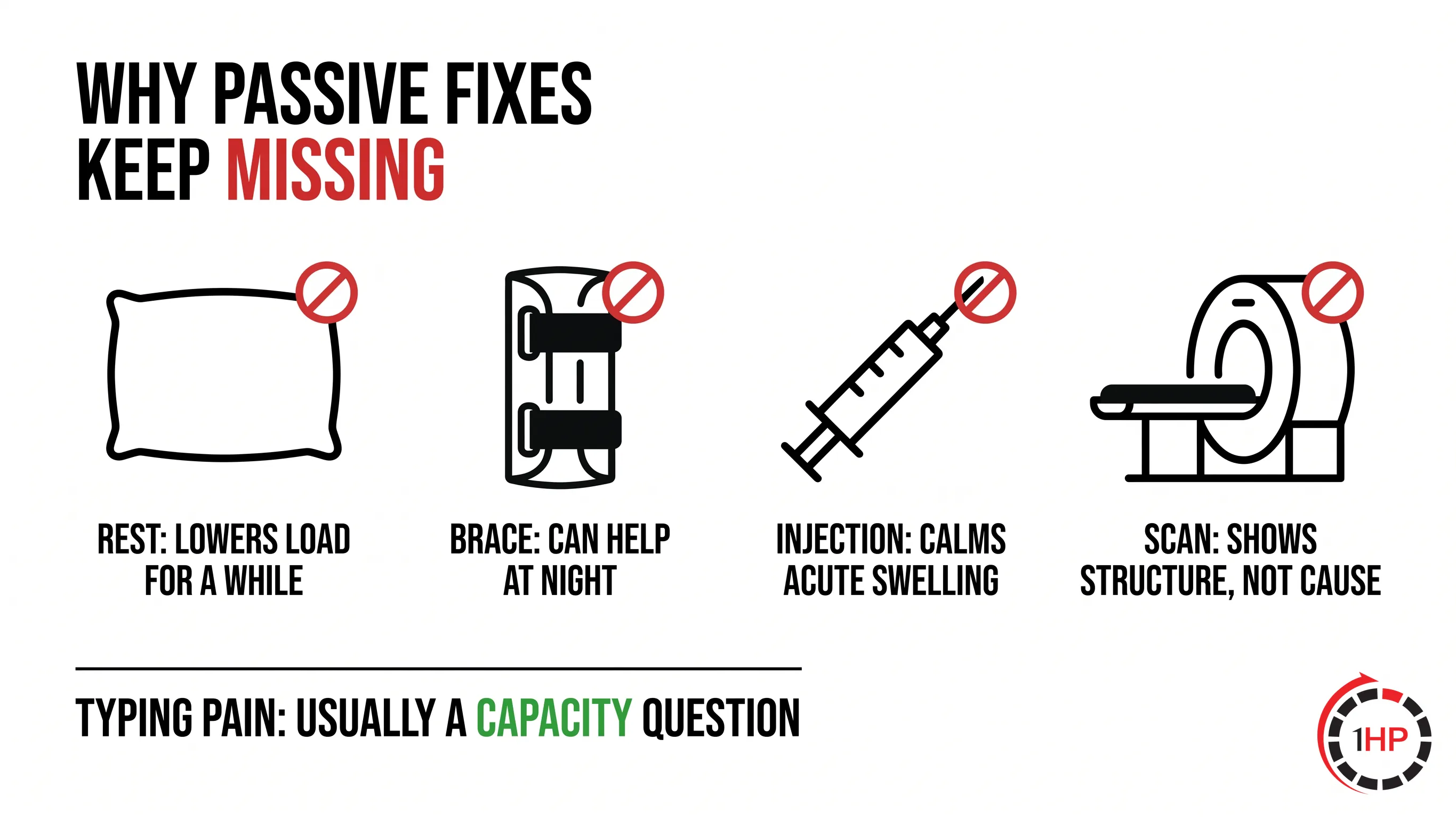
- Rest lowers load for a while, but complete rest weakens the tissue.
- A brace can help at night. It does not raise endurance.
- An injection or anti-inflammatory can calm acute swelling. It does not build capacity.
- Another scan answers a structural question, while long-running wrist pain from typing is usually a capacity question.
Ask each fix one question: what does it build? The pain keeps coming back. What changes the pattern is a personalized plan with direct 1:1 access to a 1HP expert.
If a carpal tunnel label is part of your story, our page on carpal tunnel from repetitive strain explains why irritated tendons can press on the median nerve and mimic the classic picture. Which leaves the real question after years of this: if the tests and the passive fixes are not the answer, what is actually worth your time and money next?
What should you try next after years of wrist pain and multiple doctors?
After more than 3,000 people over 10 years across our practice, esports work and programs, the path I trust most measures your capacity and rebuilds it while you keep working.
Here is the simple version. Load > Endurance = Pain. Your keyboard, mouse, controller or instrument is the load. Your tendons and muscles bring the endurance. When the daily load keeps outrunning that endurance, tissues get irritated, and resting only lowers the load until you come back to it.
Our approach began with professional esports athletes, whose long, high-repetition sessions mirror desk work. Nobody in that world can quit their main job for six months to rest. So the plan has to work around the keyboard, not away from it. In practice, a capacity-first path usually looks like this:
- Check the red flag list below with a doctor before you start.
- Map where it hurts, what sets it off and how long you can type or click before it starts.
- Test the endurance of the muscles and tendons behind the painful area.
- Build that endurance with graded exercise, about 30 to 60 minutes a day, split into 15 to 30 minutes twice a day, 6 days a week.
- Adjust your work and play load as you go, so you keep doing what you love instead of stopping.
- Learn how pain works, so a normal flare after more activity does not send you back to rest.
See a doctor before starting if you have any of these:
- Constant numbness that doesn't change with activity
- Worsening weakness
- Visible muscle wasting
- Major swelling or color change
- A recent injury or fall
- Fever
- Severe, unrelenting pain
- Symptoms that wake you every night
Seek urgent care for emergencies.
Does it actually move the needle? In The 1HP Clinical Outcomes Report 2026, 72% of Power Leveling members who completed a follow-up survey reached a meaningful improvement in arm, wrist and hand function, compared with 33% in the self-guided program. Among members who completed follow-up, the median time to that improvement was 45 days, and 55% had reached it by their 4-week check-in. Results vary.
Long-running cases are the part I care about most for this article. Our Wrist and Hand Pain Report 2026 looked at 106 program members who had been in pain for more than a year and completed a follow-up survey, both programs combined: 58% reached a meaningful improvement. Results vary.
Years in pain do not close the door. They mostly tell you how long the old loop has been running.
Most members see meaningful improvement within 6 to 12 weeks. Full recovery can take up to 18 months depending on the case. Results vary. I would much rather you spend 30 to 60 minutes a day building capacity than another year collecting scans that look fine.
Where your pain lives changes which muscles and tendons need the work. If yours sits on the little-finger side, our guide to pinky side wrist pain from repetitive strain shows how that region gets loaded at the desk, and the next step from there is a plan built around your own hours at the keyboard.
How do you fix pinky-side wrist pain from mouse use without another year on the wheel?
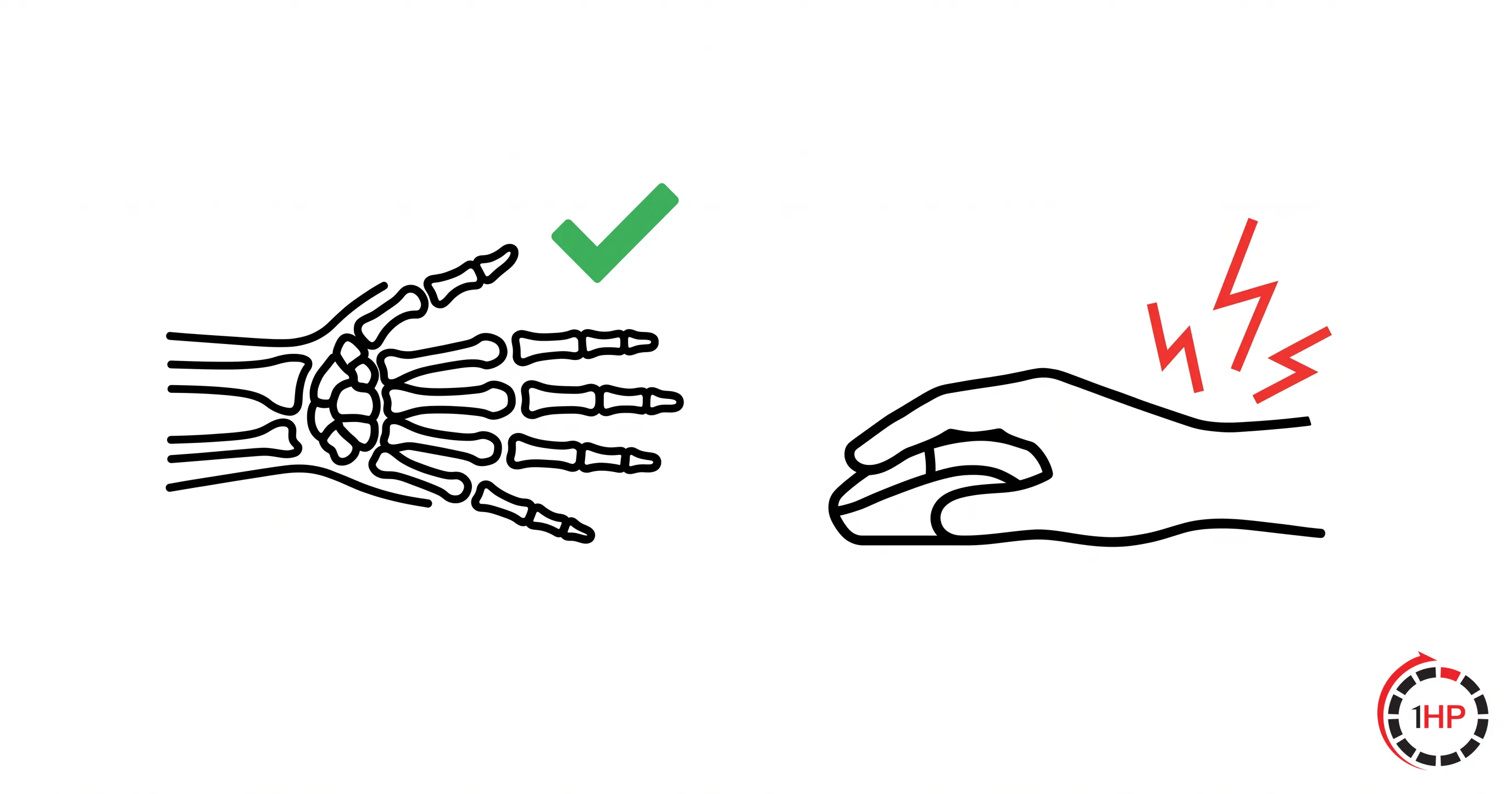
Pinky-side pain from mouse use, such as ECU tendinopathy or TFCC irritation, often calls for building endurance in the muscles and tendons doing the work, rather than another scan or brace.
Here is my forward-looking bet. The money will keep shifting away from scans first and toward capacity first. A 2024 analysis in AJMC found that 52.6% of wrist MRIs in its cohort were inappropriate, mostly because no X-ray came first. Before the next scan, ask how its result would change your plan.
Your own bill tells the same story. Count the mouse hours you lose to pain each week, because that number shows your real cost. I'd rather you test how long your mouse hand lasts before it aches, then build that number up.
You don't need another gadget. You need a plan that matches your load. People start with a free consultation, where a 1HP expert looks at your pain region, your hours at the mouse and what you have already tried, so the next dollar you spend actually moves you forward.
Summarize This Article With AI
Open this article in your preferred AI engine for an instant summary.
Frequently Asked Questions
What else do people ask about the cost of long-term wrist pain?
Most questions come down to a few worries: whether another scan is worth paying for, whether surgery is the cheaper end point, and how to tell if anything is working.
How common is wrist pain in adults?
Very common. Research puts wrist pain at about 19.1% of adults. You are not alone, and a long case is not a hopeless one.
Is an MRI worth it if my wrist X-ray was normal?
Sometimes, though often not as the next step. For an acute wrist injury with a negative or unclear X-ray, radiology guidance rates a repeat X-ray in 10 to 14 days as usually appropriate, right alongside MRI or CT. For pain that built up slowly over months or years, a scan can show structure clearly, yet it often can't show whether your tendons are ready for a full day of typing.
Is carpal tunnel surgery cheaper than years of other care?
Not by default. In a 2017 cost model, going straight to surgery only beat one injection attempt when more than 80% of injected patients still needed surgery under Medicare rates. The cheapest path it modeled was three injections before surgery. Injections are a cost step, not a capacity builder. If surgery is on the table for you, 1HP offers Carpal tunnel guidance before considering surgery.
How can I tell if my wrist is actually getting stronger?
Measure it, like checking your stats before a boss fight. Compare your painful side with your other side for range of motion (how far the joint moves) and for grip force, then watch the gap close over the weeks. A simple hand-grip dynamometer makes grip easy to track at home.
Why does my grip feel weak when my wrist hurts?
Pain can turn your strength down. In a fresh injury, lost force likely reflects pain holding you back, while in long-running cases with no pain during testing it may be true weakness from disuse or avoidance.
How much does a 1HP consultation cost, and how do I book one?
The consultation is free. People start with a free consultation, which you can book on the 1HP website at 1-hp.org. No referral is needed, and everything happens online. Power Leveling is our done-with-you coaching program with unlimited 1-on-1 expert calls. Pricing depends on your case and is discussed in a free consultation.
Written by
Dr. Elliot Smithson
PT, DPT, MS, ATC, EMT, Co-Founder
Dr. Elliot Smithson earned his undergraduate degree from the University of Central Florida in Athletic Training, his Master's from Marshall University in Athletic Training, and his doctorate in Physical Therapy from the University of St. Augustine for Health Sciences.
Follow on XThis article is for educational purposes only and is not a substitute for professional medical advice, diagnosis, or treatment.