Table of Contents
Coding Careers After Wrist Pain: What Real Recovery Cases Show
By Dr. Elliot Smithson, PT, DPT, MS, ATC, EMT·
Quick answer
Most typing pain is a forearm endurance problem. Your muscles and tendons can be trained to handle full-time coding again, often while you keep working.
In 1HP's endurance testing, people who reach 40 to 60 easy reps of wrist flexion and extension at 5% of body weight can handle up to 9 to 11 hours of hand use a day.
Results vary. One database administrator with 4 years of pain went from hurting after 10 minutes of typing to full pain-free work days in 8 weeks.
If you have typed through a year or more of wrist and forearm pain, one question probably runs on repeat. Can I keep doing this job?
You will meet desk workers who lived with pain for years, including a database administrator and a researcher who writes code, and see their history, the labels they were given, what was measured and how long recovery took. Each one is an individual outcome. Results vary.
You will also see what 1HP's two published reports, The 1HP Clinical Outcomes Report 2026 and The 1HP Wrist and Hand Pain Report 2026, found about time to improvement and about people who had been hurting for more than a year, with the group behind each figure named so you know exactly who it describes.
Every case below runs on the same three-step method, which we call the 1HP Load Reset Framework. It is the framework we use to keep professionals working while they rebuild capacity:
- Reset load. Find what your forearms can handle today and set work and gaming windows inside that limit, instead of stopping everything.
- Activate with isometrics. Start with gentle holds that load the irritated tendons without provoking them.
- Build endurance. Progress the reps and weight until your capacity sits above the hours your job and hobbies demand.
In my view, the order is the whole trick. According to Dr. Matthew Hwu's case write-ups, three of the four cases in the table below had already been through doctors, an MRI, X-ray, EMG or nerve conduction test, physical therapy or passive treatments before anyone measured their forearm endurance, and none of that closed the gap between load and endurance on its own.
| Case (source) | Job | Time in pain | Starting point | Reported result |
|---|---|---|---|---|
| OW (Dr. Matthew Hwu case study) | Database administrator | 4 years | Wrist endurance 20% of normal (right), 40% (left); pain after 10 minutes of typing | Full pain-free workdays plus 5 hours of gaming a night at 8 weeks |
| ZR (Dr. Matthew Hwu case study) | Researcher and programmer | 4 years | Wrist endurance 30% (right), 60% (left); 80% voice dictation | Full keyboard use at work and unrestricted gaming, including StarCraft 2, at 10 weeks |
| Amy (Dr. Matthew Hwu case study) | Fiscal specialist, accounting | About 1 year | 30 reps at 4 lbs for wrist flexion and extension; QuickDASH 61 | QuickDASH 16 and full return to work at 16 weeks |
| Alex (1HP testimonial) | CNC machinist, CAD designer, gamer | More than 2 years | 1 to 2 hours at the computer before pain reached 6 to 7 out of 10 | A 12-hour gaming session with zero pain at 12 weeks |
| The 1HP Clinical Outcomes Report 2026 | Program members | Mixed | Average QuickDASH 34.4 | Median 45 days to meaningful improvement, among members who completed follow-up |
These are individual outcomes, and results vary. Still, reading the rows together tells me two things. First, time in pain did not predict time to a result: OW's 4 years took 8 weeks, while Amy's single year took 16. Second, every case with a measured baseline started well below normal endurance, which suggests the number worth tracking is your capacity, not how long you have hurt.
The practical thread running through all of it is three questions. What can my wrist handle right now? What should I do when pain changes? When is it safe to do more?
Dr. Matthew Hwu and I built the Wrist Pain Troubleshooter around those exact questions, and they make a useful lens even if you never open the 1HP app or join Power Leveling. A capacity baseline, including an endurance test matched to the muscles involved, answers the first. Flare rules that pull the exercise program back for a while, instead of ending it, answer the second. Logging your work and hobby hours so an Irritability Index can suggest the next day's activity windows answers the third.
None of this asks you to quit your job or give up gaming. It asks you to find out where your forearms stand today, which is exactly where the first case begins.
You have been feeling that burn along your forearm for a year, maybe longer. It shows up halfway through a standup, flares during a long debugging session, and follows you into your evening ranked games. Somewhere along the way a quiet question started looping in the background: will this end my career as a software engineer?
It is a very common worry. You are not alone in it.
Many people who type for a living arrive with a label like carpal tunnel syndrome or RSI (repetitive strain injury), a clean scan, a brace in the drawer, and no clear explanation of why the pain keeps coming back. That missing explanation matters more than it seems, and I would argue it is the biggest gap in how the system handles typing pain. When nobody gets to the root cause, rest and new gear quietly become the whole plan, and the pain tends to return as soon as the workload does.
Our own data backs this up. When we coded the written answers of 1,023 people who applied for 1HP's coaching program (November 2025 to September 2026) for The 1HP Wrist and Hand Pain Report 2026, we found that 46% (475 people) said they could not get a clear diagnosis or explanation of what was going on. The largest group was not any one condition. It was people who never got an explanation that made sense to them. To me, that is the most telling number in the whole report.
Our endurance testing shows what was missing in two of the cases ahead. According to the case write-ups by Dr. Matthew Hwu, PT, DPT, OCS, CSCS, on 1-hp.org, a database administrator measured at 20% of normal wrist endurance on the right and 40% on the left, and a researcher who programs measured at 30% and 60%. According to the 1HP evidence-based approach page, we set the daily target from our own data: endurance tests show that people who can do 40 to 60 easy repetitions of wrist flexion and extension at 5% of body weight can handle up to 9 to 11 hours of hand use a day, typically 6 to 8 hours of work plus 3 to 4 hours of a hobby. I find that benchmark far more useful than any scan, because it turns a vague fear into a gap you can measure and close.
I think the more useful question is not whether your hands are broken. It is whether the muscles and tendons of your forearm have enough endurance for the hours you ask of them. Endurance can be measured. It can also be built.
So start with the question underneath every case: what do years of typing pain usually mean for a career?
Will wrist pain from typing end my software career?
For most people, no. Long-standing typing pain usually means your forearm tissue has run out of endurance, and endurance can be rebuilt while you keep your job.
If the career worry is loud right now, it can help to sort your situation with four plain questions before deciding anything big:
- How long can you type before symptoms start, and how strong do they get?
- Do symptoms settle overnight, or do they carry into the next day?
- Has anyone actually measured how much repetitive work your forearm muscles can handle?
- Are you avoiding the keyboard because it hurts, or because you are afraid of making it worse?
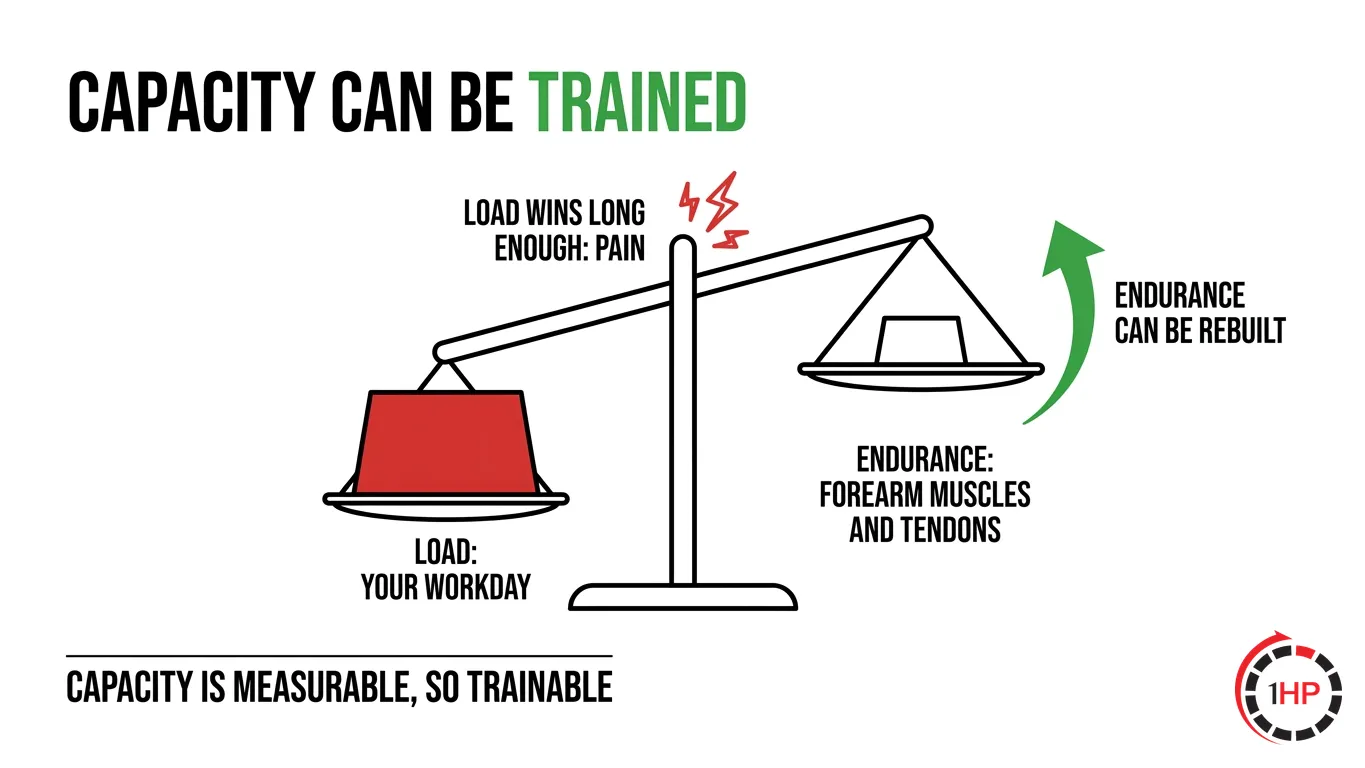
Those answers tell you far more than the number of years you have been hurting. They point to the real equation underneath most typing pain: Load > Endurance → Pain. Your workday is the load. Your forearm muscles and tendons supply the endurance. When the load wins for long enough, the tissue gets irritated and your nervous system starts guarding it.
The common assumption is that the longer it has hurt, the less there is left to work with. I see it the other way around. Duration tells you how long the mismatch has gone on, not whether it can change. That is the lens behind our work with more than 3,000 people over 10 years across 1HP's practice, esports work and programs, and it is laid out step by step on our evidence-based recovery approach page.
One member, Alex, shows what that looks like in real life. He is a CNC machinist, CAD designer and gamer who came to us with more than 2 years of pain in both wrists. He could use the computer for only 1 to 2 hours before his pain reached 6 to 7 out of 10, and he had started reading that he might have to quit gaming and change careers. His picture fit bilateral wrist extensor tendinopathy with central sensitization. After 12 weeks, he finished a 12-hour gaming session with zero pain and said he now feels confident applying for desk-heavy jobs. One person, one story, and results vary.
Group numbers point the same way, with limits worth stating plainly. The 1HP Clinical Outcomes Report 2026, an internal analysis that has not been peer reviewed, found that 72% of Power Leveling members who completed a follow-up survey reached a meaningful improvement in arm, wrist and hand function, compared with 33% in the self-guided program, a raw comparison the report does not adjust for other differences between the two groups. Those figures describe members who finished follow-up, not everyone who started.
So the career question is really a capacity question. Capacity is measurable. Measurable things can be trained.
How long does recovery take when nobody has explained your pain?
Among 1HP program members in The 1HP Clinical Outcomes Report 2026 who completed follow-up, the median time to a meaningful improvement was 45 days, and 55% had reached it by their 4-week check-in. Results vary.
Those numbers come from The 1HP Clinical Outcomes Report 2026, and they describe members who completed follow-up, not everyone who ever felt a twinge at a keyboard. I share them because they set a realistic first checkpoint. Most members see meaningful improvement within 6 to 12 weeks. Full recovery can take up to 18 months depending on the case.
A timeline only helps if you know what you are recovering from.
Many people never get that far. Among 1,023 people who applied for our coaching program between November 2025 and September 2026, 46% (475 people) said they could not get a clear diagnosis or explanation of what was going on, according to The 1HP Wrist and Hand Pain Report 2026. These are self-reported answers, not diagnoses we made. Still, the largest group in that data was not any single condition. It was people who never got an explanation that made sense to them.
That gap matters for your career worry. Without an explanation, every flare feels like proof of damage. You cut back hours, then cut back more. The tissue gets less use, so it handles less, and the spiral keeps going.
It is common to arrive with a label like carpal tunnel, tennis elbow or plain "RSI." Labels can be useful starting points. In our experts' view, though, many of these turn out to be irritated tendons that look like something else. With carpal tunnel symptoms, for example, 1HP experts often find irritated tendons crowding the median nerve rather than a thickened ligament, which our guide to carpal tunnel from repetitive strain walks through in plain language.
This is why a generic exercise sheet tends to stall. Two people with the same label can have very different endurance, schedules and pain behavior. Our approach is a personalized plan with direct 1:1 access to a 1HP expert, built from esports medicine work with Team Liquid, 100 Thieves, CLG, Immortals and FlyQuest. Pro players run long sessions at high repetition, which looks a lot like a sprint week before a release.
So the timeline question splits in two. How fast can your tissue adapt? And how fast can you stop reading every ache as a warning sign? The second part is where long-standing cases tend to get stuck, and it has a name worth understanding next.
What does real recovery look like once someone finally explains the pain?
Among 1HP program members in The 1HP Clinical Outcomes Report 2026 who completed follow-up, average disability scores fell 46%, from 34.4 to 18.0 on the QuickDASH. A clear cause plus graded loading tends to move function, though results vary.
That figure comes from The 1HP Clinical Outcomes Report 2026, an internal analysis that has not been peer reviewed. The QuickDASH is a short survey of how well your arm, wrist and hand handle everyday tasks. A lower score means daily life got easier. It measures function, and it describes a group, not a promise about your own case.
Numbers can feel abstract after years of hurting. So here is one person behind them.
OW is a database administrator who had 4 years of pain in both wrists and hands, labeled wrist flexor tendinopathy. Within 1 minute of typing his pain reached 5/10, and by 10 minutes it sat at 6/10. He spent about 8 hours a day on a PC for work and gamed for roughly 3 more. Along the way he saw chiropractors, physical therapists and doctors, with an MRI, X-rays and nerve conduction tests, without finding help that changed things.
When Dr. Matthew Hwu, one of our experts, tested him, his posture was decent. The gap was endurance. His right forearm measured 20% of normal and his left measured 40% of normal. So the plan built wrist and forearm endurance, capped his gaming in the first week, and raised that cap gradually based on how he felt. Pain science was part of it too, because pain is about protection and is never a direct readout of tissue damage.
After 8 weeks, OW reported full pain-free workdays, no pain while driving, and about 5 hours of gaming a night with breaks built in. He kept his exercise routine going afterward. One case is one case. Still, Dr. Hwu wrote that OW's story is representative of most cases seen in tech workers such as data analysts and software engineers.
What changed was not his job. It was his forearms' ability to handle it.
OW's tendon picture fits what Dr. Hwu told an aim-training community in one of our YouTube sessions: carpal tunnel is usually the first thing people name, yet tendon irritation turns out to be a much bigger issue. The same capacity thinking applies whether the ache sits on the palm side, like OW's, or along the outer edge of the wrist, which is covered on our page about pinky-side wrist pain from repetitive strain.
Some people want accountability built into the process. Power Leveling is our done-with-you coaching program with unlimited 1-on-1 expert calls. Pricing depends on your case and is discussed in a free consultation. It carries a 3-Month Results Guarantee: a member who took part in good faith and is not satisfied with progress toward their onboarding goals after three months can ask for a full refund. Those onboarding goals are what the promise measures, so a concrete one, like getting through a full workday at the keyboard, gives it something real to track.
Can years of typing pain still end in full days at the keyboard?
Four years into his hand pain, a researcher and programmer was dictating most of his work by voice. Ten weeks into our program, he had full keyboard use back at work.
Dr. Matthew Hwu, one of our 1HP experts, wrote up the case with his consent. Typing hurt instantly, gaming had stopped for years, and he feared losing his ability to work. His wrist endurance measured 30% of normal on the right and 60% on the left. By the end it was 90%. Dr. Hwu traced the case to "clear endurance-based deficits and a poor understanding of pain."
His was one of four published case studies we reread, all from members who use a computer for work. Each is one person's result, shared with consent, and none is a typical or promised outcome.
| Member | Work | Pain before joining | Reported at | What they reported |
|---|---|---|---|---|
| ZR | Researcher and programmer | 4 years | 10 weeks | Full keyboard use at work, unrestricted gaming |
| OW | Database administrator | 4 years | 8 weeks | Full pain-free workdays plus 5 hours of gaming a night |
| Alex | CNC machinist and CAD designer | More than 2 years | 12 weeks | A 12-hour gaming session with zero pain |
| Amy | Fiscal specialist in accounting | About 1 year | 16 weeks | Full return to work; QuickDASH work score from 75 to 0 |
Alex once hit pain of 6 or 7 out of 10 after one to two hours at a computer and worried he would have to change careers. After 12 weeks he felt confident applying for desk-heavy jobs.
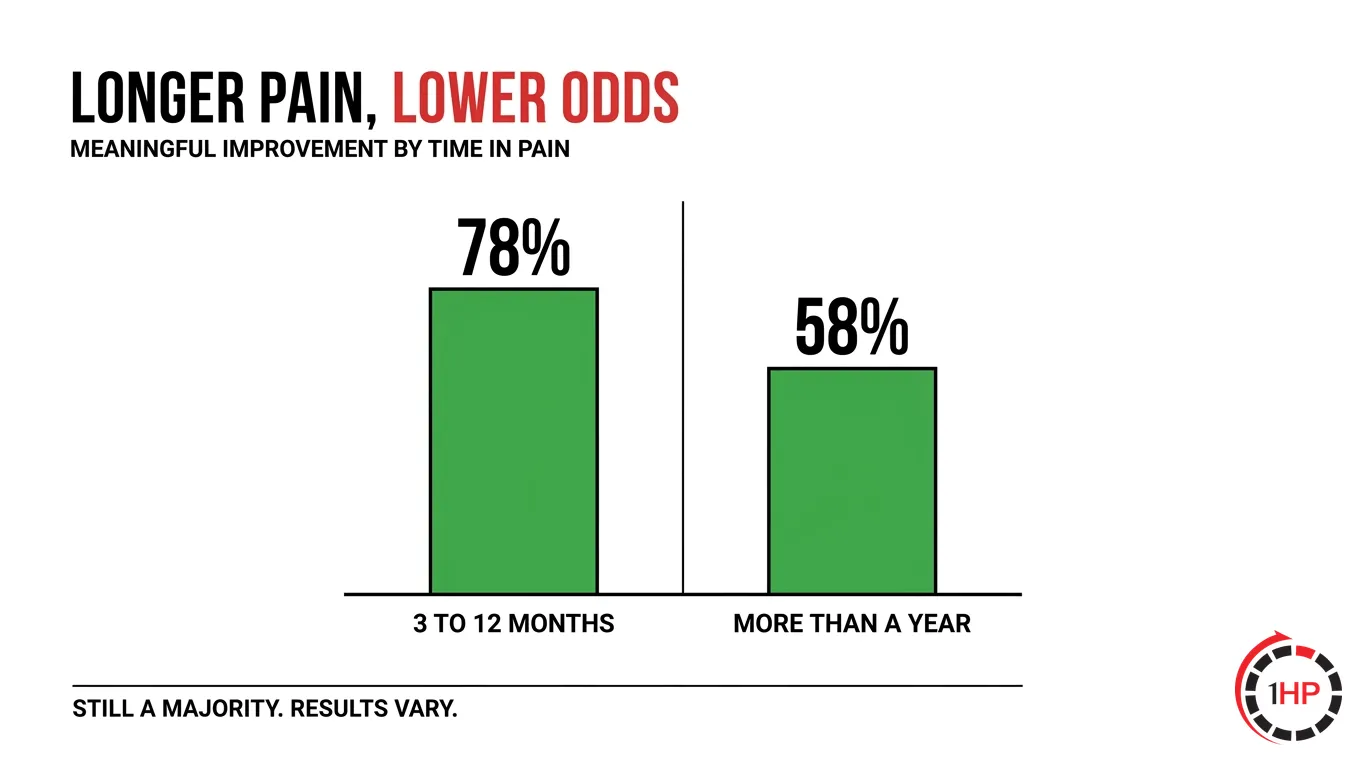
A few stories chosen for publication cannot tell you your odds, so we checked our follow-up data. Long pain is the normal starting point: among 229 program members, 65% had been in pain for more than a year before joining. Did those years hold people back?
Somewhat. According to The 1HP Wrist and Hand Pain Report 2026, members in pain for more than a year reached a meaningful improvement less often than those in pain for 3 to 12 months, yet more than half still got there. In our Power Leveling program alone, 69% of members in pain for more than a year reached one, according to The 1HP Clinical Outcomes Report 2026. Both figures count only members who completed follow-up, and results vary.
What did the turnarounds share? Two case files point first to an explanation. Among 1,023 people who applied for our coaching program, 46% said they could not get a clear diagnosis or explanation of their pain. Amy had been told by a workers' compensation doctor that she had carpal tunnel syndrome, but her EMG came back normal. Her fear-avoidance score was 68 out of 100 when she joined and 0 sixteen weeks later. In a case review on our YouTube channel, our co-founder Dr. Elliot Smithson describes long-running pain as the brain stuck in protective mode, "like a car alarm that keeps going off even though nobody's trying to break in."
The second thread is load. In the same video, Smithson reviews a writer and gamer with more than two years of pain who had been playing 4 to 12 hours a day. On stopping, Smithson is direct: "we didn't tell him to stop gaming completely." When flares came, the plan cut gaming by 2 hours, then rebuilt in 15-minute steps. NHS advice on RSI, as summarized by a UK safety-training provider, points the same way: keep active, reduce activity at first if necessary, then increase it gradually.
The third thread is the one most likely to shake you. Recovery is "almost never a straight line," Smithson says. The same member improved dramatically by September, then slipped back while following the plan, which Smithson calls "exactly where most people give up." Sleep and stress changed what he could tolerate: after good sleep and low stress he could game for 4 hours with little pain, while after poor sleep and high stress, 30 minutes of the same game spiked it. By February 2025 he was back to high-intensity games with almost no limitations.
The years counted, but they did not decide the outcome. In our follow-up data, long-standing pain improved less often, yet both published cases with four years of history ended in full days at a keyboard. Where the files describe how, the same elements recur: a measured limit, an explanation that made sense to the person, work and hobbies cut back and rebuilt in steps, and a plan for the setback that eventually came.
- Ask whoever is helping you to measure how long you can type before symptoms start, alongside any label you have been given.
- If you have a label but no explanation that fits when and how your pain behaves, ask for one before making career decisions around it.
- Log keyboard hours, sleep and stress next to your pain for a few weeks, so a flare after a bad night can be read against the trend.
- Before a flare arrives, ask what the step back will be and how fast you will rebuild, like the 2-hour cut and 15-minute steps in one member's plan.
- If your pain is years old, expect somewhat lower odds and a wobbly path, and judge progress at a checkpoint months out rather than week to week.
How we checked this
We reread three written case studies by Dr. Matthew Hwu, one case video and one video case review by Dr. Elliot Smithson. We also used our two published 2026 reports and NHS self-care advice as summarized by a UK safety-training provider. Every case detail and percentage here is 1HP's own data. The case studies come from members who agreed to share them. They report individual results, partly self-reported, and do not show what is typical. Both reports are internal analyses that have not been peer reviewed, and they count only members who completed follow-up. The comparison by pain duration is not adjusted for other factors. We sell coaching programs for this kind of pain and wrote these case studies ourselves, so we have a clear stake in the answer. Still unknown: how members who skipped follow-up did, how long gains last, and how many members kept the same job throughout.
- Dr. Matthew Hwu, 1HP case study "From Chronic Pain & Instant Typing Pain to Pain-Free in 10 Weeks" (ZR), published on 1-hp.org.
- Dr. Matthew Hwu, 1HP case study "8-Week Wrist Pain Recovery: Desk Worker Goes from 10-Minute Limit to Full Days of Work + 5 Hours of Gaming" (OW), published on 1-hp.org.
- Dr. Matthew Hwu, 1HP case study "How the Healthcare System Can Create Helplessness in Chronic Wrist & Hand Pain" (Amy), published on 1-hp.org.
- 1HP, Alex case study video, YouTube.
- Dr. Elliot Smithson, 1HP video case review on nonlinear recovery, April 2025.
- Smithson E, Hwu M., The 1HP Wrist and Hand Pain Report 2026, November 2026.
- 1HP, The 1HP Clinical Outcomes Report 2026, 2026.
- Manual Handling Training, RSI statistics and NHS self-care summary, April 2026. This secondhand summary comes from a training provider that sells workplace safety courses.
So where does your coding career go from here?
Your career can keep its direction. What changes first is how you pace your typing load while capacity builds. Our three-step framework is built to keep professionals working while they rebuild capacity.
In one live session with an aim-training community, someone in the chat wrote that they had irreversible damage. My honest reaction was skepticism. I still feel that way when a developer tells me their hands are finished after a few rough years at the keyboard.
The cases in this article are individual outcomes, and results vary. Before making a big career decision, it may help to ask your manager about a short, temporary change in workload while you rebuild, rather than a permanent step back.
Your next step can be small. Measure what your forearms can handle today, and let that number, rather than the worry, set the pace for your next few weeks of typing.
Summarize This Article With AI
Open this article in your preferred AI engine for an instant summary.
Frequently Asked Questions
What else do programmers ask about typing pain and their careers?
Most questions come back to rest, scans, injections and labels. Each one looks different once you think of pain as a load problem rather than a broken part.
Will my wrist pain go away if I just rest?
Rest lowers the load, but it does not build capacity. Tendon researcher Jill Cook of La Trobe University said on the Here All Day podcast that tendinopathy, a load-related change in a tendon, builds up with exposure to load, not with age itself. So the fix sits in how you build up to load, not in avoiding it.
Can an MRI show whether my tendon is torn?
Not reliably. Cook also said research shows neither MRI nor ultrasound can tell tendon pathology apart from a partial tear. That is why I put more weight on how your pain responds to load than on a scan report.
Is a cortisone shot a good long-term fix?
In the same conversation, Cook said 12-month outcomes are always worse for people who receive a corticosteroid injection than for those who do not. Short relief can feel like progress. It rarely changes capacity.
Why do I keep getting vague labels instead of answers?
Vague labels show up across sports medicine. On The Ask Mike Reinold Show, a panel of physical therapists called one common knee label a catch-all and argued the real value is in ruling other problems out.
Does pain mean I should stop typing?
Not by default. Mainstream advice from neuromuscular therapist Gary Mendelssohn frames pain as an invitation to slow down, listen and pivot. In my view, a pivot means adjusting the dose, then building back up.
How do I get started?
People start with a free consultation, booked through 1-hp.org.
Written by
Dr. Elliot Smithson
PT, DPT, MS, ATC, EMT, Co-Founder
Dr. Elliot Smithson earned his undergraduate degree from the University of Central Florida in Athletic Training, his Master's from Marshall University in Athletic Training, and his doctorate in Physical Therapy from the University of St. Augustine for Health Sciences.
Follow on XThis article is for educational purposes only and is not a substitute for professional medical advice, diagnosis, or treatment.