
Table of Contents
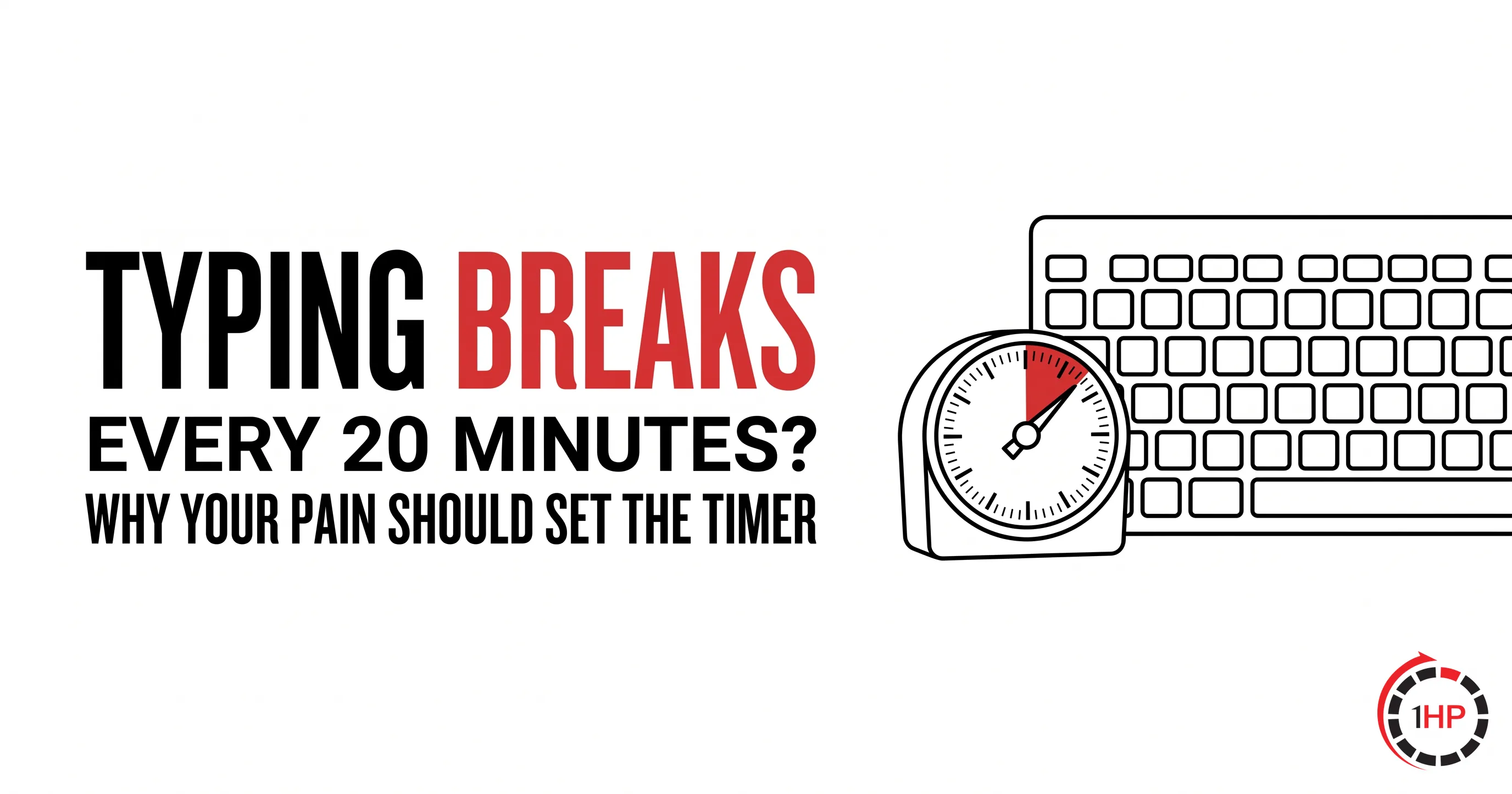
Typing Breaks Every 20 Minutes? Why Your Pain Should Set the Timer
By Dr. Elliot Smithson, PT, DPT, MS, ATC, EMT·
Quick answer
If typing already hurts, time each break a few minutes before your own usual symptom onset. The stock 20 to 30 minute schedule was written to keep pain-free workers pain-free.
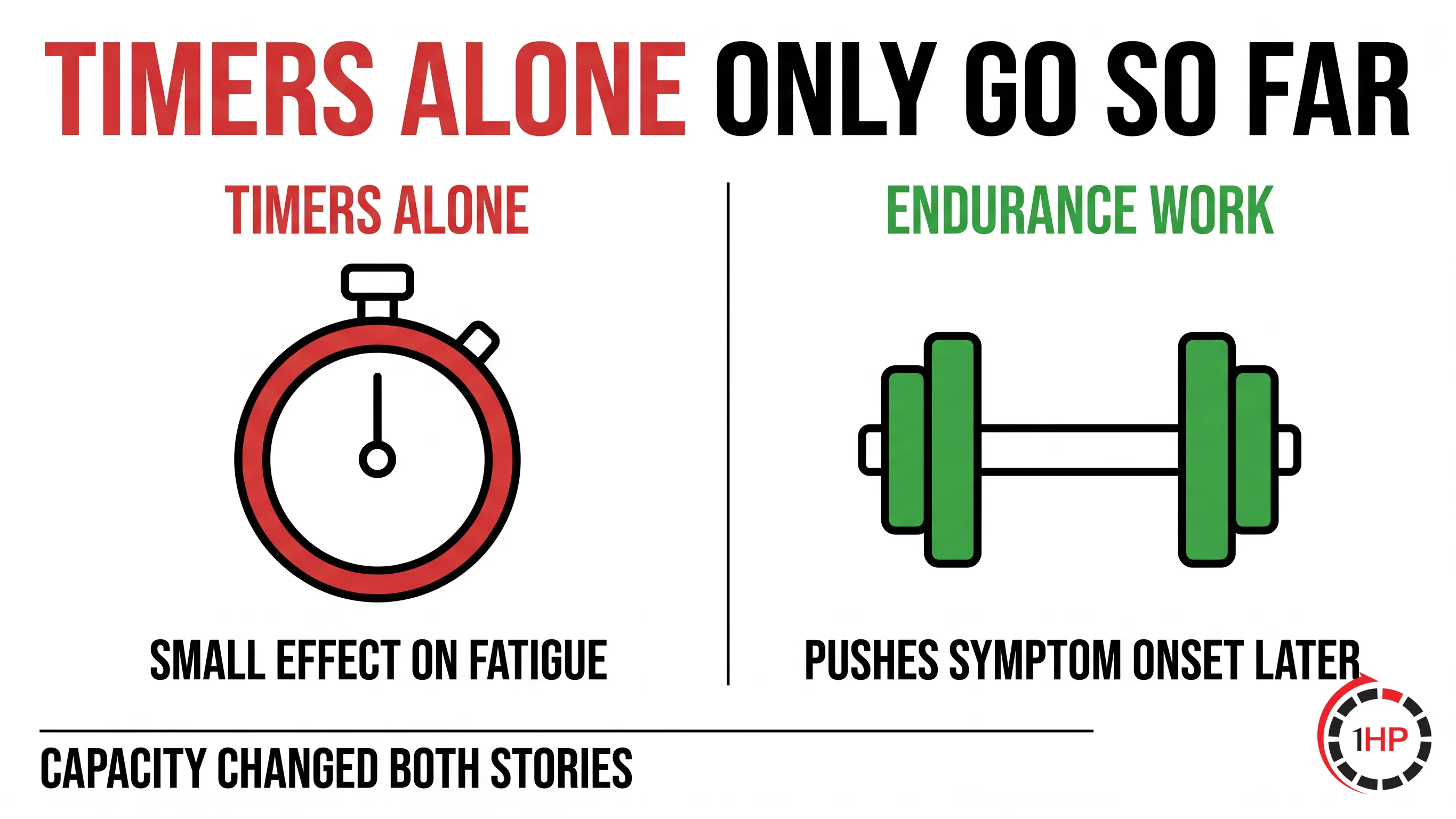
Breaks pace the pain. They do not build capacity. ZR, a programmer in one of our case studies with instant typing pain, started with wrist endurance at 30% of normal on his right side, and no break schedule moves that number.
Here is the strange part about typing breaks: many of the people who hurt most are already taking them.
ZR, a researcher and programmer in one of our case studies, had 4 years of wrist and hand pain. He was doing 80% of his work by voice dictation. He split his day into a 2 to 3 hour morning block and a 3 to 4 hour afternoon block, with breaks of up to 10 and 15 minutes. Typing still brought pain the moment he started, at 1.5 out of 10, climbing to around 3 out of 10 after 3 hours. Then it took another 3 hours to settle.
No stock timer fixes that pattern. A 20 minute alarm assumes your first 19 minutes are free. His were not.
Dr. Matthew Hwu, the 1HP expert who wrote up his case, linked part of his pain to fear avoidance, where worry about typing kept his nervous system more sensitized. A 2025 study in the Journal of Occupational and Environmental Medicine, by Bodor Bin sheeha, noted that institutional office setups follow ergonomic principles but "may not consider individual requirements." The same study found office workers scored a mean of 3.98 out of 9 on ergonomic knowledge, a level the author described as low to moderate.
So I want to flip the usual question. A useful question to put to anyone guiding you is simple: what in this plan builds my capacity, and how will we know it is working?
For ZR, the turn came from a different direction than break length. His plan started at exercise once a day instead of twice, and as he learned how pain works, he felt confident enough to actually try using his hands again.
You set the timer for 25 minutes, like the guides say. By minute 12 your wrist is already burning. You keep typing anyway, because the timer has not gone off yet.
If that sounds familiar, you are not doing breaks badly. One question worth asking yourself: does your pain show up at about the same minute most days, or does it drift? In a 1HP video on what wrist pain really costs, our experts note that people in chronic cases often see four to five providers over several years. My take is that a timer alone rarely changes that story when typing already hurts, because the pain reflects how much load your forearm can handle right now.
The research behind stock intervals is thinner than the confident advice suggests. A 2022 meta-analysis titled "Give me a break!" pooled 22 samples covering 2,335 people and found that micro-breaks, meaning pauses of 10 minutes or less, gave a small lift in energy but no significant boost to performance. Longer breaks did more.
Tracking your own symptoms takes attention, and a stock timer asks for none. For someone already hurting, though, ignoring what the body reports usually costs more.
In one of our videos, Mayur describes years of normal nerve tests before a plan finally worked on both his conditioning and his understanding of pain. Pacing was part of that plan, and it starts with knowing where the 20 minute habit came from.
Where did the 20 to 30 minute break rule come from?
The 20 to 30 minute habit comes from productivity routines that split typing into timed blocks, not from workplace safety guidance, which sets an hourly pause or no fixed clock at all. They are good starting points, but they were never built around your symptoms.
OSHA, the US workplace safety agency, notes that a proficient typist can easily perform more than 18,000 keystrokes per hour, because computers stripped out the natural pauses of older office work. That is a lot of reps. Before you copy any break timer from the internet, it can help to check three things:
- Who the advice was written for: people with no symptoms, or people who already hurt.
- Whether the number comes with a reason, or is just a tidy habit.
- Whether your symptoms usually show up before the first break would arrive.
Here is what the official guidance actually says. OSHA recommends this: "Every hour, take a five-minute break from computer tasks," plus short micro pauses built into each session. The agency says these brief pauses "provide time for muscles and tendons to recover." That is sensible advice, and it is a real improvement over grinding for hours straight.
The UK Health and Safety Executive (HSE) adds a useful twist. It states plainly that "there is no legal guidance about how long and how often breaks should be" for screen work, and that short, frequent breaks beat long, rare ones: "5 to 10 minutes every hour is better than 20 minutes every 2 hours." It also says users should ideally be able to choose when to take breaks. Honestly, I think that last line is the most underrated sentence in all of break guidance.
Then the internet tightens the clock. Some people work in 25 minute chunks with 5 minutes off, tracked on a watch timer. A dictation software company pitches about 25 minutes of work followed by roughly 90 seconds of hand rest, and argues the timer should come first and the feeling second. That is the vendor's own claim, and it treats your body's signals as an afterthought.
Conventional wisdom treats these numbers as one dose for everyone. They are not. Even the HSE says the right length and frequency depends on the kind of work being done. That push for prevention had a real cost behind it: a 2019 Cochrane review reported that musculoskeletal disorders accounted for 21% to 28% of work absenteeism days in 2017/2018 in the Netherlands, Germany and the UK.
A real example shows the gap. Dr. Matthew Hwu, one of 1HP's experts, worked with a database administrator who already took regular breaks and still hurt. Within 1 minute of typing, his pain reached 5/10. A 25 minute timer would have rung long after his hands had tapped out.
If your workplace hands you a break policy, it is fair to ask whether it lets you choose when to pause. A timer that rings after your pain starts is a reminder to clean up, not to prevent. This is the core of the evidence-based approach to wrist pain we use at 1HP: when load outruns your endurance, symptoms follow, and the break has to land before that point.
The same reviewers suggested pairing breaks with other measures, such as ergonomic training or counselling, rather than leaning on breaks alone.
Who set the 20 minute typing break, and was it meant for a wrist that already hurts?
Search for an official source behind the 20 minute typing break and you find a rule about eyes, an hourly pause, and a regulator that declines to set any timer at all.
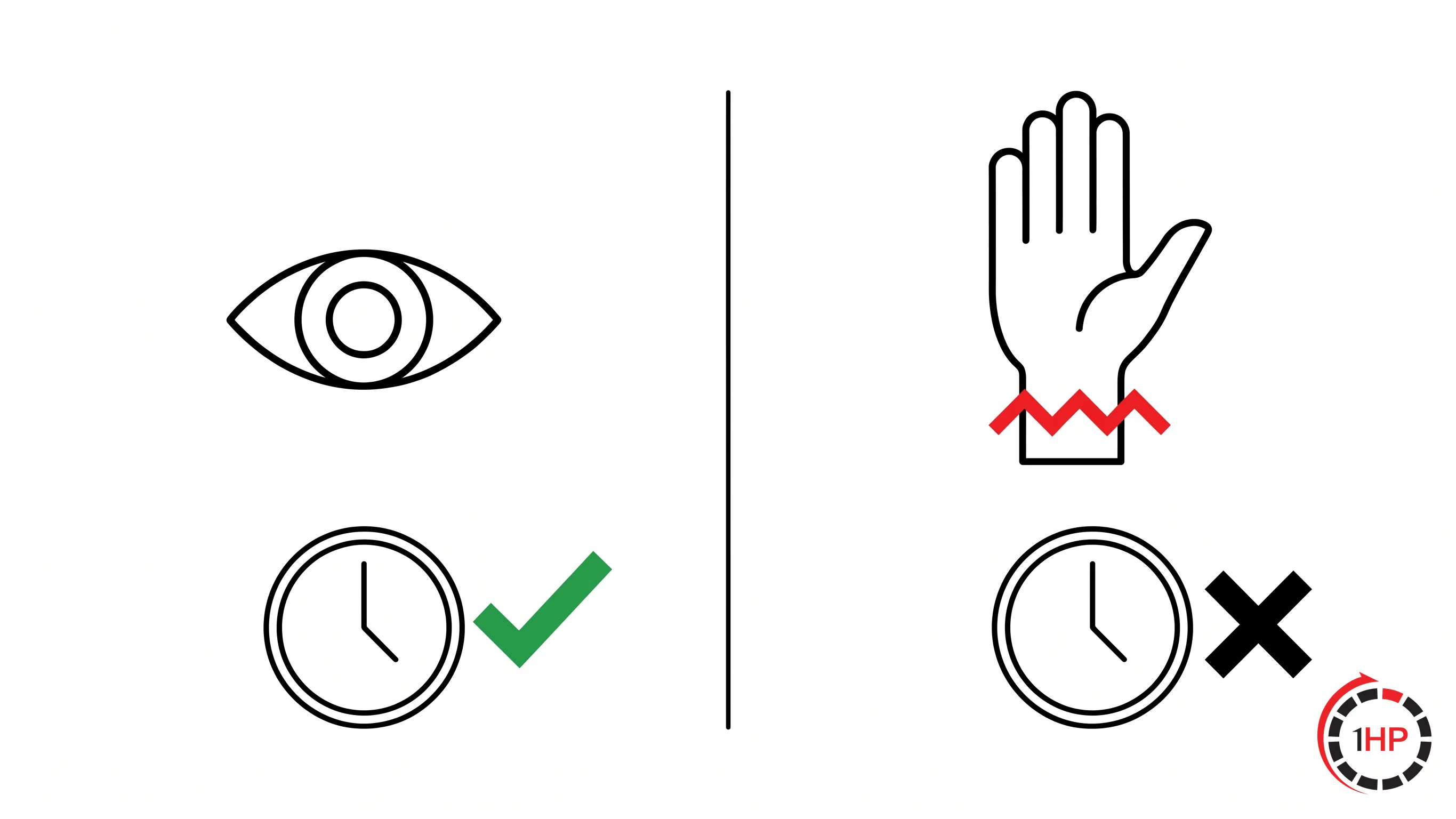
The clearest 20 minute rule we found comes from eye care. The American Optometric Association advises that "for every 20 minutes of computer viewing, look into the distance for 20 seconds to allow the eyes a chance to refocus." Its stated aim is to prevent eyestrain. Nothing in that advice mentions tendons or asks you to take your hands off the keyboard.
Workplace safety agencies do write about hands, and neither of the two we read sets a 20 or 30 minute clock. OSHA, the US workplace safety agency, says: "Every hour, take a five-minute break from computer tasks." It adds, "Build short micro pauses into computer use sessions," without saying how often. Its concern is recovery: when motions repeat for long periods, "there may be inadequate time for your muscles and tendons to recover."
"There is no legal guidance about how long and how often breaks should be for DSE work."
UK Health and Safety Executive, guidance on display screen work, updated 2025
The UK regulator's only numbers come as an illustration: "5 to 10 minutes every hour is better than 20 minutes every 2 hours." It also says: "Ideally, users should be able to choose when to take breaks."
If the official advice is loose, perhaps the research beneath it is firmer. A 2019 Cochrane review led by Tessy Luger of the University of Tübingen included six randomized trials of work-break schedules, with 373 workers. All of the trials enrolled healthy adults who were free of musculoskeletal complaints at the start. The review found low-quality evidence that additional breaks "may not have a considerable effect on musculoskeletal pain, discomfort or fatigue." Its comparison of more frequent with less frequent breaks rested on one study of 10 people. "No trials were identified that assessed the effect of different durations of work breaks," the authors wrote, and they judged every included study at high risk of bias.
A 2022 meta-analysis of micro-breaks, pooling 2,335 people, found effects on fatigue and vigor that were statistically significant but small, and no significant effect on overall performance. The authors note "there is still no established standard regarding the length of such short breaks." In ergonomics, where the idea began, micro-breaks are "scheduled rests that individuals take to prevent the onset or progression of physical symptoms." Managing symptoms that already arrive at a predictable minute is a different job.
| Source | Timing it gives | Written for or tested on |
|---|---|---|
| American Optometric Association | Look into the distance for 20 seconds every 20 minutes | Eyes, to prevent digital eyestrain |
| OSHA workstation guidance | Five minutes every hour, plus micro pauses of unstated frequency | Computer workers, to prevent musculoskeletal disorders |
| UK Health and Safety Executive | No legal rule; 5 to 10 minutes every hour offered as an example | Display screen users and their employers |
| Cochrane review, 2019 | No trials on break duration | 373 workers free of musculoskeletal complaints |
| Micro-break meta-analysis, 2022 | No established standard length | 2,335 people in 22 samples |
Read closely, the official guidance already contains another signal. OSHA puts it plainly: "Localized pain, stiffness, and tenderness can signal that the muscle or tendon has been exerted beyond its capacity." It asks workers to report symptoms "as early as possible to prevent serious injury or permanent damage." For someone who already hurts, that signal can come long before any stock interval runs out. In case write-ups by Dr. Matthew Hwu, a 1HP expert, one desk worker described "Severe wrist & hand pain after only 10 minutes of typing," and a researcher and programmer had "Instant pain with typing." Two cases cannot show how common that is. Our member data on onset times, later in this article, shows how widely the starting point varies.
Traced to their sources, the familiar intervals assume a body that is not yet signaling. The 20 minute number belongs to the eyes. The hourly break and the micro pause were written to keep symptoms from starting, and the trials that tested break schedules recruited only people without them. Once pain shows up, the guidance itself points to another cue: the pain, stiffness and tenderness it tells workers to report. No study we found has tested breaks timed to a person's own symptom onset, so treat that approach as a reasoned, untested adaptation of the guidance.
Before you set your next timer
- If your timer copies the 20-20-20 eye rule, it was built to rest your eyes. Ask whether any of your breaks actually take your hands off the keys.
- If your employer uses break software with a fixed interval, ask whether you can adjust it. The UK regulator says users should ideally choose when to take breaks, though its guidance applies to UK employers.
- When an app or guide cites research for its interval, ask whether the studies included anyone who already had pain. The trials in the Cochrane review did not.
- Note the minute your pain, stiffness or tenderness usually starts during typing, and report it early at work. OSHA treats those as signs of working past capacity.
How we checked this
We read guidance from two workplace safety regulators and an eye care association, a Cochrane systematic review, a peer-reviewed meta-analysis, and two case write-ups by a 1HP expert. The case quotes are 1HP's own material. They describe two people 1HP chose to write about and show what can happen, not how often it happens. The Cochrane review rests on six small trials, all from Europe or North America, with evidence its authors rated low or very low quality. The meta-analysis mixed lab students and employees and measured fatigue, vigor and performance rather than wrist pain. 1HP sells online coaching programs that time breaks to each member's own symptom onset, so we have a stake in this question. Still unknown: who first attached a 20 or 30 minute interval to hand breaks, and whether breaks timed to personal onset work better than fixed ones. No trial in this evidence has tested that.
- American Optometric Association, computer vision syndrome guidance, retrieved November 2026.
- OSHA, Computer Workstations eTool, additional information, undated.
- UK Health and Safety Executive, display screen work routine and breaks, updated March 2025.
- Luger T, Maher CG, Rieger MA, Steinhilber B, Cochrane review of work-break schedules, July 2019.
- Meta-analysis of micro-breaks on well-being and performance, August 2022.
- Matthew Hwu, PT, DPT, OCS, CSCS, 1HP case write-ups on a database administrator with wrist flexor pain and a researcher and programmer with chronic hand pain, undated.
How should you set a break timer when typing already hurts?
Our baseline is a 5 minute break every 50 minutes of play, and a skipped break carries over. When you already hurt, your own symptom onset sets the clock instead.
That carry-over rule is the part most people miss. If you blow through a break and keep going for 2 hours, the next break becomes 10 minutes, not 5. Breaks are a debt you pay back, not a coupon you can skip. We set it up this way because rest you owe does not vanish just because the match got interesting.
The 50 minute number is a starting point for people managing load. It is not a promise that your tendons can last 50 minutes today. So here is how to find your own number, using nothing more than your phone:
- For a few normal workdays, start a stopwatch each time you begin a typing or gaming block.
- Note the minute your usual symptom first appears (ache, burning, tightness), and rate it from 0 to 10.
- Pick the earliest onset time that shows up on a typical day, not your best day.
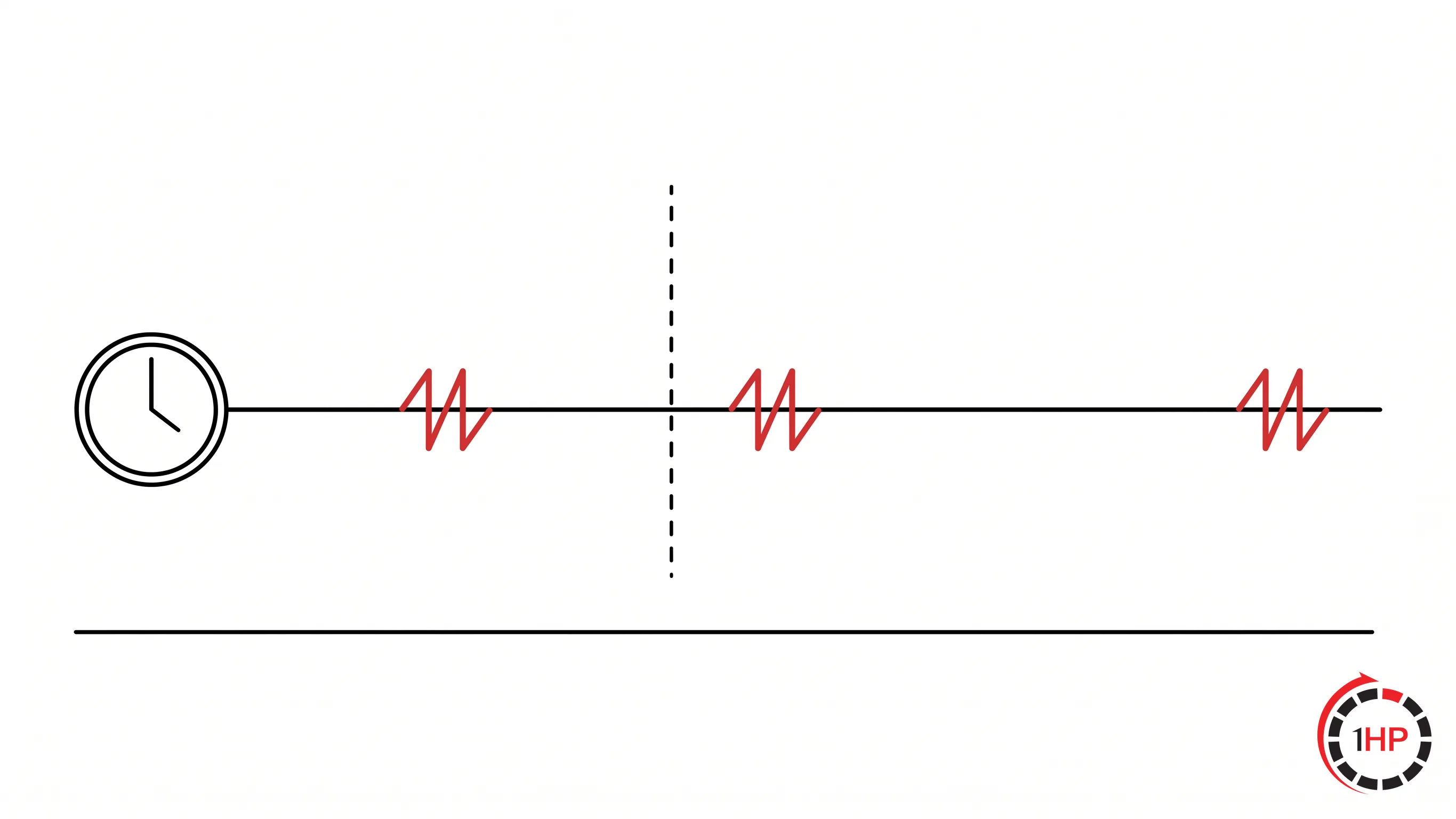
- Set your break timer a few minutes before that point.
- When it rings, stop even if you feel fine, and get your hands fully off the keyboard and mouse.
- Recheck every week or so. When symptoms start showing up later, stretch the timer to match.
Breaking before the symptom matters more than breaking often. A pause taken after the burn starts is recovery. A pause taken before it is prevention, and that is the version that adds up across a full workday.
People living with repetitive strain often land on this idea by trial and error. In a 2016 thread about break software on r/RSI, a Reddit forum on repetitive strain injury (RSI), one user described changing their settings depending on how bad their symptoms were, and at the time took a 15 second break every 5 minutes. That is one person's experience, not a rule. Our own reason for letting the interval move with you comes from 1HP's work, not from forum threads.
I learned to think this way in esports. 1HP's approach was built from esports medicine work with Team Liquid, 100 Thieves, CLG, Immortals and FlyQuest, where players perform millions of repetitive movements. It has since been shaped by more than 3,000 people over 10 years across our practice, esports work and programs. One pattern never changes: two people with the same job rarely tolerate the same load.
That is why we build a personalized plan with direct 1:1 access to an RSI specialist, not a generic exercise sheet. The break interval is one dial in that plan. If your symptoms include tingling into the fingers, our page on carpal tunnel from repetitive strain explains how the same load logic applies there.
Your onset number is personal. But how much do those numbers actually vary from one person to the next?
How long do people with wrist pain usually type before symptoms start?
In our data, among 229 program members (August 2025 to November 2026), the typical member manages about 48 minutes of activity before symptoms start, but the spread runs from under 27 minutes to past 100 minutes.
Those numbers come from The 1HP Wrist and Hand Pain Report 2026. Among 229 program members (August 2025 to November 2026), the report records a baseline median of 48.4 minutes of activity before symptoms start, measured in 161 of those members. Baseline means the measure taken when someone joins. These are starting points, not results.
The median is simply the middle person in the line. The more interesting part is the spread around them.
The middle half of those members sat between 26.7 and 102.4 minutes. Statisticians call that the interquartile range, which is a plain way of saying where the middle 50% of people land. So one in four members hit symptoms before 26.7 minutes, and another one in four kept going past 102.4.
A 30 minute timer arrives too late for the first group. For the last group, it interrupts work that was going fine.
The same report gives two more starting measures worth holding side by side. Worst pain during activity had a median of 4 out of 10 (124 members), while pain at rest had a median of 1 out of 10 (161 members). That gap matters. Think of it through load vs. capacity: pain tends to show up when the work you ask of a tissue outruns what it can handle right now, and it settles when the work stops. Low pain at rest with higher pain during use fits that picture well.
It also explains why the clock on your stopwatch is the useful number. Your onset time is your current capacity, written in minutes.
A fair question is how much weight these figures can carry. We work only with repetitive strain injuries of the wrist, hand and forearm, so the members behind them look a lot like a typist who already hurts. They are still a small slice of the people we have worked with over the last decade. And like the short reports we publish as 1HP Research, this is an internal analysis, not peer reviewed, and it states the limits of its own data.
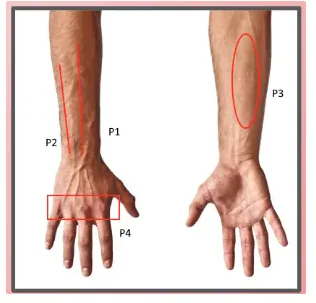
What the spread does not tell you is where you sit inside it. Your number may land anywhere in that range, whether your pain lives in the forearm, the thumb or the pinky side of the wrist. Two people at the same desk, with the same keyboard, can be an hour apart.
If your stopwatch said 20 minutes, a 30 minute timer has you playing the last 10 on a low health bar.
So should you ditch the 20 minute timer?
Retune it rather than ditch it. If typing already hurts, set each break a few minutes before your usual onset, then build capacity so that onset moves later.
Among 229 program members in The 1HP Wrist and Hand Pain Report 2026, symptoms typically began a little under an hour in, and many hit them far sooner. At 1HP we see this kind of pain as a capacity problem, not a structural one, which is why a clean MRI or a cortisone shot so often leaves it in place. I expect timers set by your own onset to become the normal way people in pain pace their day.
Breaks are pacing. They are not the fix. The "Give me a break!" meta-analysis found that longer breaks gave a bigger boost to performance than shorter ones, yet no break of any length trains a tendon to handle more work.
That is why I would rather you spend some energy on the question our YouTube Short asks: could 20 minutes a week help prevent wrist pain?
Start with tomorrow's stopwatch. Note the minute your wrist first speaks up, and set the next alarm a few minutes before it.
Frequently Asked Questions
What else do people ask about typing breaks and wrist pain?
Most questions come down to one thing: whether your own symptoms or a stock schedule should run your day. Here are the ones I hear most.
What if I get instant pain when typing?
Then there is no onset window for a timer to sit in front of. A clock-based break cannot help when the first keystroke already hurts. In that case I would shrink the typing block to whatever feels manageable, even a few minutes, and put the real effort into building tolerance with guidance rather than waiting for the pain to clear on its own.
Is one long typing session worse than several short ones?
Office posture checklists treat it that way. A 2025 study in the Journal of Occupational and Environmental Medicine scored workers with the Rapid Office Strain Assessment (ROSA), a picture-based checklist of chair, screen, mouse, phone and keyboard setup. ROSA adds a risk point for continuous computer use of more than 1 hour a day, while intermittent use of 1 to 4 hours leaves the score unchanged.
Can a good desk setup score say I am fine when I hurt?
Yes. In that same 2025 study of 336 office workers, every participant reported musculoskeletal symptoms from computer use, yet ROSA rated 83% as low risk. Your symptoms are better data than a setup score.
Do more frequent breaks reduce pain?
Not clearly. A 2019 review of break-schedule trials found only low-quality evidence, and it suggested break frequency may make little difference to pain. Every worker in those trials started out free of complaints, and no trial tested how long a break should last.
I am a dentist with wrist pain. Does this apply to me?
The logic carries over to any repetitive hand work. Note when symptoms usually start across a typical clinic day, then plan short resets a little before that point.
How do I get help setting my own interval?
People start with a free consultation with a 1HP expert, booked through the 1HP website.
Written by
Dr. Elliot Smithson
PT, DPT, MS, ATC, EMT, Co-Founder
Dr. Elliot Smithson earned his undergraduate degree from the University of Central Florida in Athletic Training, his Master's from Marshall University in Athletic Training, and his doctorate in Physical Therapy from the University of St. Augustine for Health Sciences.
Follow on XThis article is for educational purposes only and is not a substitute for professional medical advice, diagnosis, or treatment.