
Table of Contents
Intersection Syndrome: The Squeaking Pain Above Your Wrist
By Dr. Elliot Smithson, PT, DPT, MS, ATC, EMT·July 22, 2026

If you have pain on the back of your forearm, a few inches above your wrist on the thumb side, and especially if it sometimes makes a faint squeaking or creaking sensation when you move your wrist, there is a specific condition you should know about. It is called intersection syndrome, and it is one of the more commonly misidentified sources of forearm pain in people who use their hands repetitively.
It frequently gets mislabeled as generic tendinitis, or confused with De Quervain's, or lumped in with wrist pain and treated with rest and a brace that never resolves it. I want to walk you through exactly what it is, why it happens, how to recognize it, and the specific way we actually treat it, including the exercises we use.
This is a thorough one. Let us get into it.
What Intersection Syndrome Actually Is
To understand this one, you need a quick picture of the anatomy, because the name describes exactly what is happening.
On the back of your forearm, two groups of muscles and tendons cross over each other. Running down toward your wrist are the tendons of your radial wrist extensors, the muscles that cock your wrist back. Crossing over the top of them, at an angle, are the muscle bellies of two thumb muscles that travel out to your thumb. These two groups literally intersect on the dorsal, thumb-side of your forearm, roughly two to three inches above the wrist. That crossing point is the intersection [1].
Every time you move your wrist, these two groups slide against each other at that crossing point. Under normal, well-conditioned conditions, that is completely fine. But when the tissues are overloaded by repetitive movement, friction builds up at the intersection, and the tendon sheath of the wrist extensors becomes irritated and inflamed. This is a friction-driven tenosynovitis, inflammation of the tendon and its surrounding sheath, at the precise point where these two tendon groups rub against one another [2].
That is intersection syndrome. Not a mysterious wrist problem, but a specific, identifiable irritation at a specific anatomical crossing point.
How You Get It
Intersection syndrome is an overuse condition. It comes from repeated wrist extension and flexion, particularly when combined with the repetitive movements that make those two tendon groups slide against each other over and over.
It is well known in rowers, to the point that it has historically been nicknamed after them, as well as in weightlifters, racquet sport players, and skiers. But for the population we work with, it shows up from the repetitive demands of daily hand use. Heavy mouse and keyboard work with the wrist held in extension. Repetitive gripping and wrist movement. Drumming. Manual and craft work involving repeated wrist motion. Anything that drives high volumes of wrist extension and movement can build the friction that irritates the intersection.
As with every repetitive strain problem, the underlying issue is that the demand placed on these tissues exceeded their capacity to handle it. Which is the key to understanding why it happens and how to fix it.
How To Recognize It
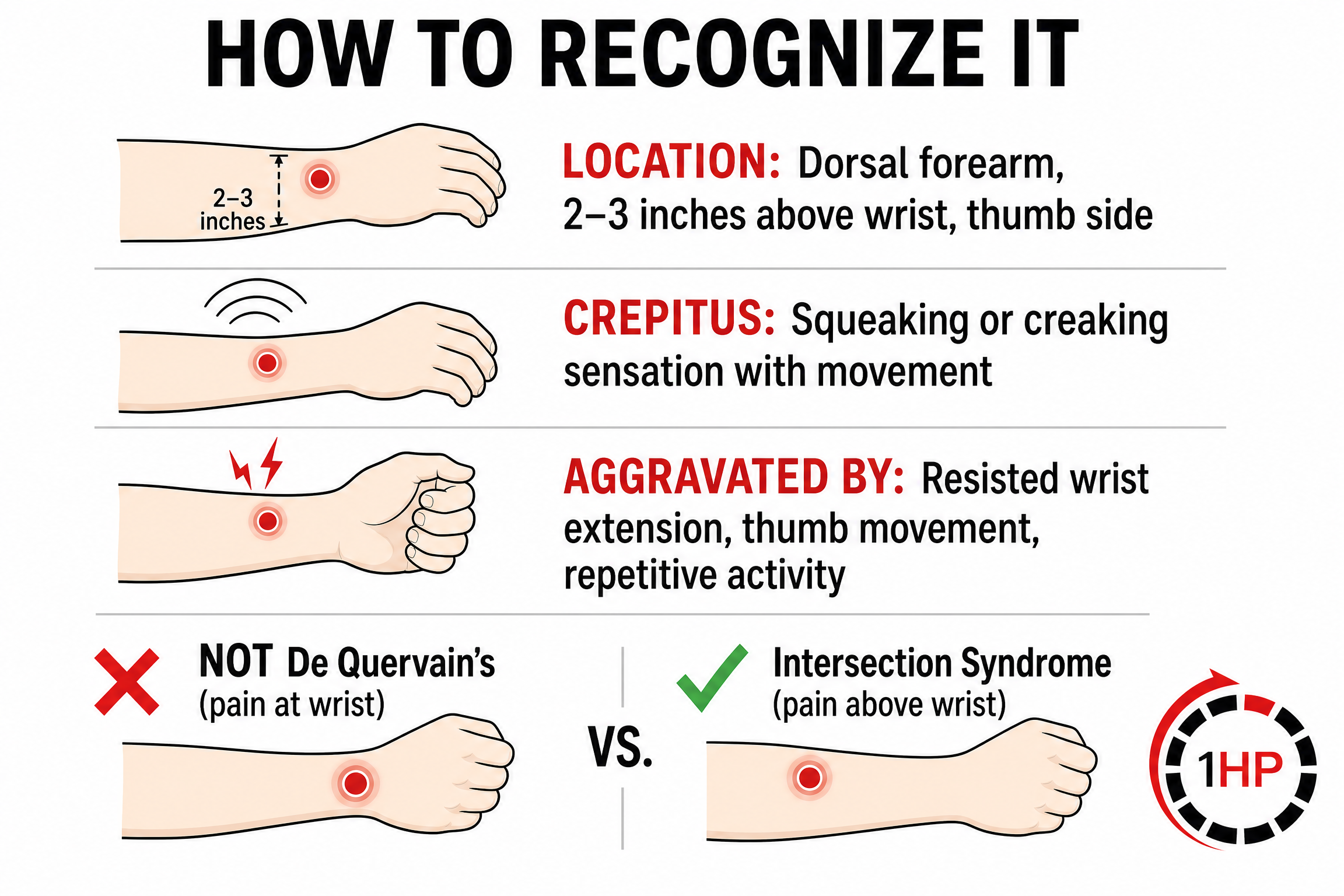
Intersection syndrome has a recognizable signature, and the location is the most important clue.
The pain and often visible swelling sit on the dorsal, thumb-side of the forearm, roughly two to three inches above the wrist. This proximal location is what distinguishes it from De Quervain's, which involves some of the same thumb tendons but produces pain right at the wrist and base of the thumb, lower down. Intersection syndrome is higher up the forearm. If your pain is a few inches above the wrist on the back of the forearm rather than at the wrist itself, that points toward the intersection [3].
The other hallmark is crepitus. Many people with intersection syndrome notice a faint squeaking, creaking, or rubbing sensation when they move the wrist, sometimes describable as the feeling of walking on fresh snow. That is the inflamed, friction-loaded tissue moving, and it is fairly characteristic of this condition.
You will typically also notice the pain worsening with resisted wrist extension, with thumb movement, and with the repetitive activity that drives it. There may be tenderness and swelling you can feel directly over that crossing point on the forearm.
Why It Happens, In The Terms That Matter

Here is the framing that makes the solution obvious. Think of the wrist extensor and thumb tendon groups as having a healthbar that represents how much repetitive load and friction they can tolerate before they become irritated. Every wrist movement costs a little from that bar. When the bar runs to zero, the friction at the intersection outpaces what the tissue can handle, the sheath becomes inflamed, and you feel pain and notice the crepitus [4].
The size of that healthbar is determined by the endurance capacity of these tissues. And in intersection syndrome, that capacity has fallen below the demands you are placing on the crossing point. This is why it developed, and it is also why the standard approach so often fails to resolve it.

Rest and bracing offload the tissue, which quiets the acute irritation, and in a genuinely acute flare a short period of relative rest is reasonable. But rest alone shrinks the healthbar further, so when you return to your normal activity the tissue can handle even less friction than before, and the irritation returns. A corticosteroid injection can temporarily reduce the local inflammation, but it does nothing to build the capacity that was missing, and the problem tends to come back once you resume the activity. None of these address the actual deficit, which is why intersection syndrome so often becomes a recurring or lingering problem.
The durable solution is to build the endurance capacity of the involved tissues, so the crossing point can tolerate the friction of your daily activity without becoming irritated, while managing your load intelligently as that capacity rebuilds. Which brings us to the exercises.
How We Actually Treat It: The Exercises

Our exercise approach for intersection syndrome centers on the wrist and finger extensors, the tissues at the heart of the problem. We use a deliberate progression. We start by reducing tension and opening a window for the tissue to work efficiently, then introduce gentle loading that builds capacity while actually reducing pain, then progress into endurance loading that rebuilds the healthbar for the long term. Here are the three core movements.
Wrist Extensor Stretch

We start here. When the wrist extensors are irritated, they reflexively tighten and guard, which increases tension through the tendons and adds to the friction and compression at the intersection. Gently stretching the wrist extensors reduces that protective tightness and opens a window in which the tissue can move more efficiently and tolerate loading better. It is important to understand that stretching alone does not fix the underlying capacity deficit. It is a preparatory step that reduces tension and makes the loading work that follows more effective. We use it to set the stage, not as a standalone treatment.
Wrist Extensor Isometric

Next we introduce isometric loading of the wrist extensors, holding a contraction without movement. This is a deliberate and evidence-informed choice for an irritated tendon. Isometric loading lets us begin loading and building capacity in the tissue without the repeated sliding movement that drives the friction at the intersection, which makes it an ideal way to start when the area is still reactive. Research on tendon rehabilitation has also shown that sustained isometric contractions can produce a genuine reduction in tendon pain and can favorably influence how the nervous system controls the muscle [5]. So this exercise does two things at once. It starts rebuilding the capacity of the wrist extensors, and it helps calm the pain, all while sparing the irritated crossing point from repetitive friction.
Finger Extension With Bands

As the tissue tolerates more, we progress into banded finger extension. This is high-repetition, low-load endurance work for the finger and wrist extensor group, and it is where we build the real, lasting capacity that grows the healthbar. By training these extensor tissues with the higher-volume, lower-load loading that matches the endurance demands of your daily activity, we build their tolerance to sustained, repetitive use, which is exactly the quality that was deficient. This is the loading that ultimately allows the intersection to handle your normal activity without becoming irritated, because the tissues finally have the endurance capacity to meet the demand.
The progression through these three, reduce tension, load gently and reduce pain, then build endurance capacity, is how we take an irritated intersection and rebuild it into tissue that tolerates your daily hand use. Alongside the exercises, we manage your activity load so you rebuild without repeatedly re-irritating the crossing point, which is what prevents the recurring flare cycle that makes this condition so frustrating for people.
An Honest Note
Most intersection syndrome responds very well to this capacity-based approach. But if you have significant, persistent swelling, a locking or catching sensation, or symptoms that do not respond at all to appropriate loading and load management, it is worth a proper in-person evaluation, because occasionally a more involved presentation needs additional care. A good assessment sorts this out. The point is that for the large majority of cases, the underlying driver is a capacity deficit at the intersection, and that is very much fixable.
How Our Full Program Addresses It
The exercises are one piece. Our complete approach starts by assessing the actual endurance capacity of the involved tissues so we know your real baseline and deficit. From there we build the progressive loading program described above, scaled to your specific tolerance and advanced based on how you respond. We manage your daily activity load using your tissue irritability so you keep building without re-flaring the intersection. And we address the nervous system component through pain science education, because when pain has been present for a while, the system becomes sensitized in ways that loading alone does not fully resolve. Tissue capacity, load management, and nervous system, handled together.
If This Sounds Like What You Are Dealing With
A free consultation is where we start. We assess the actual capacity of the involved tissues, confirm whether your presentation fits intersection syndrome, and show you a clear, specific path to resolving it for your situation.
Most people leave that call understanding their forearm pain more clearly than they have in months of appointments.
We have a small number of spots remaining this month.
Book a free consultation with our physical therapists today.