

Table of Contents
Tennis Elbow From Computer Use
By Dr. Elliot Smithson, PT, DPT, MS, ATC, EMT·August 18, 2026

You have not picked up a tennis racquet in years. Maybe ever. So when a doctor tells you that the pain on the outside of your elbow is tennis elbow, it can feel almost absurd. How can you have a tennis injury from sitting at a desk?
Here is the answer that reframes the whole thing. Tennis elbow has almost nothing to do with tennis. Tennis is just one of many activities that can cause it, and frankly not even a common one. The actual cause is repetitive loading of a specific group of forearm muscles, and it turns out that a full day of typing, clicking, and mousing loads those exact muscles just as effectively as any backhand ever could. The name is a historical accident. The mechanism is pure repetitive strain, and computer work is one of the most reliable ways to produce it.
Let me show you exactly how, what is actually happening in your elbow, and the specific way we resolve it, including three exercises you can start with.
What Tennis Elbow Actually Is
The medical name is lateral elbow tendinopathy, or lateral epicondylalgia. The lateral epicondyle is the bony bump on the outside of your elbow, and it is the anchor point where a group of forearm muscles attaches through a shared tendon called the common extensor tendon [1, 2].
When that tendon becomes irritated and overloaded at its attachment, you get the pain of tennis elbow. And research is quite specific about which muscle is usually responsible. One muscle, the extensor carpi radialis brevis, accounts for roughly 90 percent of lateral elbow tendinopathy cases. So while a whole group of muscles attaches at that spot, the brevis is the one that most often becomes the problem.
The Anatomy of the Extensor Complex
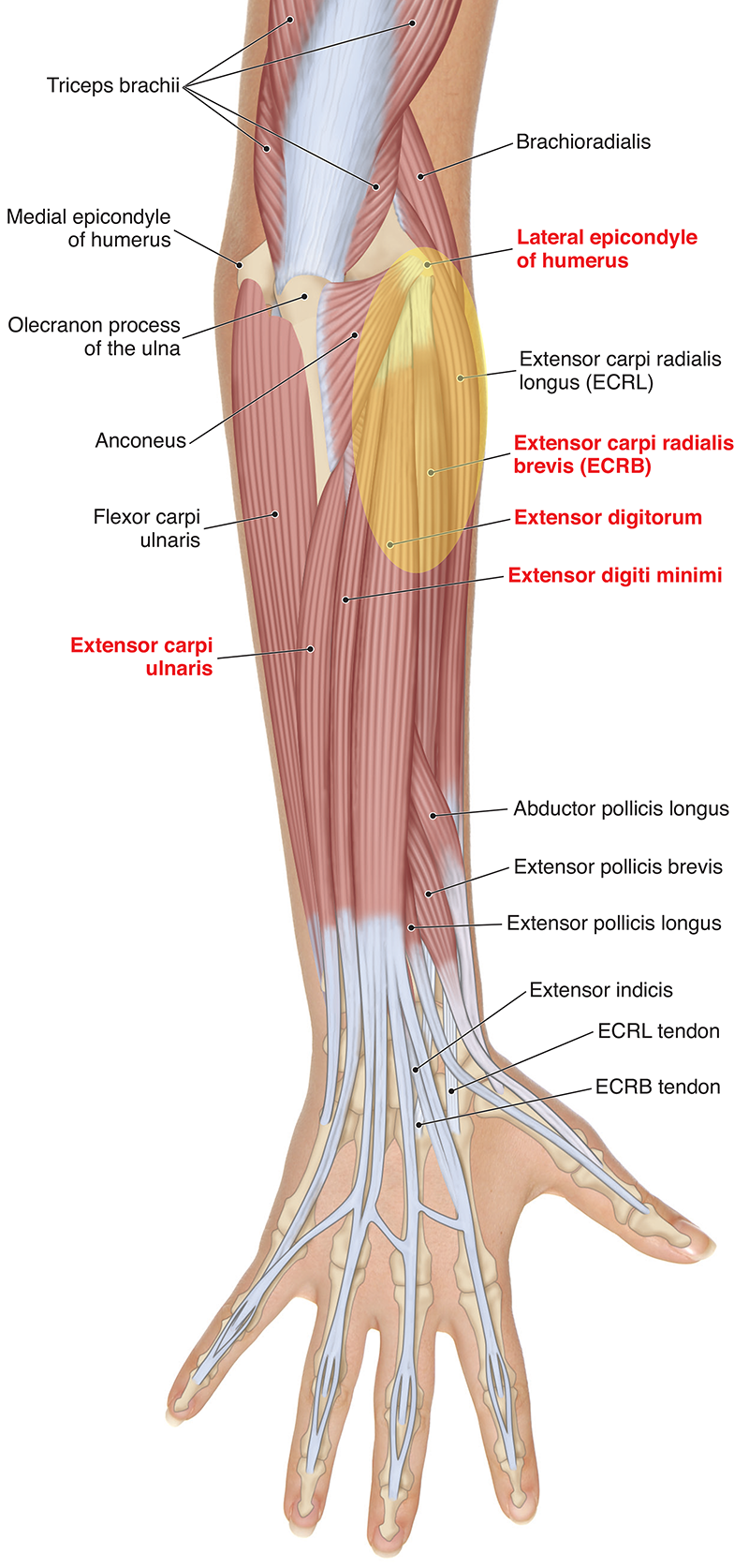 The muscles that share that common attachment at the lateral epicondyle are your wrist and finger extensors. The main players are the extensor carpi radialis brevis and longus, which extend and stabilize your wrist and cock it back, the extensor digitorum, which straightens your fingers, and the extensor carpi ulnaris, which works with the others to move and stabilize the wrist. They all originate at or right around that same bony point on the outside of your elbow, run down the back of your forearm, and travel out to your wrist and fingers.
These muscles do two jobs. The obvious one is movement, extending your wrist and straightening your fingers. But the job that matters most for understanding tennis elbow from computer use is the quieter one: stabilization. Your wrist extensors are constantly working to hold your wrist steady and positioned so that your fingers can do precise work. And that stabilizing role is where desk work quietly hammers them.
How Computer Use Overloads Them

Here is the mechanism almost nobody explains. It comes down to a concept called co-contraction.
When you press a key or click a mouse button, your finger flexors do the pressing. But for your fingers to press precisely and forcefully, your wrist has to be held stable. If your wrist just flopped around, you could not type or click accurately. So every time your fingers work, your wrist extensors have to contract to stabilize the wrist against that motion and against gravity, holding it in a slightly extended, steady position. The flexors press, and the extensors brace. That is co-contraction, and it means your extensor muscles are working almost continuously the entire time you use a keyboard or mouse, even though it feels effortless.
Now layer on the other demands. Gripping your mouse requires the extensors to co-contract, because you cannot generate grip force with a floppy wrist. The extensors stabilize so the grip can happen. Moving your mouse around involves repeated radial and ulnar deviation, side-to-side wrist movements driven by these same extensor muscles. Clicking involves the finger extensors lifting your fingers between clicks, thousands of times a day.
Add it all up across a full workday. Thousands of keystrokes, thousands of clicks, constant mouse movement, sustained gripping, each and every one requiring your wrist extensors to fire and stabilize. It is a low-level contraction, but it is held and repeated for hours, day after day. That is an enormous cumulative load on the extensor complex, and specifically on that vulnerable extensor carpi radialis brevis tendon at the elbow. A tennis backhand loads this tendon in a few sharp bursts. A workday loads it continuously for eight hours. You genuinely do not need the racquet.
The Physiology: Load, Capacity, and Your Healthbar

Here is the framing that makes the whole thing make sense. Think of your extensor muscles and their tendon as having a healthbar that represents how much repetitive load they can handle before they become irritated. Every keystroke, every click, every second of stabilizing co-contraction costs a small amount of HP. When the healthbar runs to zero, the tissue at the tendon attachment becomes irritated and inflamed, and you feel the pain of tennis elbow.
The size of that healthbar is set by the endurance capacity of these tissues. And tennis elbow develops when the cumulative demand of your daily hand use exceeds that capacity. Your extensors simply do not have the endurance to handle the sustained co-contraction and repetitive load your work requires, so they get overloaded and irritated. This is a reactive tendinopathy, the tendon reacting to a load it has not been built to tolerate [6].
Which means the fix is not to run from load. It is to build the healthbar so the tissue can handle your daily demands.
Common Symptoms
Tennis elbow from computer use has a recognizable pattern. You will typically feel pain and tenderness on the outside of the elbow, right over that bony bump, and it often radiates down into the forearm. The pain tends to flare with gripping and with the very activities that cause it, typing, mousing, and gripping, as well as everyday tasks like shaking hands, turning a doorknob, opening a jar, or lifting a coffee cup. Many people notice grip weakness, a sense that their grip gives out or that holding things is harder than it should be. There is often stiffness in the morning or after rest, and some people notice a warm-up phenomenon, where the pain is worse at first, eases somewhat during activity, then returns worse afterward. That warm-up pattern is actually characteristic of tendon problems [3].
Why Your Imaging Came Back Clean
If you had imaging, there is a good chance it came back unremarkable, which may have left you confused or feeling dismissed. Here is why that happens.
An X-ray only visualizes bone. It cannot see the tendon at all, so for a tendon problem it can do nothing except rule out a fracture. MRI and ultrasound can image the tendon, but in the reactive and early stages, the changes are subtle and often do not register, because the tendon structure is still largely intact. Worse, tendon findings on imaging notoriously fail to correlate with pain. Abnormal-looking tendons show up in large numbers of people with no pain at all, and plenty of genuinely painful tendons look acceptable on a scan.
The reason is that your problem is not a visible structural lesion. It is a capacity deficit, how much repeated load the tendon can tolerate, and that is something no static image can measure. A clean scan does not mean nothing is wrong. It means the problem is not the kind a scan can see.
Why Rest and Bracing Do Not Fix It

The standard advice is rest it and wear a strap. Both feel reasonable. Both fail to resolve the actual problem, and it is worth understanding exactly why.
Rest offloads the tendon, which quiets the irritation in the short term. But rest also shrinks the healthbar. Unloaded tissue deconditions, its capacity drops, so when you inevitably return to your work, the tendon can handle even less than before. The pain returns faster, you rest again, and your capacity spirals downward. Rest treats the symptom while quietly making the underlying deficit worse.
The tennis elbow strap, the counterforce brace, deserves a closer look because the rationale sounds clever. It is a band worn around the upper forearm, a couple of inches below the elbow, over the muscle bellies of the extensors. The theory is that by compressing the muscles at that point, it creates a kind of false anchor and disperses some of the force before it reaches the irritated tendon attachment at the elbow, reducing the strain on the painful spot.

Here is why it does not hold up as a solution. At best, the strap is a load-management tool that can dampen the strain at the tendon origin and take a bit of the edge off the pain in the moment. That is the ceiling of what it does. It does absolutely nothing to build the capacity of the tissue. It does not make the tendon stronger, it does not increase its endurance, and it does not address the co-contraction demand that is overloading the extensors in the first place. Rest and bracing manage the pain. Neither builds the healthbar. And building the healthbar is the only thing that actually fixes tennis elbow for good.
Our Philosophy: High Volume, Low Load, Tendon Neuroplastic Training

So if the problem is capacity, the solution is to rebuild it with the right kind of loading. And there is now direct evidence for exactly this in tennis elbow.
A 2018 case series applied tendon neuroplastic training to lateral elbow tendinopathy for the first time. The approach centered on metronome-paced wrist extension loading, chosen specifically to target that extensor carpi radialis brevis tendon responsible for the majority of cases. Over eight weeks, both patients achieved clinically meaningful reductions in pain and improvements in function, and critically, they did so while continuing their normal, demanding work duties the entire time. One of them, treated with the loading program alone and no passive therapy at all, became completely pain-free, and the results held at follow-up months later [1].
What makes tendon neuroplastic training different from just doing exercises is the reason it works on two levels at once. Research has shown that chronic tendinopathy is not only a tissue problem. It also involves measurable changes in how the brain controls the muscle, alterations in the motor cortex that affect muscle recruitment [4, 7]. Traditional passive treatments do nothing for this neurological component. Tendon neuroplastic training combines resistance loading with an external pacing cue, a metronome, and that pacing has been shown to drive the corticospinal adaptations that address the motor control side of the problem. So you rebuild the tendon's capacity and retrain the brain's control of the muscle at the same time. Tissue and nervous system, together.
Three Exercises To Start With
Here are three movements that make a solid starting point for computer-related tennis elbow. They follow a deliberate progression: reduce the protective tension, introduce gentle loading that also calms pain, then build real endurance capacity.
Wrist Extensor Stretch

Three sets of 30 seconds. When the extensors are irritated, they tighten and guard, which adds tension and strain at the elbow attachment. Gently stretching them reduces that protective tightness and opens a window for the tissue to work more efficiently and tolerate loading better. It sets the stage. It is not a fix on its own.
Wrist Extensor Isometric

Three sets of 45 seconds. Here you load the extensors by holding a contraction without movement. This is a deliberate early-stage choice, because it lets you start loading and building capacity in the tendon without the repetitive movement that tends to aggravate it, and sustained isometric loading has been shown to actually reduce tendon pain and favorably influence the nervous system's control of the muscle [5].
Metronome-Paced Wrist Extension
 Wrist extension with a dumbbell, paced to a metronome at 50 beats per minute, performed until failure, using a weight equal to about 5 percent of your bodyweight. This is the high-volume, low-load, metronome-paced loading that builds the real, lasting endurance capacity, the piece that ultimately grows the healthbar so your extensors can handle a full workday without becoming irritated. The metronome pacing is doing the neuroplastic work, and taking the set to failure at a light load is what drives the endurance adaptation these tissues need.
Stop Managing It and Start Resolving It
Here is the truth. If your living depends on your hands, tennis elbow is not something to keep taping over with a strap and pushing through, hoping it fades. It is a capacity deficit in a specific tendon, it is measurable, and it is fixable, but only if you actually rebuild the capacity instead of endlessly managing the pain.
We offer a free consultation, and it is a real diagnostic session. We run an actual endurance assessment of the involved muscles to measure exactly where your capacity sits, we confirm whether your pain fits computer-related tennis elbow, and we show you the clear path to resolving it.
Book a free consultation with our physical therapists today.