
Table of Contents
Weak Grip After Years of Wrist Pain: What a PT Checks First
By Dr. Elliot Smithson, PT, DPT, MS, ATC, EMT·
Quick answer
Compare your pain-free grip with your maximum grip for 2 weeks. Grip that rises and falls with pain usually points to irritated tendons; weakness that stays flat deserves nerve testing. Years of pain alone don't settle it. The trend across your log counts more than any single day.
You reach for your coffee mug and your fingers hesitate. Maybe a pen slips during a meeting, or your mouse hand feels oddly flimsy by the end of a ranked session. After years of wrist pain, that new weakness can feel like a debuff you never agreed to.
It's common to worry that something has quietly broken. Often the story is simpler than that. In a case written up by Dr. Matthew Hwu, one of 1HP's experts, a database administrator felt severe wrist and hand pain after only 10 minutes of typing, plus forearm pain just lifting a cup. His posture was decent. Testing pointed instead to low forearm endurance, exactly the gap that load vs. capacity thinking predicts.
Another case shows how low that ceiling can sit. Julian, a crypto trader and lifelong gamer, could not hold a mouse for 5 minutes. His wrist flexors managed 26 reps at 1.5 lbs before pain began, even though his X-rays and EMG had come back negative and his MRI was normal.
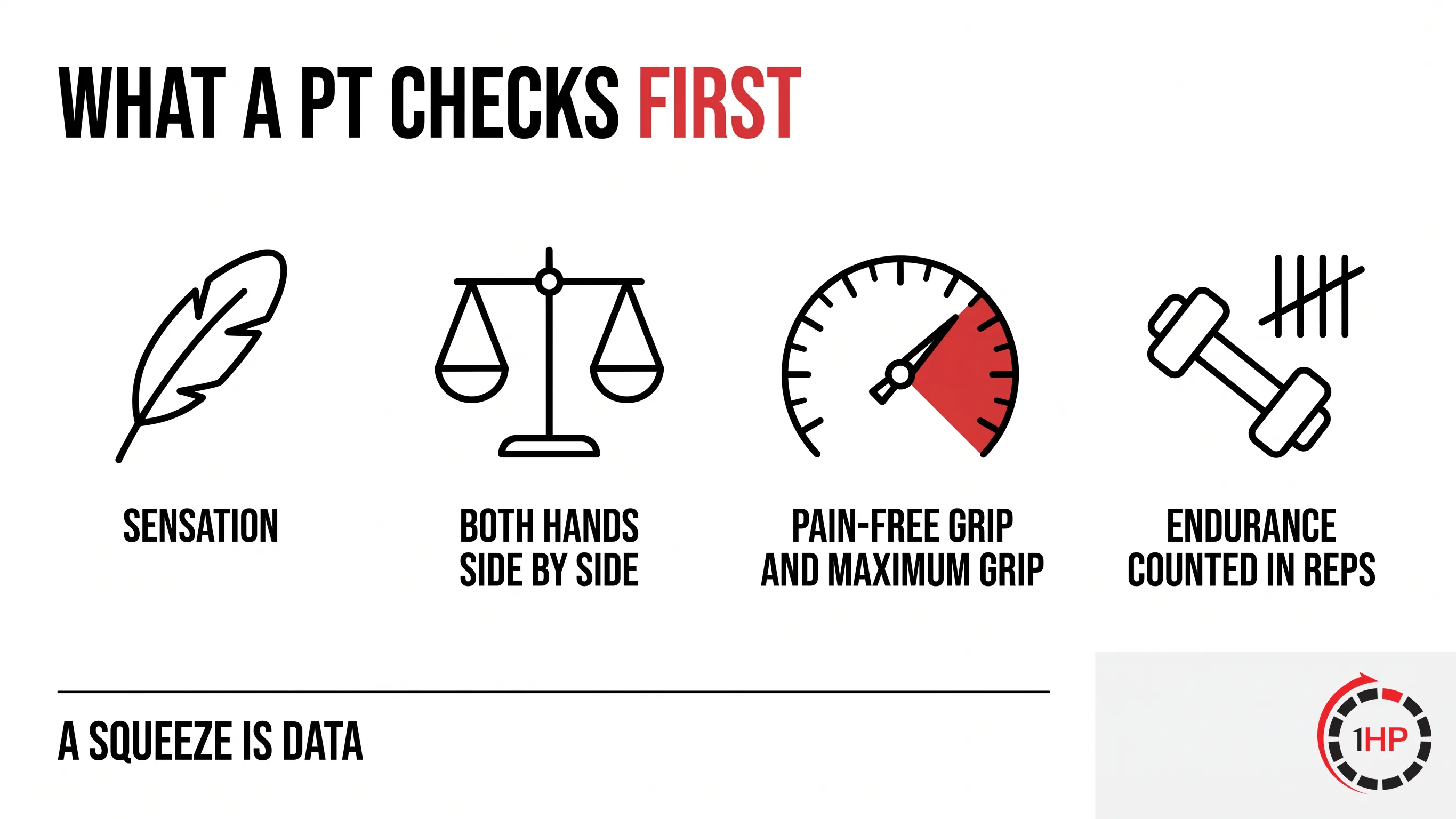
You are not alone if your scans look clean and your grip still feels off. In this article, I walk through what a physical therapist usually checks first when grip fades: sensation, both hands side by side, pain-free grip (the hardest squeeze you can make before pain starts) next to maximum grip, and endurance counted in reps. I'll also show how two weeks of simple numbers can separate grip that rises and falls with pain from weakness that stays flat and deserves a nerve check.
First up: why grip drops at all.
A jar lid that used to be easy now takes a second try. After years of wrist pain, you may have already swapped in a new mouse, worn a brace, or even set up dictation software to spare your hands, and now your grip feels weaker on top of everything else.
Weak grip is worth measuring, not guessing about. A 2024 review by Vaishya and colleagues went as far as proposing hand grip strength as a new vital sign in clinical practice, describing it as a fundamental measure of how well your muscles are working. A squeeze is data.
A two-week comparison of pain-free grip against maximum grip is the key.
Why does your grip feel weak after years of wrist pain?
Weak grip after years of wrist pain often means pain is capping how hard you squeeze, rather than lost muscle, while steady weakness with numbness points toward a nerve check.
Before anything else, it can help to ask yourself four plain questions:
- Does your grip feel weaker on high-pain days and stronger on calm ones?
- Does squeezing start to hurt before your hand actually gives out?
- Do you also notice numbness or tingling in your fingers?
- Has the weakness stayed the same, or slowly grown, no matter how your pain feels?
Yes to the first two often fits grip that rises and falls with pain. Yes to the last two is a good reason to get your nerves checked first. Many people land somewhere in between, and that is completely normal.
Grip is not just a muscle score. Pain and sensory loss are among the factors known to affect hand grip strength, alongside age, sex and BMI, according to a 2020 paper by Wollesen, Gräf and colleagues in Safety and Health at Work.
The same paper noted that grip measured with the wrist bent forward or back comes out lower than grip in a neutral position, because the muscles change length and can no longer produce their maximum force. It also described carpal tunnel syndrome as a cause of lower grip, through nerve impairment and a loss of strength in the small muscles inside the hand.
So two very different problems can feel identical. Your hand cannot tell you which one it is.
I think of it as load vs. capacity. When the daily load on irritated tendons runs past what they can handle, pain drains your health bar, and a full-strength squeeze stops feeling safe. That is a capacity problem. Capacity is trainable. A nerve that is being squeezed is a different quest with different rules, which is why the order of checks matters so much.
That idea runs through our work with more than 3,000 people over 10 years across our practice, esports work and programs. Build the capacity of the tendons, and the goal is that they cope with the keyboard, the mouse and the long ranked session again.
The 1HP Clinical Outcomes Report 2026 gives one view of how that plays out. Among Power Leveling members who completed a follow-up survey, 72% reached a meaningful improvement in arm, wrist and hand function, and 33% did in the self-guided program; those are raw rates, not a head-to-head test of the two programs. The figure comes with limits: the report is an internal analysis of 226 members who joined between August 2025 and October 2026, it has not been peer reviewed, and it counts only those who answered the follow-up. Results vary. Both of our published reports are collected on the evidence-based approach page if you want to read them in full.
A weak squeeze on a bad day does not have to mean the strength is gone. You can measure which story fits you, at your own pace.
What does a PT check first when your grip is weak?
A physical therapist usually starts with your story and safety screening, then tests sensation, compares grip on both hands at pain-free and maximum effort, and counts endurance reps.
- Your history. How long the pain has been around, what makes it flare, and when your grip first felt different.
- Safety screening. A short, calm set of questions about signs that belong with a doctor first.
- Sensation. Light touch across the fingers to see whether any area feels dull, tingly or different from the other hand.
- Grip on both hands, two ways. One squeeze up to the point where pain starts, and one full-effort squeeze, so the gap between them is visible.
- Endurance. How many smooth reps you can do with a light load before form or comfort starts to slip.
Most grip charts were never built for people in pain.
A 2011 normative study by Massy-Westropp and colleagues, drawn from the North West Adelaide Health Study, removed 435 people with hand pain or arthritis before setting its averages, leaving 1,366 men and 1,312 women. Its data showed men gripping harder than women at every age, and the paper describes grip peaking in the fourth decade of life before easing down. Anyone who had pain or aching in the shoulder, arm or hand on most days for a month or more was left out of those averages.
So a chart can tell you how pain-free adults squeeze. It cannot tell you what your grip should be after years of irritated tendons. Comparing you to you works better, like checking your own ranked history instead of the global leaderboard.
The same researchers measured grip seated, with the elbow tucked at the side and bent to a right angle, the wrist neutral, and the average of three squeezes per hand. That setup is worth copying at home, because a reading only means something next to another reading taken the same way. If the sensation check turns up tingling, the guide to arm and hand numbness from repetitive strain walks through what that can feel like.
Function matters as much as force. The QuickDASH is a short survey of how well you use your arm, wrist and hand in daily life, and it is the same survey our Clinical Outcomes Report 2026 tracks. Among 1HP program members who completed the report's follow-up survey, average QuickDASH scores fell 46%, from 34.4 to 18.0. In that same group, the median time to a meaningful improvement was 45 days, and 55% had reached it by their 4-week check-in. Results vary.
Change can show up in weeks. A two-week log is a starting snapshot, not a final score.
That is why a 1HP plan is built around your own numbers, with direct 1:1 access to an RSI specialist rather than a generic exercise sheet. And the first thing those numbers help sort out is whether a nerve or a tendon is setting the limit on your squeeze.
What can a grip number tell you about why your hand got weaker?
A squeeze on a dynamometer produces one number. When German researchers tested 145 factory workers, that number tracked neck pain more closely than the wrist pain many of them reported.
The workers checked rubber tubes and sealing rings, repetitive work that wears on wrists. Bettina Wollesen of the Technical University of Berlin, Julia Gräf of the University of Hamburg and colleagues measured their grip in several wrist positions. Forty reported wrist pain. With the wrist straight, their right-hand grip averaged 37.24, against 42.53 for workers without it. The abstract reported no other significant wrist-pain difference.
Neck pain left a bigger mark. In the same right-hand test, its statistical effect was nearly three times the size of wrist pain's. The researchers added a carpal tunnel questionnaire to a model that already included age, weight and neck disability. The share of grip variation the model explained moved only from 0.355 to 0.357. The authors propose a double-crush mechanism: years of bent-neck work irritate a nerve root in the neck and leave the median nerve more vulnerable at the wrist. The study measured one workforce at a single point in time and cannot prove cause.
If a lower number does not measure wrist damage, what is it for? Hand therapists on The Hand to Shoulder Podcast in January 2023 said people with wrist pain rarely have a truly deconditioned grip. They use grip mainly as a test: measure it, support or compress the wrist, then measure again. A number that climbs once the wrist is steadied suggests pain was holding back force. One of them suspected grip strengthening is overused partly because it is easy to measure and shows the kind of change an insurance reviewer looks for. These are clinicians' views, and they fit the study.
Test position moves the number too. Grip is strongest with the palm turned up and weakest with it turned down. It drops with the wrist bent either way and differs between sitting and standing, because bent positions change muscle length, "resulting in nonmaximal grip force," the Wollesen team writes. A reading taken at home with the wrist cocked back cannot be compared with one taken in a clinic chair.
The standard way to take a reading
- Sit with your feet flat and your forearm resting on a table.
- Relax your shoulder and bend your elbow to 90 degrees.
- Hold your wrist between 0 and 30 degrees of extension, and keep it still during the squeeze.
- Squeeze as hard as you can for about 3 to 5 seconds, without jerking.
- Rest about 1 minute between trials. Do three trials per hand, alternating hands.
From the protocol in a 2024 review by Vaishya and colleagues.
Population charts help less than they seem to. Grip is lower in women and in the non-dominant hand, and it falls with age. Norms also vary by country: an Australian population study found its norms among the lowest published internationally. "In general, handgrip strength depends on gender, age, and the height of a person," said Sergei Scherbov of the International Institute for Applied Systems Analysis. His team compares each person only with others of the same sex, age and height. With wrist pain, a fairer comparison is your other hand, or the same hand on another day.
Numbness is where the worry usually goes, and it is common in our programs. Among 229 program members (August 2025 to November 2026), 62% reported numbness or tingling. Of those, 69% reported an ulnar, pinky-side pattern, according to The 1HP Wrist and Hand Pain Report 2026. A symptom that common cannot sort people on its own. Nerve trouble does not always mean flat, steady weakness either. The NHS lists "a weak thumb or difficulty gripping" among carpal tunnel symptoms and says they "often start slowly and come and go." The same report looked at 148 program members with a follow-up survey, both programs combined. Among them, 64% of those with nerve symptoms reached a meaningful improvement, against 58% of those without. The comparison is unadjusted, and results vary.
How long numbness lasts and which way weakness is heading matter more. Constant numbness and worsening weakness are both on our fixed list.
See a doctor before starting if you have any of these:
- Constant numbness that doesn't change with activity
- Worsening weakness
- Visible muscle wasting
- Major swelling or color change
- A recent injury or fall
- Fever
- Severe, unrelenting pain
- Symptoms that wake you every night
Seek urgent care for emergencies.
Pain, wrist angle, the neck, sex, age and hand dominance all move the same reading, so one number cannot show whether a hand has lost muscle or nerve signal. A series of readings taken the same way, logged alongside each day's pain and numbness, can show whether strength rises and falls with pain or keeps sliding regardless. No study we found has tested a home logging routine, so treat your log as better notes for whoever examines you.
- Take every home reading in the standard position, with the same device.
- Ask whoever examines you to measure grip with and without the wrist supported, and what a difference between the two would mean.
- Mention any neck pain or stiffness, and ask whether your neck was checked.
- Compare each hand with itself and with the other hand, remembering that the non-dominant hand usually reads lower.
- Note beside each reading whether numbness was present, where, and whether it changed with activity.
How we checked this
Our sources were a peer-reviewed study of grip and pain in manual workers, a 2024 review of grip testing methods, an Australian population study of grip norms, a news report on research comparing grip by sex, age and height, a clinicians' podcast, the NHS page on carpal tunnel syndrome, and our own member data.
Three sets of figures are ours, all from The 1HP Wrist and Hand Pain Report 2026: the 62% nerve-symptom share, the 69% ulnar share, and the 64% versus 58% comparison. Members reported these symptoms themselves when they joined our paid programs, so the figures describe those members and not the general public.
The worker study measured 145 people at one point in time, and one of its authors works for the employer whose workers were tested. The podcast comments are clinicians' views, and our source for them was a machine transcript.
We run online coaching programs for wrist and hand pain, so we have a stake in how readers interpret their grip.
Still unknown: how much grip normally varies from day to day in long-standing wrist pain, and whether a two-week log reliably separates pain-capped grip from nerve-related weakness.
- Wollesen B, Gräf J, et al., Safety and Health at Work, study of neck pain, wrist pain and grip strength, July 2020.
- The Hand to Shoulder Podcast, episode 027, wrist pain exercises discussion, January 2023.
- Vaishya R, et al., review of handgrip strength testing, January 2024.
- Massy-Westropp N, et al., Australian grip strength norms study, April 2011.
- The Hill, report on grip thresholds by sex, age and height, July 2022.
- NHS, carpal tunnel syndrome overview, retrieved November 13, 2026.
- Smithson E, Hwu M, The 1HP Wrist and Hand Pain Report 2026, November 2026.
Is it a nerve problem or a tendon problem?
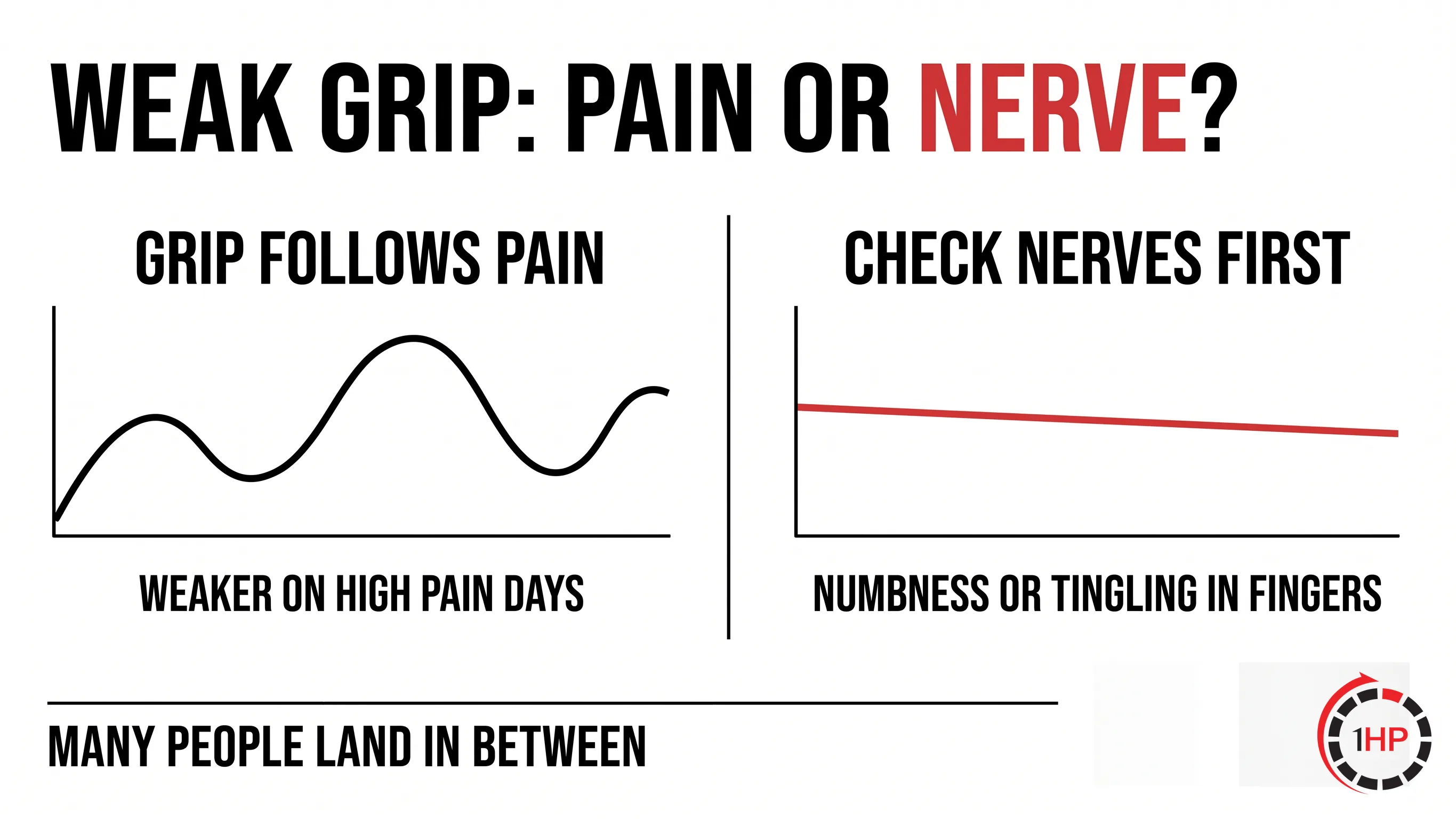
Grip that rises and falls with pain usually points to irritated tendons. Weakness that stays flat on good and bad days deserves nerve testing first.
I like a gaming analogy here. A nerve problem is like network lag: the signal to the muscle is not getting through cleanly. A tendon problem is more like a hardware limit, where the signal arrives fine but the part complains under load.
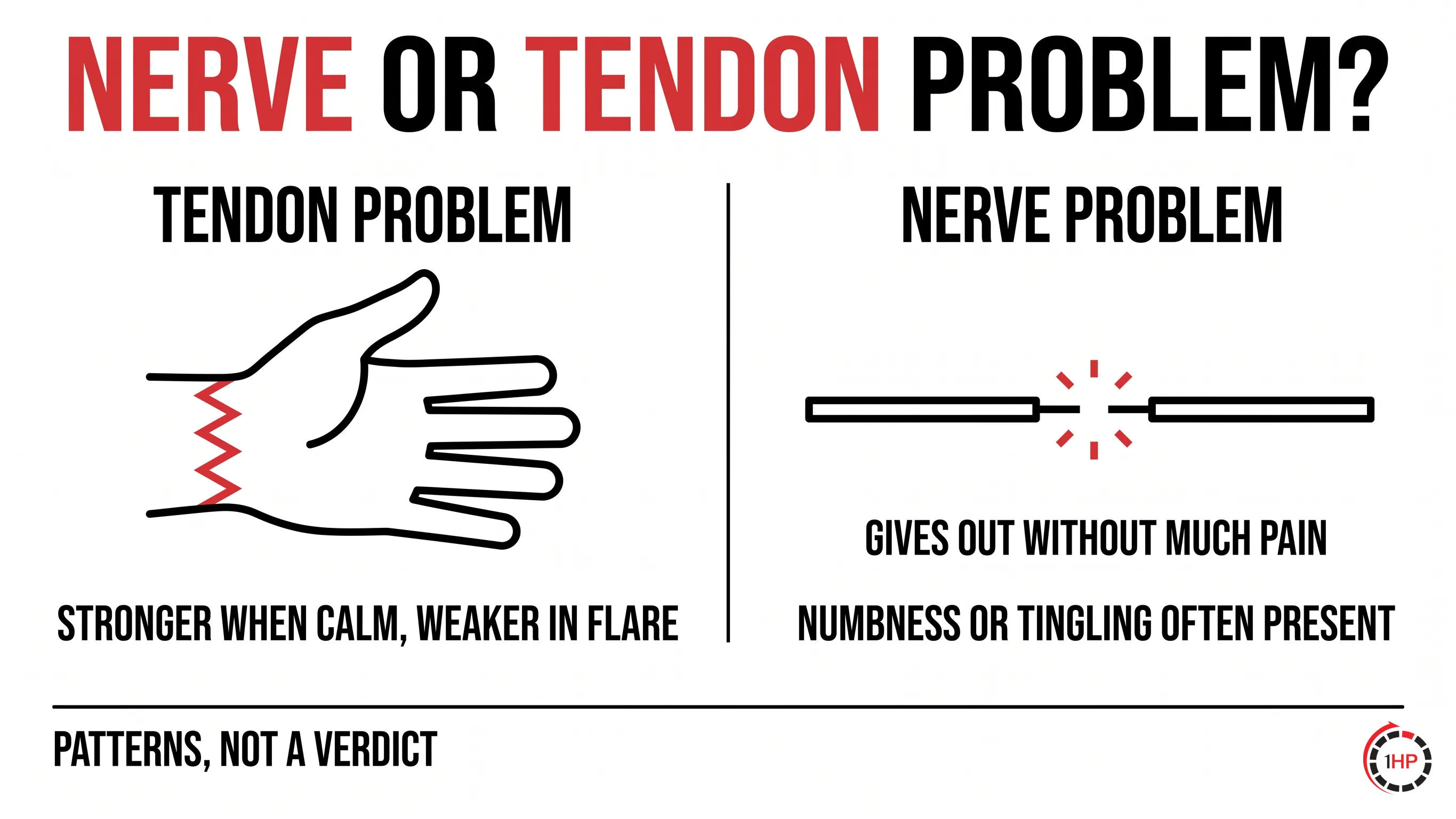
| What you notice | Pain-limited grip (tendon) | Endurance-limited grip (tendon) | Nerve-type weakness |
|---|---|---|---|
| Calm days vs flare days | Stronger when calm, weaker in a flare | First squeeze feels close to normal | About the same either way |
| When the hand gives out | Pain shows up before the muscle quits | Fades after many reps or a long session | Gives out without much pain |
| Numbness or tingling | Usually none | Usually none | Often present, in a steady pattern |
| Pain-free grip vs max grip | Wide gap between the two | Small gap, but a low rep count | The max itself stays low |
| Usual next step | Load vs. capacity work | Endurance building | Nerve testing through a doctor |
These are patterns, not a verdict. Plenty of people show a bit of two columns at once.
Why not just compare your squeeze to a chart? A 2024 narrative review by Vaishya and colleagues found that grip can be measured reliably with a hand-held dynamometer, but that cut-off values differ across populations, running lower in women and in people doing sedentary work. The same review notes that a seated grip test mostly measures the smaller muscles of the hand and wrist. For a desk worker, that means no single number says "weak." Your own trend line says far more.
In a 2026 quasi-experimental study in the Annals of African Medicine, Adhyapak and colleagues tested a 10-day program of four simple hand exercises against no program, in 200 final-year nursing students. In the exercise group, the share with weak grip fell from 85% to 36%, while the control group showed minimal change. Still, it shows how quickly grip can respond to simple training when nothing else is in the way.
So a grip that will not budge with sensible training is useful information. It nudges the question back toward the nerve column.
The tendon column often looks very different over time. Austin works in database management and plays World of Warcraft, and his doctors had found nothing on MRI or X-ray. The pattern in his case pointed to irritated tendons, including the ones behind back side wrist pain from repetitive strain, and he worked through it in 8 weeks. In his words: "I made more progress using the Troubleshooter Programs at 1HP than months of in-person PT." He is back to long sessions in game. Results vary.
For people who want a coach alongside them, Power Leveling is our done-with-you coaching program with unlimited 1-on-1 expert calls. Pricing depends on your case and is discussed in a free consultation. The 3-Month Results Guarantee applies to Power Leveling only.
Some signs skip this sorting step entirely, and they belong with a doctor before any plan starts.
What should you do next if your grip feels weak?
Start a two-week log of pain-free and maximum grip, see a doctor first for any red flag, and bring your numbers to someone who can read them with you.
Two questions from a 1HP Q&A stream get to the heart of weak grip: why does my wrist feel slow and weak at night, and how do you know when it's carpal tunnel or something serious? Your log answers more of both than a single appointment can.
Numbers change the conversation. One database administrator coached by Dr. Matthew Hwu had 4 years of pain and had already been through MRI, X-ray and nerve conduction tests, yet his forearm endurance measured 20% of normal on the right and 40% on the left. Eight weeks later he was working full pain-free days with 5 hours of gaming at night. Results vary.
Your grip has a story too. The log is how you start reading it.
Summarize This Article With AI
Open this article in your preferred AI engine for an instant summary.
Frequently Asked Questions
What else do people ask about weak grip and wrist pain?
Most questions circle the same few worries: which exercises to try, what weight to use, whether you need special gear, and how to get your numbers read.
Should you squeeze a stress ball as hard as you can?
Probably not, at least not early. On one hand-therapy podcast, a therapist said they rarely give wrist patients grip work early on, and when they do, it is a foam ball squeezed with the wrist in neutral at 20% effort, never as hard as possible. That is isometric work, meaning the muscle holds tension while the joint stays still. The same panel said wrist patients rarely have a truly deconditioned grip, so they mostly use grip as a test. I like grip as a test too. Where I part ways with that mainstream advice is the training itself: I'd rather build forearm endurance with counted reps than chase a harder squeeze.
What weight should you start with at home?
Start light. In a follow-along routine on the Tone and Tighten YouTube channel, Dr Jared says "1 or 2 or 3 lbs is usually enough to start with," and suggests a can of soup, a water bottle or a hammer if you have no dumbbell. That is common advice, and starting light makes sense. The bigger difference is what you track. I'd count continuous reps to a metronome and measure them against the benchmark of 5% of bodyweight for 60 continuous reps, so you can watch your health bar fill instead of guessing.
Do you need a grip dynamometer to track progress?
No. A dynamometer is a handheld gauge that measures squeeze force, and the standard clinic protocol has you squeeze with maximal effort for about 3 to 5 seconds, then rest about 1 minute between tries. Most people don't own one. A light dumbbell, a metronome, a rep count and the QuickDASH survey can still show whether your capacity is moving week to week.
Do you need grip exercises if your grip feels normal?
Maybe not. One popular rehab channel on YouTube points out that if you have no grip issues, you might not need dedicated grip strength and endurance work. Grip is one readout, not the whole game. If your pain-free and maximum grip match on good days and bad, your training time may go further on the forearm muscles behind the painful spot.
How do you get help reading your grip log?
People start with a free consultation. Book one at 1-hp.org, bring your two weeks of pain-free and maximum grip numbers plus any notes on what you dropped and when, and an expert from our team can go through them with you.
Written by
Dr. Elliot Smithson
PT, DPT, MS, ATC, EMT, Co-Founder
Dr. Elliot Smithson earned his undergraduate degree from the University of Central Florida in Athletic Training, his Master's from Marshall University in Athletic Training, and his doctorate in Physical Therapy from the University of St. Augustine for Health Sciences.
Follow on XThis article is for educational purposes only and is not a substitute for professional medical advice, diagnosis, or treatment.