
Table of Contents
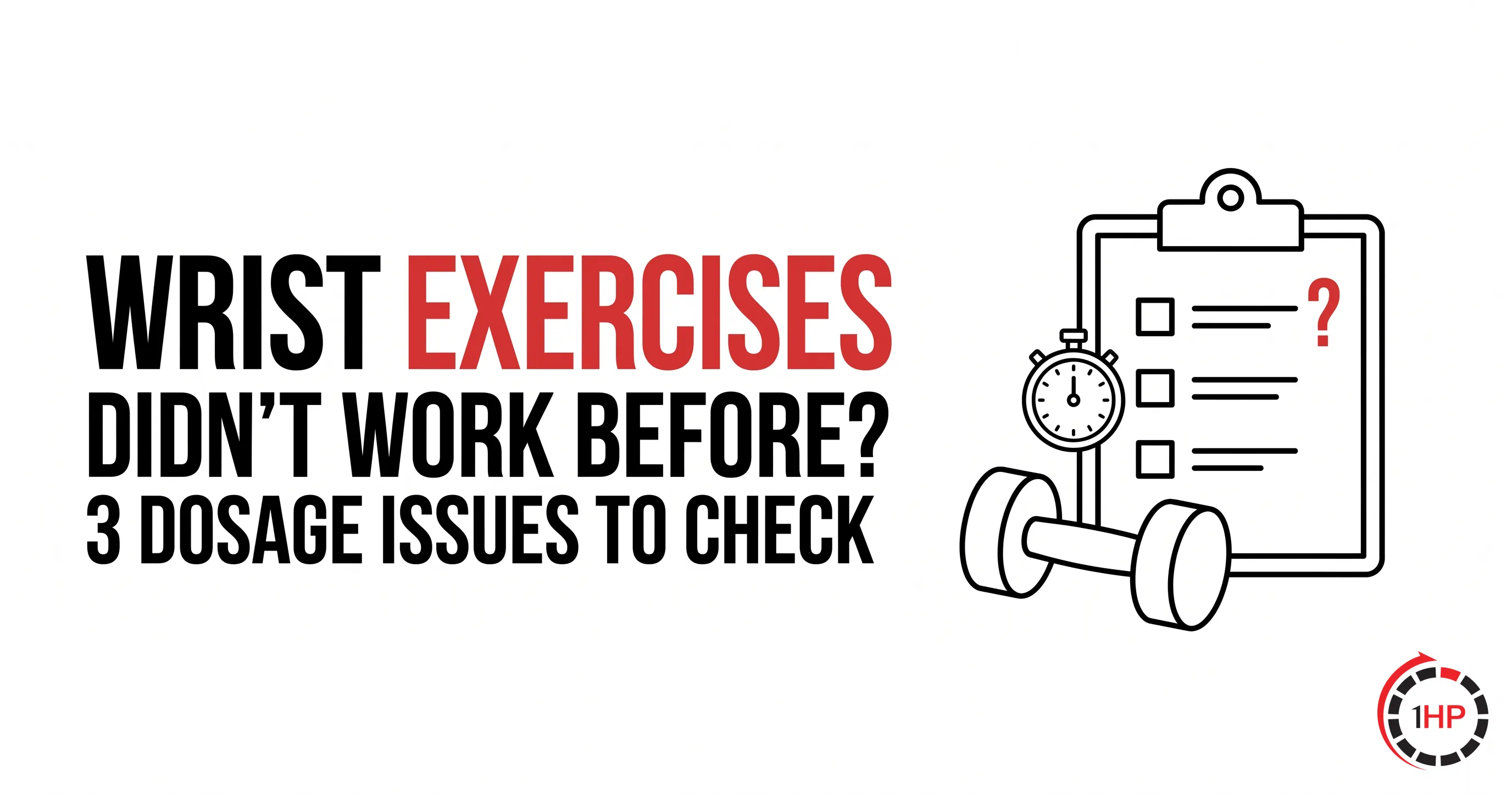
Wrist Exercises Didn't Work Before? 3 Dosage Issues to Check
By Dr. Elliot Smithson, PT, DPT, MS, ATC, EMT·
Quick answer
If wrist exercises didn't help before, check the dose before the exercise list: the load may have been too light, the ramp-up too fast, or the plan dropped at the first soreness.
The same logic applies when an approach that once helped, such as the Sarno approach, stops working. Load has usually climbed past capacity. Change the dose and the same exercises can start pulling their weight, so judge a re-dosed plan over weeks rather than days.
It's common to reach this point with a long list of things you already tried. A routine that helped for a while and then stopped. Exercises that never seemed to do anything. Rest that calmed things down until you went back to the keyboard. You are not alone in that loop, and it doesn't mean your hands are out of options.
Gareth B. is a court reporter and a gamer, so his hands carry two heavy workloads. He came to us after 6 years of wrist pain. The psychosomatic approach, often called the Sarno approach, had helped him before. Then it stopped. In his words: "I tried the Sarno approach and found it didn't really work anymore and knew something was missing." He reached a 12 week resolution with us, and along the way he learned "why the psychosomatic approach worked before." Results vary, but his story shows the pattern I care about here.
An approach that stops working is information, not a final verdict. In load vs. capacity terms, capacity is how much repetitive work your muscles and tendons can handle before they get irritated. When the load you put on them climbs past that line, a strategy that once covered the gap can quietly run out of road. Something has to build capacity back up, and for exercise to do that, the dose has to fit.
So this article walks through the three dosage issues I check first, how to test each one at home with things you already own, and how long to give a program before you judge it. It starts with the question most people are really asking when the pain hangs around.
You did the wrist curls. You did the stretches on the printed sheet, maybe for months, and your wrist pain is still not getting better. It's common to decide that exercise simply doesn't work for you. Before you write off exercise, ask one question about your last program: did anyone tell you exactly how heavy, how many reps, and when to add more?
Take Julian. He had tried physical therapy twice, flared both times, and then rested for a week. In our program he started at 3 sets of 12 to 15 reps at 1% of body weight, took 30 to 40% less load the day after any big push, and kept training at a lighter load when a long gaming session spiked his pain in week 8. It settled within a few days. Same kind of exercises. Different dose.
Back in 2020, I worked with pro Fortnite player Ghost Snood over three visits. Afterward he played 3 days of Winter Royale averaging 12 hours per day without pain, and without the clumsy keybind presses that had been hurting his game. That is the health bar at work: once capacity climbs above load, the low health warning goes quiet.
So before you write off another program, it can help to check three dosage issues: a load too light to build endurance, a ramp-up that moved too fast, and a plan dropped at the first soreness. The first one is the sneakiest, because an easy set feels a lot like progress.
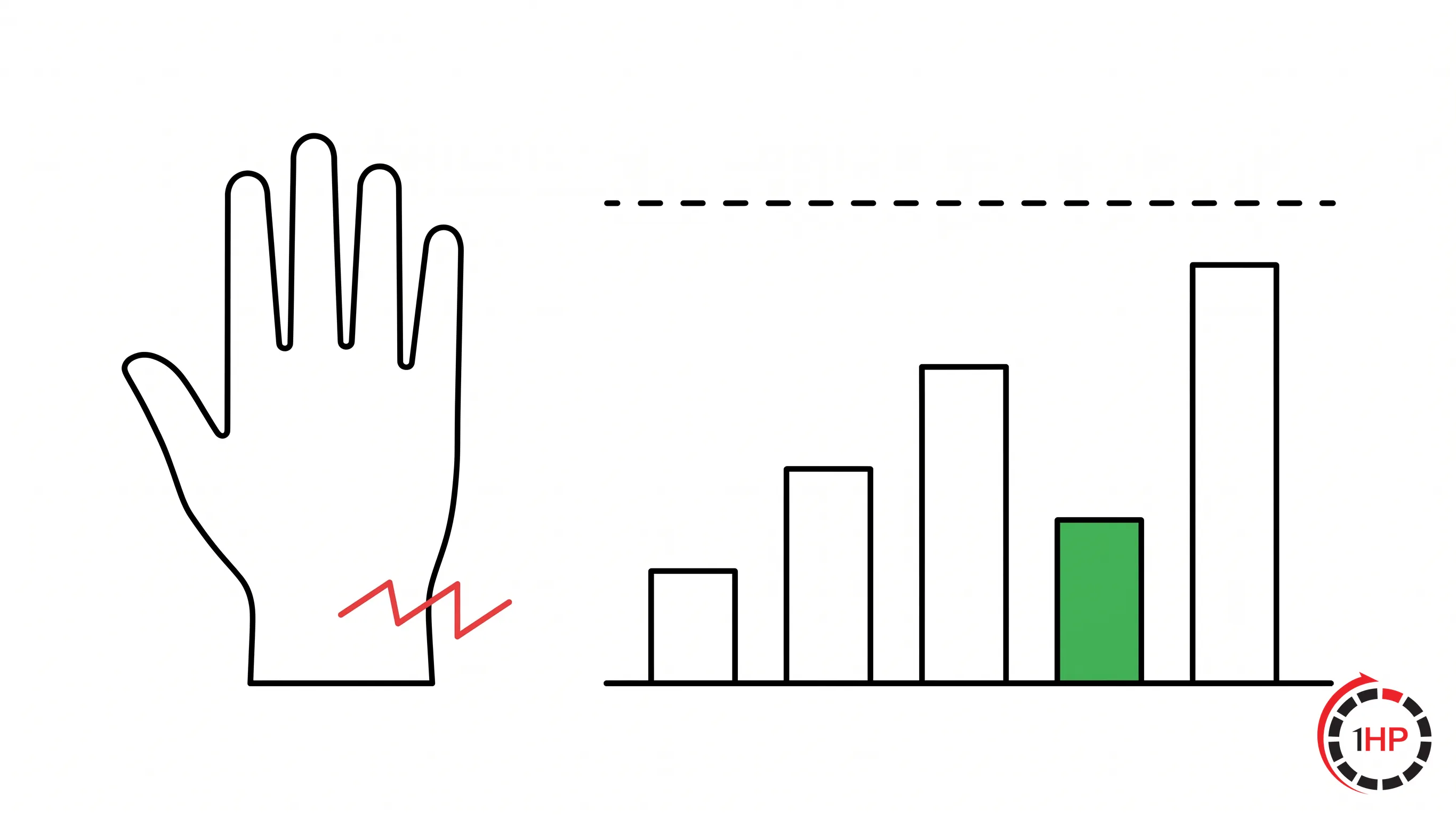
Why are my wrist exercises not working after months?
Months of wrist exercises with no progress usually point to the dose, not the exercise list: load too light, progression too fast, or a plan dropped at the first soreness.
Before you swap in a brand new routine, look back at the old one and answer three plain questions:
- Did the last few reps of each set ever feel like real work, or did every set feel easy?
- Did you add weight, reps or sessions in small steps, changing only one thing at a time?
- When soreness showed up, did you adjust the dose, or did you stop the whole plan?
Physiopedia's tendinopathy rehabilitation guide lists exercise and load management as first-line treatment for tendinopathy, which is the irritated tendon problem behind a lot of computer and gaming wrist pain. The same guide is refreshingly blunt that "there is no recipe for tendinopathy management," and it notes that "creating an individualised programme helps to prevent both under-training and over-training." Read those two lines together and the picture gets clearer. The exercises on your sheet may have been perfectly reasonable. Pull out your old exercise sheet and check whether it named a weight, a weekly schedule, and a clear rule for when to step up.
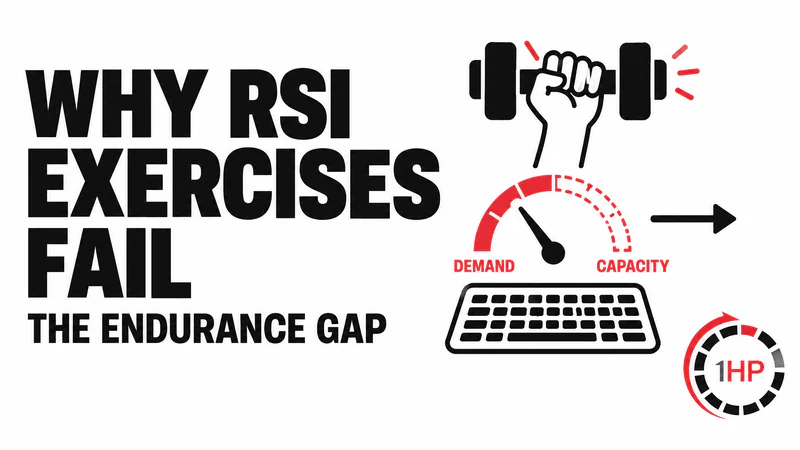
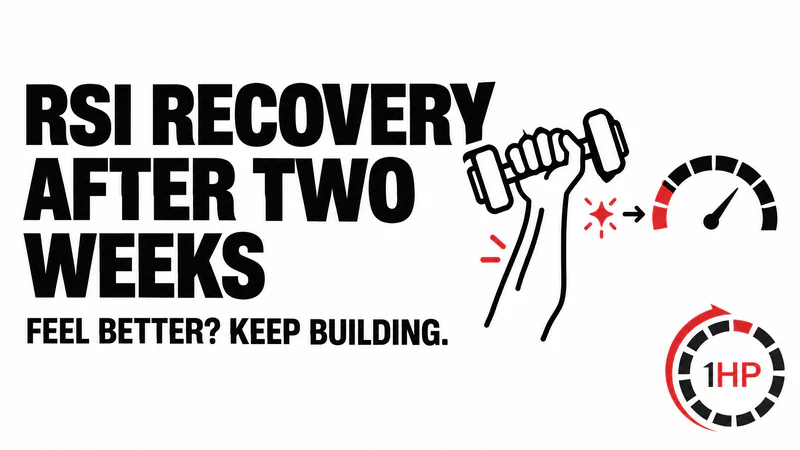
Here is the formula I keep coming back to: Load > Capacity = Pain. Your tendons have a health bar. Every hour of typing, clicking and gaming chips away at it. Exercise is supposed to raise the max HP, so the same workday stops draining you to zero. A dose that is too small never raises the bar. A dose that jumps too fast drains it faster than it can grow.
The common assumption is that a stalled program means the exercises themselves were the problem. I don't buy it. Two people can run the identical build in a game and get totally different results because their stats, gear and timing differ. Wrist programs work the same way.
That variety is something our team sees up close. We have worked with more than 3,000 people over 10 years across our practice, esports work and programs, and no single printed sheet could fit all of them. It is one reason our evidence-based approach to wrist pain starts with dosing rather than a fixed list of moves.
Dosing done with guidance can move the needle. In The 1HP Clinical Outcomes Report 2026, 72% of Power Leveling members who completed follow-up reached a meaningful improvement in function. Results vary, and that figure only covers members who completed follow-up.
So the real question is not whether exercise works for you. It's what your last plan left out, and you can spot that yourself in a few minutes with the three questions above your old sheet. The first suspect is the one almost nobody checks: whether the load was ever heavy enough to count.
Were your old wrist exercises the wrong ones, or the wrong dose?
Open almost any home wrist routine and you will find a rep count. Look for how heavy the weight should be, and the instructions turn surprisingly vague.
Take a 2025 guide from Cast21, a company that makes wrist casts. It gives 10 to 15 repetitions of flexion and extension with a light dumbbell or a water bottle, and lists a can of soup for forearm rotation. For wrist curls, it says "the desired number of reps." A 2016 post from Mueller Sports Medicine tells readers to squeeze a tennis ball "as hard as you can," at least five times a day, working up to 10. Both guides were written for sprains or prevention rather than months of tendon pain, and both leave open the number tendon research cares about most.
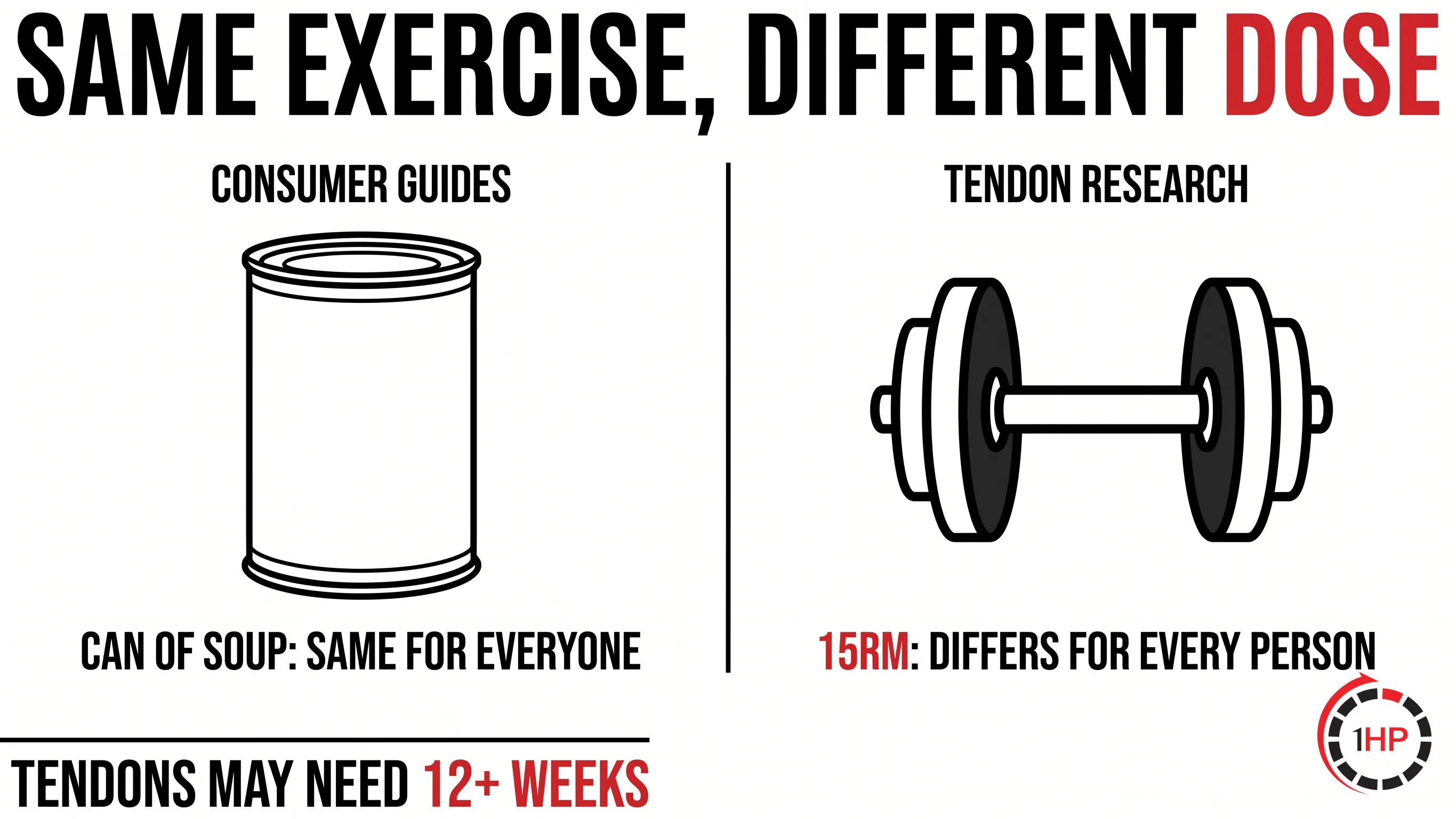
Physiopedia, an open-access physiotherapy wiki summarizing tendinopathy loading research, sets the dose against each person's own capacity. Its early stage, drawn from Malliaris and colleagues (2015), uses five 45-second holds at "70% maximal voluntary contraction." Once pain sits at 3 out of 10 or lower, it moves to sets starting at 15RM, the heaviest weight someone can lift 15 times, progressing toward 6RM. A can of soup weighs the same for everyone; a 15RM differs for every person. Physiopedia is a secondary source, its examples come mostly from leg tendons, and none of our sources tested these numbers on wrists. Still, two routines with identical exercise names can sit far apart.
| Part of the dose | Consumer wrist guides (Cast21, Mueller) | Tendinopathy loading summary (Physiopedia) | 1HP's dose rules |
|---|---|---|---|
| How load is set | Light dumbbell, water bottle, can of soup, tennis ball, or "the desired number of reps" | 70% of maximal contraction for holds; sets from 15RM toward 6RM | A tolerable dose found for each person; one member started at 1% of body weight |
| How it climbs | Add weight "as comfort improves"; grip work from 15 reps toward 25 or 30 | Gradual; tendons may need 12+ weeks to respond | Repeat predictably, change one variable at a time |
| When it gets sore | Dial back; less intensity and fewer reps | Load rises while pain is carefully monitored | A real spike lowers the load for a short, defined stretch |
| Getting back after a flare | Not specified | Individualised; "no recipe" | Load steps back up in stages as symptoms settle |
Time is the second part of a dose. Physiopedia notes that tendons may need "12+ weeks to respond to loading programmes," that "the progression must be gradual as tendons do not respond well to sudden changes in loading patterns," and that an individualised programme "helps to prevent both under-training and over-training." A routine can stall from either side: a load too light to ask much of the tendon, or a ramp steep enough to provoke it.
Then comes the bad day. Cast21 says significant aggravation means you should "dial back before resuming your exercise routine." Mueller suggests doing the exercise "with less intensity and with less reps." Both explain how to retreat. Neither explains how to climb back, which leaves room for a temporary cutback to become permanent.
Our own graded exposure rule is that a bad session changes the dose instead of ending the plan. Julian, one member who had flared through two earlier rounds of physical therapy, cut his load by a set amount the day after any big push. One member's plan shows how the rule works in practice. On its own, it cannot show how often the rule works.
Long histories are common among people who join our programs: in The 1HP Wrist and Hand Pain Report 2026, 65% of 229 program members had been in pain for more than a year before joining. A long history did not rule out progress. Among 106 such members who completed a follow-up survey, both programs combined, 58% reached a meaningful improvement on the QuickDASH questionnaire. In Power Leveling alone, the figure was 69%, according to The 1HP Clinical Outcomes Report 2026. Results vary.
Power Leveling is our done-with-you coaching program with unlimited 1-on-1 expert calls; the Troubleshooter is the self-guided program in the 1HP app. Among members who completed follow-up, the median time to a meaningful improvement was 45 days, and 55% had reached it by their 4-week check-in. Members chose their own program, and coaching adds calls and follow-up as well as dose changes, so the gap cannot show that dose adjustment alone made the difference.
Read against each other, the sources keep pointing to one blind spot. Two routines can share every exercise name and still differ on what the tendon is asked to do: how heavy the load is, how fast it climbs, and what happens after a sore day. Our member figures fit that picture, though they cannot prove it. Before you try again, check those three things in your old routine.
- Write down the load your old routine actually used. If it was a water bottle, a soup can or a ball squeeze, ask how that compares with the heaviest weight you could lift about 15 times.
- Count how many weeks you held a steady, gradually rising dose. If it was fewer than the 12 or more weeks Physiopedia gives for tendons, ask whether the earlier attempt ran long enough to judge.
- Decide your flare rule before the first session: how much you will cut, for how many days, and which sign tells you to step back up.
- If your pain is more than a year old, ask any coach or provider you consider how the dose will be adjusted between sessions and how progress will be measured, for example with the QuickDASH questionnaire.
How we checked this
We compared two consumer wrist exercise guides with Physiopedia's summary of tendinopathy loading research. We then added 1HP's written graded exposure rules, one member's example, and figures from our two published reports. The pain-duration, outcome and timing figures and Julian's dosing are ours. Our reports are internal analyses and are not peer reviewed. They count only members who completed follow-up, and the program comparison is unadjusted. Julian is one member, so his case illustrates the rule and cannot establish a pattern. Physiopedia is an undated secondary wiki that itself advises citing primary sources, and most of its examples involve leg tendons. The consumer guides were written for sprains and prevention. We sell coaching programs built around adjusting the dose, so we have a stake in this answer. Still unknown: whether Physiopedia's loading percentages carry over to wrist and forearm tendons, and how much of the program difference comes from dose, from coaching contact, or from who chose to enroll.
- Cast21, wrist sprain exercises guide, April 3, 2025.
- Mueller Sports Medicine, simple wrist exercises blog post, February 16, 2016.
- Physiopedia, Tendinopathy Rehabilitation page, undated.
- Smithson E, Hwu M., The 1HP Wrist and Hand Pain Report 2026, November 2026.
- 1HP, The 1HP Clinical Outcomes Report 2026, 226 members who joined August 2025 to October 2026.
- 1HP, written graded exposure rules and member example (Julian), internal material, 2026.
Dosage issue #1: Was your load too light to build endurance?
A load that never feels like work rarely builds endurance. If every set felt easy from first rep to last, your tendons probably never got a clear reason to adapt.
Picture a typical home sheet. Cast21's wrist sprain guide suggests 10-15 repetitions of wrist flexion and extension with a lightweight dumbbell or water bottle, holding each one for "a few seconds." It cautions against "too heavy a weight," and for wrist curls it simply says to do "the desired number of reps." That advice was written with sprains in mind, and for a fresh sprain, caution makes sense. Months of typing and gaming pain is a different situation.
Vague load is easy to follow. It is also easy to under-dose.
Contrary to the idea that wrist work should always feel feather-light, tissue that has been irritated for a long time often needs a load that actually challenges it. Think of it like power leveling. You can farm level 1 slimes all day, but your character stays at level 1. (Yes, that pun was intentional, and no, I'm not sorry.) Your wrist and finger muscles do thousands of small, repeated movements across a workday, so the goal is endurance: many controlled reps where the last few feel genuinely hard, without sharp pain.
You can check where you stand with things you already own:
- Grab a light dumbbell or a full water bottle you can lift comfortably.
- Open a free metronome app and pick a slow, steady tempo.
- Rest your forearm on a table, palm down, hand off the edge, and lift and lower using only your wrist, one movement per beat.
- Count the continuous reps you can do before your form slips or the muscle burn makes you stop.
- Write that number down, and retest later with the exact same weight and tempo.
If that number barely moves over several weeks, the dose is a likely suspect. If your pain sits mostly on the inner wrist, our page on palm side wrist pain from repetitive strain explains that region in more detail.
With the range of people our team has helped, one starting weight for everyone would make little sense. That is exactly why our plans are personalized, with direct 1:1 access to an RSI specialist, not a generic exercise sheet. Someone with a lot of capacity left needs more challenge. Someone running on empty needs a gentler start that still progresses.
When the dose fits, change can show up sooner than many people expect. The 1HP Clinical Outcomes Report 2026 found a median of 45 days to meaningful improvement among members who completed follow-up, and 55% had reached it by their 4-week check-in. Results vary. Even so, it reframes the question. A routine that showed nothing after months may have been running at a dose too small to register.
Of course, the fix for a too-light load is not to grab the heaviest dumbbell in the house tomorrow. That swing in the other direction is where the second dosage issue usually starts.
Dosage issues #2 and #3: Did you ramp up too fast, or stop at the first soreness?
Ramping up too fast and quitting at the first soreness are two sides of one problem: the dose was never adjusted. Change one thing at a time and track the next morning.
Our video Why Rehab Didn't Work For Your Wrist Pain names three common reasons home programs stall: deconditioning after years of low physical activity, poorly prescribed exercises, and fear around flare-ups. The phrase we use for the second one is simple: "Too much, too quick, too soon." In the video, we compare it to running a marathon with zero training.
Issue #2: The jump was too big
This one usually starts with good intentions. You feel a little better, so you double the reps, grab a heavier weight and add a third session, all in the same week. Three changes at once. Then the wrist flares, and there is no way to know which change caused it.
The video also tackles a rebuttal we hear a lot: "Well, it never hurt before, and I would spend 10 to 12 hours a day using my PC and playing games." Fair point. But conditioning drifts down over time, especially for people who sit for long stretches, and a body that tolerated a heavy load in its younger years may have less in the tank later on. Exercising a deconditioned wrist often brings some soreness at first. That is normal, and it is not a sign of damage.
Issue #3: The soreness ended the plan
Here is where many programs quietly end. Soreness shows up, it feels like proof that exercise "makes it worse," and the whole routine goes in the bin.
Even mainstream guidance points another way. A 2016 Mueller Sports Medicine post advised that if you "persistently feel sore after this exercise, try performing it with less intensity and with less reps." Notice what it did not say. It did not say stop forever. It said turn the dial down.
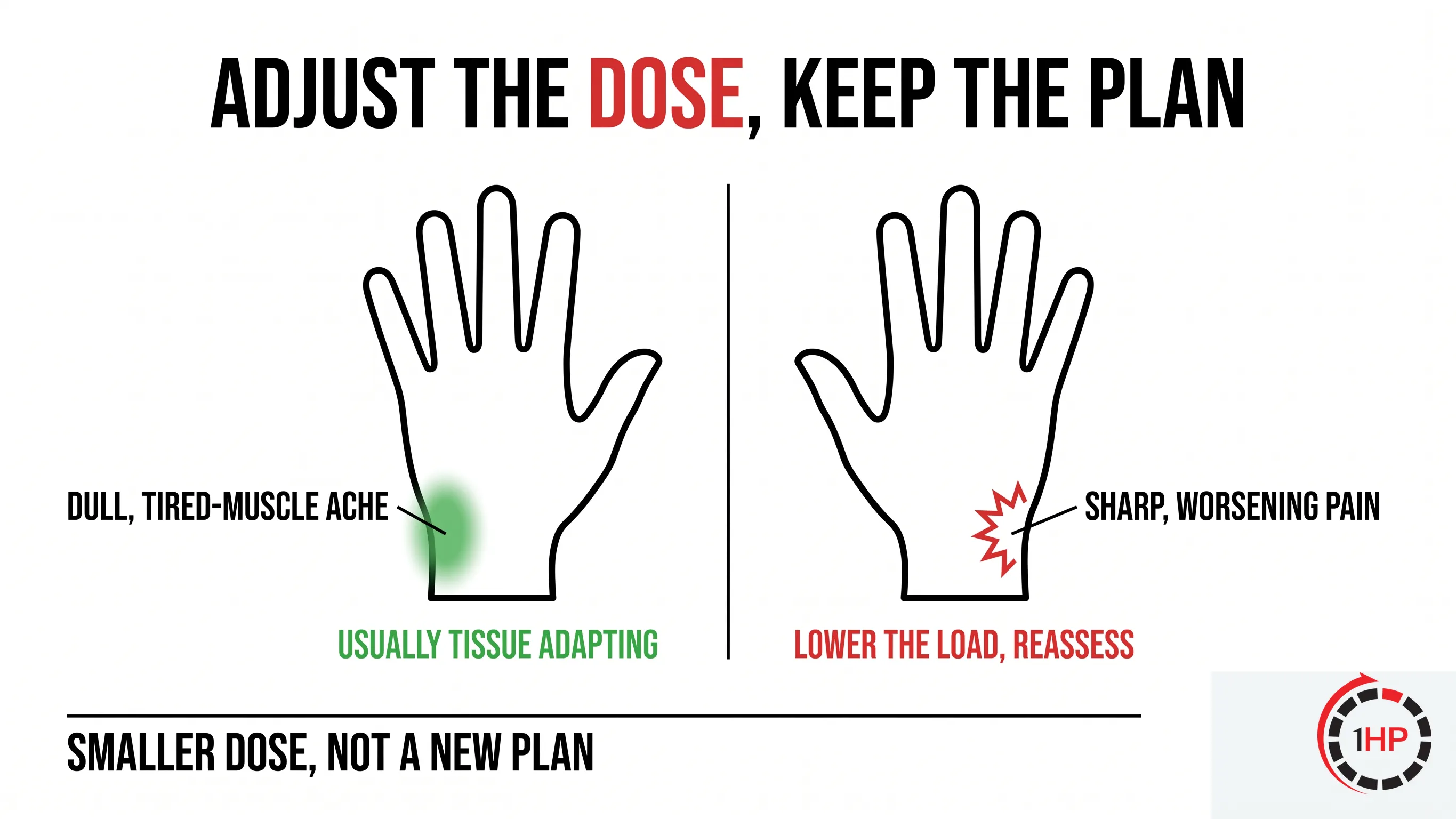
That is how I think about soreness. It works like a low health warning, not a game over screen. A dull, tired-muscle ache after a set is usually your tissue being asked to adapt. Sharp, worsening pain is the signal to lower the load and reassess. LOG THE LOAD, THE REPS AND HOW YOUR WRIST FEELS THE NEXT MORNING.
This approach did not come out of nowhere. Our method was built from esports medicine work with Team Liquid, 100 Thieves, CLG, Immortals and FlyQuest, a world where players rarely have the option of stepping away for weeks, so the dose has to bend around real schedules. If your ache has crept up toward the elbow, our page on outer elbow pain from repetitive strain covers that pattern too.
Adjusting rather than quitting can add up. In The 1HP Clinical Outcomes Report 2026, average disability scores fell 46%, from 34.4 to 18.0 on the QuickDASH, among members who completed follow-up. The QuickDASH is a short survey of how easily you can use your arm, shoulder and hand for daily tasks. Results vary. You can take the same survey at home today, write down your score, and retake it every few weeks so your progress is measured by function, not just by how one sore morning feels.
People in pain are usually offered two plans, total rest or pushing through, but our flare rules add a third: training continues through a flare at a lighter load, so there is always a clear way back to where you were.
What should you change before you try wrist exercises again?
Change the dose before you change the exercises. Pick a load that feels like work, progress in small steps, and treat soreness as a signal to adjust rather than quit.
Back in 2018, I filmed the program I gave a professional Overwatch player for his wrist pain. Nothing in it was exotic: Therabar and dumbbell wrist extension, bent-over Y's, and two kinds of external rotation. Each one came with how to do it and how often. That second part is what most printed sheets leave blank, and it explains why the same moves can carry one person back to full-time play while another person stalls.
I expect home programs to be judged more and more on dose rather than on exercise choice. You don't have to wait for that shift. Most members of 1HP's coaching programs see meaningful improvement within 6 to 12 weeks. Full recovery can take up to 18 months depending on the case. Results vary.
Tonight, pull out your old sheet and write the missing numbers beside each exercise: the load, the reps, and what you will do on a sore day.
Summarize This Article With AI
Open this article in your preferred AI engine for an instant summary.
Frequently Asked Questions
What else do people ask when wrist exercises stopped working?
Most follow-up questions circle back to dose: how sore is too sore, how long a session runs, when to rest, and how to restart after a flare.
How do I tell normal exercise soreness from a sign to back off?
Working muscles tend to leave a dull ache. Tissue strain tends to feel sharp and comes with weakness. Learning that difference is one of the first things I coach, because it decides whether you keep the load or trim it.
How much time does a wrist program take each day?
Plan on about 30 to 60 minutes a day, split into 15 to 30 minutes of exercise twice a day, 6 days a week. That fits around a workday and a gaming session.
Should I rest my wrist completely until the pain is gone?
Rest lowers load, which can calm things down for a short while. Complete rest also weakens the tissue, so capacity drops while you wait. Nothing about it builds endurance.
What does graded exposure mean?
Graded exposure means finding a tolerable dose of the activity you have been avoiding, repeating it predictably, and changing one variable at a time. It sits between total rest and pushing through.
Is it safe to restart after a flare?
Our Wrist Pain Troubleshooter screens for red flags with 14 questions first. The signs it checks for match this list.
See a doctor before starting if you have any of these:
- Constant numbness that doesn't change with activity
- Worsening weakness
- Visible muscle wasting
- Major swelling or color change
- A recent injury or fall
- Fever
- Severe, unrelenting pain
- Symptoms that wake you every night
Seek urgent care for emergencies.
How do I get a plan dosed for my own wrists?
People start with a free consultation at 1-hp.org, where a 1HP expert looks at what you tried and how it was loaded.
Written by
Dr. Elliot Smithson
PT, DPT, MS, ATC, EMT, Co-Founder
Dr. Elliot Smithson earned his undergraduate degree from the University of Central Florida in Athletic Training, his Master's from Marshall University in Athletic Training, and his doctorate in Physical Therapy from the University of St. Augustine for Health Sciences.
Follow on XThis article is for educational purposes only and is not a substitute for professional medical advice, diagnosis, or treatment.