
Arm/Hand Numbness From Gaming
Thoracic Outlet Syndrome
By Brett Becker, OTR/L, MS, ACE-CPT
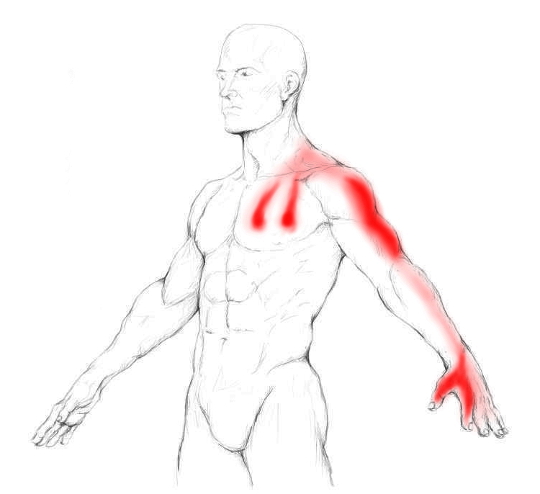
Table of Contents
Expert Opinion
- Thoracic Outlet Syndrome is a condition near the neck and shoulder involving compression of nerves or blood vessels resulting in pain and/or decreased sensation, coordination, and strength.
- There are three different types of thoracic outlet syndrome all with different presentations and symptoms.
- A common type of thoracic outlet syndrome is compression of the brachial plexus which innervates (supplies) specific muscles in the arm and hand. Nerves are responsible for providing muscles with necessary strength, coordination, sensation, and ultimately function which is hugely important in gaming.
What Does This Diagnosis Mean
Thoracic Outlet Syndrome (TOS) is a condition that affects the nerves or blood vessels within a small area located near the neck and shoulder. These are important structures which branch out to the entire arm and hands. Typically the space of the thoracic outlet is large enough to allow the nerves and blood vessels to pass through just fine, but when certain muscles become tight or space becomes narrowed then the nerves and blood vessels can be compressed as they pass between the clavicle and the first rib. The space can become tight as a result of poor posture/ergonomics, traumatic injury, or failure to stretch/strengthen necessary muscles.
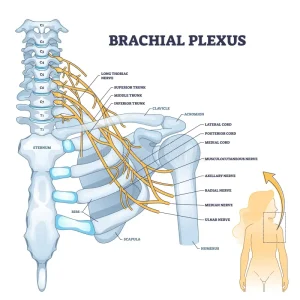
These compressed nerves happen at the brachial plexus which is the network of nerves that come off of the spinal cord and travel down the neck, shoulder, and chest region down into the arm and hand which it innervates (supplies muscles). Symptoms include numbness, tingling, pain, and weakness in your arms and hands. Many people are familiar with other forms of nerve compression conditions such as carpal tunnel or cubital tunnel, but TOS is another condition which should be well understood as this can often mimic other nerve compressions. The key difference between these nerve compressions is where the entrapment location is, which is critical for understanding the cause and how to go about fixing it.
It is also important to know the three types of TOS that are possible. The first and most common is neurogenic TOS, neuro meaning "relating to nerves or the nervous system." This is when compression occurs at the brachial plexus. Secondly, there is venous TOS which is compression of the blood vessels as they return blood back to the heart from the arm. Lastly, there is arterial TOS which is very similar to venous TOS as it is compression of the blood vessels, but now with the blood traveling from the heart to the arm. Arterial TOS is the least common of the 3 types. The name "Thoracic Outlet Syndrome" comes from the anatomical location of the opening between your neck and chest.
"An analogy that can be used to think of nerves is like a water hose. When someone steps on the hose there may be a little water sputtering out which can be like the tingling often first experienced with mild compression at the chest/neck region. If someone comes along and steps on the hose with all their weight then the water flow may stop. Similarly, if the chest or muscles in the neck are tight then they may significantly compress the nerves resulting in numbness, pain, or decreased strength. If there is no water coming from the hose to feed the plants then the plants will begin to die after months, similar to how our muscles can start to atrophy (die/weaken) if they are not getting proper innervation (supply) from the nerve."
Brachial Plexus nerves:
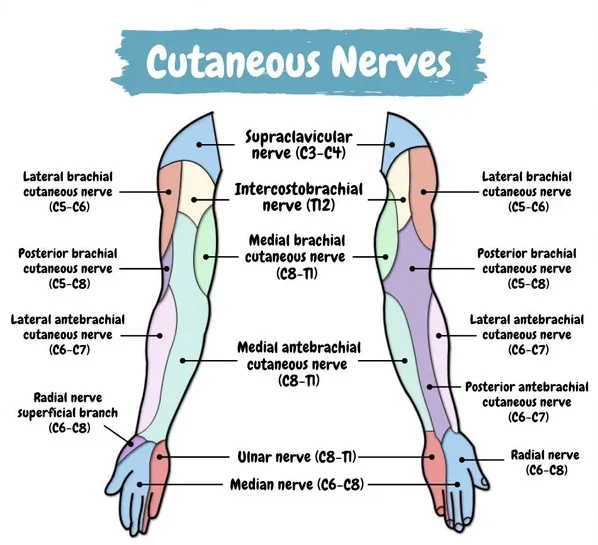
- Radial Nerve: Divides into the superficial branch and the deep branch. The superficial branch provides innervation to the dorsal side of the thumb, index, middle, and the radial half of the ring finger just proximal to the IP joints as well as a small portion of the volar side of the thumb. The deep branch (posterior interosseous nerve, PIN) is a motor branch which gives input to the supinator muscle as well as extensors of the wrist and digits.
- Median Nerve: Provides innervation to the thumb, index finger, middle finger, and the radial half of the ring finger on the volar side as well as the dorsal aspect of the same fingers, but only distal to the proximal interphalangeal joint (PIP).
- Ulnar Nerve: Provides innervation to the small finger and ulnar side of the ring finger both on the volar and dorsal side.
Common Things You Might Feel
Gamers are likely to experience pain, tingling, and numbness throughout the arm along with weakness and poor coordination. Individuals may find their arms to be heavy at times doing activities at or above shoulder height such as driving or participating in various hobbies or overhead sports such as baseball, basketball, volleyball, weightlifting, etc. Gamers may find it challenging gripping and moving a mouse or a controller because of their decreased sensation. Finger dexterity is likely to be reduced which is likely to decrease performance and alter the gameplay of the individual. Individuals may also experience discomfort at night when sleeping due to sleep positioning with the arms overhead or laying on a shoulder and causing increased pressure. It may be hard to distinguish where specifically this pain or altered sensation is because it may not always follow the same pattern or nerve involvement as it would with carpal tunnel or cubital tunnel syndrome. Because these symptoms can mimic other forms of nerve compression it is important to write down or be mindful when symptoms are exacerbated and what potentially was a trigger for these symptoms.
Disclaimer: The following information is provided for general educational purposes only and should not be considered medical advice. It is not intended to replace consultation with a qualified healthcare professional. If you have specific concerns or questions about your health or medical condition, please seek the guidance of a licensed physician or another qualified medical practitioner. Any reliance you place on the information provided is solely at your own risk. In no event will the author or 1HP be liable for any loss or damage arising from using this information. Always consult with a healthcare professional before starting or changing any medical treatment or regimen.
Quick Test
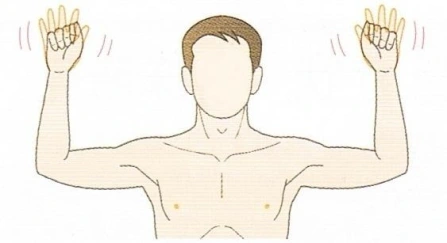
Perform this quick test for yourself (Roos Test):
- Instructions: The patient is to open and close the hands slowly over a 3-minute period.
- Normal Response: Some minimal discomfort and fatigue.
- Positive test: Reproduction of symptoms occurs such as numbness/tingling or pain.
How Does It Happen to Gamers?
Gamers are at risk for this injury due to the long durations we play. Gamers or office workers spend a significant portion of the time sitting which may lead to poor posture over time resulting in tightness of the neck and chest. Gamers oftentimes take minimal rest breaks because they are so engaged and locked in and don't always think to put their body first. Pain and discomfort is something that can be reduced from distractions and gaming is a good distractor which makes it hard for gamers to know when to stop due to pain/discomfort.
Thoracic outlet syndrome in gaming occurs as players sit in a slumped posture resulting in forward head posture with tight pec muscles (chest), scalenes, sternocleidomastoid, and levator scapulae. When the core is weak and players fail to move and take rest breaks then they may begin to rely on external supports like the armrest and desk. In this rounded shoulder position the space in the thoracic outlet becomes compressed which is how poor posture/ergonomics in gaming can result in this diagnosis.
How to Fix It / Recover / What Can You Do?
Returning from this injury takes a concerted effort, but can be done without much time away from the game. Below are a few steps that individuals need to understand and take when discomfort in this area occurs.
- Identify the issue — Oftentimes TOS can be challenging to identify due to the variety of differential diagnoses possible. Be sure to track symptom location and what makes it better or worse to better help a practitioner identify the root cause.
- Stretching — Frequently stretching tight muscles is important to help loosen these over time to decrease compression on the nerves and blood vessels. Helpful in decreasing tightness and stiffness throughout the chest and neck.
- Scalenes Stretch
- Doorway Chest Stretch
- 1st Rib Mobilization (Equipment: belt, towel, purse/satchel strap)
- Ergonomics — Evaluating one's ergonomic setup to ensure that the chair, desk, and armrest height is optimal to allow the shoulders and elbow to be both supported but relaxed. A secondary effect to a poor ergonomic setup could be poor posture.
- Posture — Poor posture could mean increased pressure on the nerves or blood vessels, likely due to lack of core strength and endurance.
- Exercise — Strengthening the core and back muscles can often counteract the effects which prolonged sitting has on an individual.
- Scapular Squeezes (Equipment: resistance band)
- Resistance Band Rows
- Chin Tucks
- Wall Slides (emphasize scapular movement)
- Nerve Glides — To restore mobility between the nerve and the surrounding tissues.
- Massage — A great way to decrease muscle tightness and increase blood flow to the muscles, tendons, and nerves.
- Sleeping — Sleep can be significantly impacted due to positioning. It is suggested to sleep flat on the back or on the unaffected side if possible. Completing a Cyriax Release maneuver may be helpful prior to bed in order to unload the neurovascular structures (hold ~15–30 min; let the tingling happen and stop once it subsides — over a few weeks this may no longer be necessary).
- Breathing Exercises — Diaphragmatic breathing can be great to incorporate to decrease stress/anxiety and retrain proper breathing with less chest or accessory breathing.
- Utilize heat (hot packs) — Prior to gaming sessions, stretches, or massage to decrease tightness in the neck and shoulders.
- Rest breaks — Incorporate breaks in gameplay to complete some of these strategies and get out of a prolonged static position.
Surgery is seldom required to effectively treat neurogenic TOS, but may be indicated for arterial or venous TOS.
Science Behind The Injury
The diagnosis was explained in short above, but for those wanting to know and learn more this is for you.
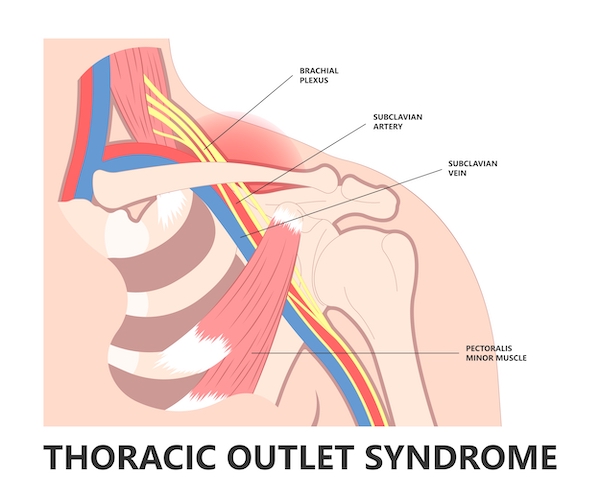
Specifically, this diagnosis is looking at compression or irritation of the brachial plexus nerves, subclavian artery, or subclavian vein as they pass through the narrow space between the collarbone (clavicle) and the first rib, known as the thoracic outlet. This compression can result from various factors such as anatomical variations, traumatic injury, or abnormal tightness of surrounding muscles (scalene muscles and the pectoralis minor). The compression of these vital structures can lead to symptoms such as pain, numbness, tingling, and weakness in the shoulders, arms, and hands, ultimately affecting the functionality of the upper extremities.
Due to the complexity of the diagnosis it can be hard to identify which type of TOS is present or even identifying TOS as a diagnosis in the first place. There are many different clinical tests that may be performed.
Nerve Responsible:
- Brachial Plexus: A network of nerves that originates from the spinal cord in the neck and extends into the armpit. It is responsible for providing motor and sensory innervation to the shoulders, arms, and hands. This is what becomes compressed in neurogenic TOS.
Relevant Structures:
- Pectoralis Minor — Attaches at the scapula where it passes over the brachial plexus and blood vessels to insert on ribs 3–5. Helps with stability and mobility of the scapula and assists in respiration as an accessory muscle.
- Scalenes — A group of 3 muscles (anterior, middle, posterior) in the side neck region. Attach at various points on the vertebrae where they pass over the brachial plexus and blood vessels to insert on the first two ribs. Help with stability and mobility of the neck and assist respiration as accessory muscles.
- 1st Rib and Clavicle — Form the space through which blood vessels and nerves travel.
- Subclavian Vein — Returns blood from your arm toward your heart. Pressure prevents blood from leaving your arm, leading to swelling and heaviness. Compressed in venous TOS.
- Subclavian Artery — Supplies blood to your arm. Pressure reduces blood flow resulting in numbness, tingling or pain, and skin that feels cool to the touch. Compressed in arterial TOS.
It should also be known that gaming is not the only activity to bring on this condition; school, work, and hobbies are also important to thoroughly evaluate.
Differential Diagnosis
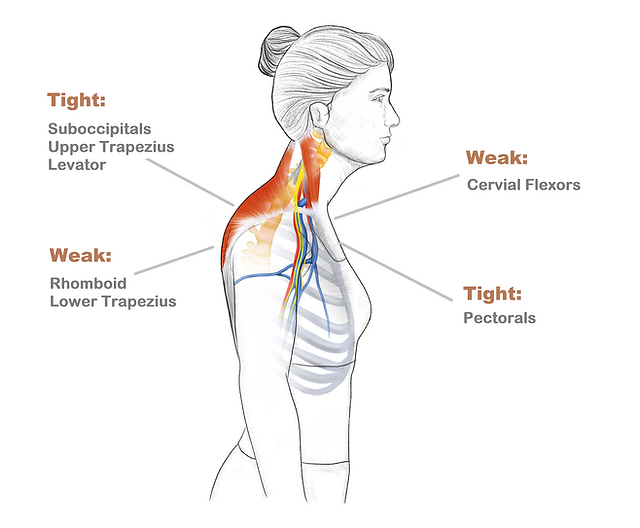
- Upper Crossed Syndrome — A postural condition characterized by muscle imbalances in the upper body from prolonged poor posture. Tight/overactive muscles in the neck and shoulder (upper trapezius, pectoralis, levator scapulae) with weak/lengthened muscles (rhomboids, deep cervical flexors).
- Carpal Tunnel Syndrome — Affects the median nerve in your wrist. TOS can be mistaken for carpal tunnel as both result in numbness/tingling and discomfort, but differ in several ways.
- Cubital Tunnel Syndrome — Affects the ulnar nerve at the elbow ("funny bone"). TOS can be mistaken for it as both result in numbness/tingling and discomfort, but differ in several ways.
- Wartenberg Syndrome — Compression of the superficial branch of the radial nerve at the wrist/forearm. TOS can be mistaken for it as both result in numbness/tingling and discomfort, but differ in several ways.
Preventative Approach
There are 5 main factors to first focus on, plus secondary factors.
- Ergonomics/Posture — Poor positioning may lead to tightness in the neck, chest, and shoulders as a forward head posture develops.
- Stretching (during and after gaming sessions) — Prioritize stretching the neck and chest.
- Exercise — Increased strength and muscular endurance of the back and core can offset the effects of prolonged sitting and help open the chest and neck. Confidence from regular exercise can also improve posture.
- Mental health — Stress may increase tension/tightness throughout the neck, chest, back, and shoulders. Stressed/anxious individuals are more likely to have rushed, shallow breathing requiring accessory muscles of the chest and neck, which can become tight.
- Breathing — Practice diaphragmatic breathing to rely less on accessory muscles and breathe more efficiently.
Additional:
- Rest breaks — Take breaks every 45–60 minutes to assess how you feel; build a schedule around your games.
- Massage — Decrease muscle tightness and increase blood flow.
- Heat — Prior to gaming sessions, stretches, or massage.
- Nutrition/Sleep — Both cannot be ignored in overall wellbeing; poor sleep increases stress and tension, and poor nutrition increases fatigue resulting in poor posture.
References
- Garraud T, Pomares G, Daley P, Menu P, Dauty M, Fouasson-Chailloux A. Thoracic Outlet Syndrome in Sport: A Systematic Review. Front Physiol. 2022 Jun 8;13:838014.
- Levine NA, Rigby BR. Thoracic Outlet Syndrome: Biomechanical and Exercise Considerations. Healthcare (Basel). 2018 Jun 19;6(2):68.
- Luu D, Seto R, Deoraj K. Exercise rehabilitation for neurogenic thoracic outlet syndrome: a scoping review. J Can Chiropr Assoc. 2022 Apr;66(1):43-60.